


doi: 10.1038/s41577-020-00458-y.
Do cross-reactive antibodies cause neuropathology in COVID-19?
Affiliations
- PMID: 33024283
- PMCID: PMC7537977
- DOI: 10.1038/s41577-020-00458-y
Item in Clipboard
Do cross-reactive antibodies cause neuropathology in COVID-19?
Nat Rev Immunol.
2020 Nov.
Abstract
Neurological symptoms are seen in patients with COVID-19 and can persist or re-emerge after clearance of SARS-CoV-2. Recent findings suggest that antibodies to SARS-CoV-2 can cross-react with mammalian proteins. Focusing on neurological symptoms, we discuss whether these cross-reactive antibodies could contribute to COVID-19 disease pathology and to the persistence of symptoms in patients who have cleared the initial viral infection.
Conflict of interest statement
The DZNE and Charité – Universitätsmedizin Berlin have filed a patent application on therapeutic SARS-CoV-2 monoclonal antibodies on which J.K., S.M.R. and H.P. are named as inventors.
Figures
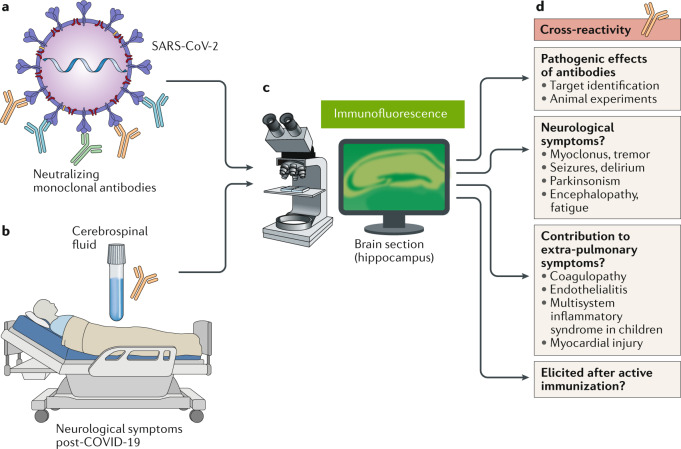
a | A fraction of SARS-CoV-2-binding monoclonal antibodies that have been derived from patients with COVID-19 can cross-react with mammalian tissue antigens. b | Similarly, antibodies detected in cerebrospinal fluid from patients with COVID-19 can bind to vessel, muscular and neuronal autoantigens. c | Indirect immunofluorescence using mouse brain (and further organ) sections has demonstrated specific autoantibody binding. d | Potential implications of antibody cross-reactivity that require urgent research.
References
MeSH terms
Substances
LinkOut - more resources
Full Text Sources
Medical
Miscellaneous
