. 2021 Mar;25(3):961-972.
doi: 10.1007/s10461-020-03055-1. Epub 2020 Oct 7.

Physical, Emotional, and Psychosocial Challenges Associated with Daily Dosing of HIV Medications and Their Impact on Indicators of Quality of Life: Findings from the Positive Perspectives Study

Affiliations

Physical, Emotional, and Psychosocial Challenges Associated with Daily Dosing of HIV Medications and Their Impact on Indicators of Quality of Life: Findings from the Positive Perspectives Study

Patricia de Los Rios et al. AIDS Behav. 2021 Mar.

Erratum in

Abstract

To assess challenges with daily oral antiretroviral therapy (ART), we analyzed data for 2389 participants in the 2019 Positive Perspectives survey of people living with HIV in 25 countries. ART-related challenges reported included difficulty swallowing pills (33.1% [790/2389]); stress from daily dosing routine (33.3% [795/2389]); bad memories from daily intake of HIV medication (35.1%[839/2389]), and concern "that having to take pills every day means a greater chance of revealing my HIV status to others" (37.9% [906/2389]). Individuals who felt empowered by daily oral dosing ["taking my pill(s) every day reassures me that my HIV is being kept under control"] had 69% higher odds of optimal overall health (AOR 1.69, 95% CI 1.40-2.04). Conversely, odds of optimal overall health were lower among those who felt daily pill intake "limits my day-to-day life" (AOR 0.53, 95% CI 0.44-0.64). These findings show that there is need for increased flexibility of ART delivery to meet diverse patient needs.

Keywords: Antiretrovirals; Difficulty swallowing; Privacy; Quality of life; Stigma.


Conflict of interest statement

The following authors are employees of ViiV Healthcare: PD, CO, BY, MM, and NV.

Figures
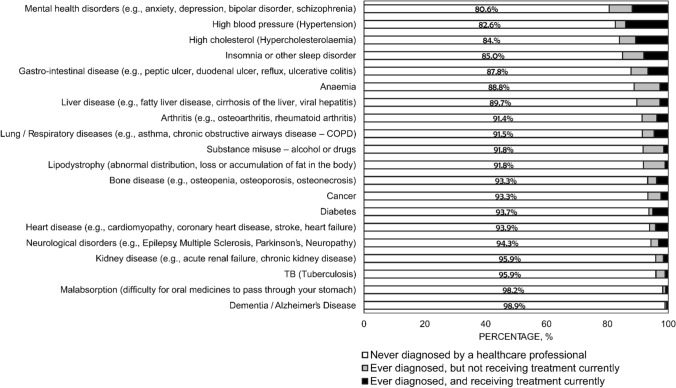
Fig. 1
Fig. 1
Percentage of people living with HIV in 25 countries who reported being diagnosed of various health conditions by a healthcare provider, 2019 (N = 2389)
Fig. 2
Fig. 2
Percentage who reported substance use disorder, ART side effects, HIV-related privacy concerns, and emotional challenges, by time since diagnosis, among people living with HIV in 25 countries, 2019 (N = 2389). ART antiretroviral therapy. All trends were statistically significant (p-trend < 0.05). Assessment of whether observed trends were statistically significant was performed in a binary logistic regression model, adjusted for gender, geographic region, education, and ethnicity. The following indicators saw a statistically significant downward trend by duration of disease: experience of ART side effects, hiding of HIV pills, and the perception that pills limit life. All other depicted outcomes increased significantly at p < 0.05
Fig. 3
Fig. 3
Comparisons of percentages for self-rated health and various treatment-related outcomes, by reported ART side effects, among people living with HIV from 25 countries, 2019 (N = 2389). ART antiretroviral therapy. All p < 0.001 based on χ2 tests. "Optimal” self-rated health was assessed within the past 4 weeks; self-rating of health as "good" or "very good" was classified as "optimal" (vs. "neither good nor poor", "poor", or "very poor"). Participants who answered “Agree” or “Strongly agree” to the statement “Taking my HIV medication limits my day-to-day life” were classified as perceiving that daily intake of HIV pills limited their daily life. The perception that there was room for improving current HIV medication was defined as a score of ≥ 4 (on an ordinal scale from 1 to 5) in response to the question "Do you feel that there is room for improvement with your current HIV medication or do you feel that it fully meets your needs?" The feeling that "there is room for improving the way my HIV is managed" was based on a response of "Agree" or "Strongly agree" to this statement. Poor self-prognosis regarding HIV mortality was an affirmative response ("Agree" or "Strongly agree") to either statement below: "HIV will reduce my life span" or "Because of my HIV, I do not plan for my old age"
Fig. 4
Fig. 4
Comparison of reasons (%) for not sharing HIV status between those with or without HIV-related privacy concerns among people living with HIV from 25 countries, 2019 (N = 2389). Asterisks (*) indicate p < 0.05 based on χ2 tests. ART antiretroviral therapy

References

    1. World Health Organization. Global Health Observatory (GHO) Data. World Health Organization. 2019. https://www.who.int/gho/hiv/en/. Accessed 28 Oct 2019.
    1. Pence BW, Miller WC, Whetten K, Eron JJ, Gaynes BN. Prevalence of DSM-IV-defined mood, anxiety, and substance use disorders in an HIV clinic in the Southeastern United States. J Acquir Immune Defic Syndr. 2006;42(3):298–306. doi: 10.1097/01.qai.0000219773.82055.aa. - DOI - PubMed
    1. Smith R, Rossetto K, Peterson BL. A meta-analysis of disclosure of one's HIV-positive status, stigma and social support. AIDS Care. 2008;20(10):1266–1275. doi: 10.1080/09540120801926977. - DOI - PubMed
    1. Heckman TG, Anderson ES, Sikkema KJ, Kochman A, Kalichman SC, Anderson T. Emotional distress in nonmetropolitan persons living with HIV disease enrolled in a telephone-delivered, coping improvement group intervention. Health Psychol. 2004;23(1):94–100. doi: 10.1037/0278-6133.23.1.94. - DOI - PubMed
    1. Stutterheim SE, Pryor JB, Bos AE, Hoogendijk R, Muris P, Schaalma HP. HIV-related stigma and psychological distress: the harmful effects of specific stigma manifestations in various social settings. AIDS. 2009;23(17):2353–2357. doi: 10.1097/QAD.0b013e3283320dce. - DOI - PubMed

Substances
