


Neurosyphilis: Still prevalent and overlooked in an at risk population
- PMID: 33027255
- PMCID: PMC7540903
- DOI: 10.1371/journal.pone.0238617
Neurosyphilis: Still prevalent and overlooked in an at risk population
Abstract
Background: Neurosyphilis (NS) presents with a variety of clinical syndromes that can be attributed to other aetiologies due to difficulties in its diagnosis. We reviewed all cases of NS from the "Top End" of the Australian Northern Territory over a ten-year period to assess incidence, clinical and laboratory manifestations.
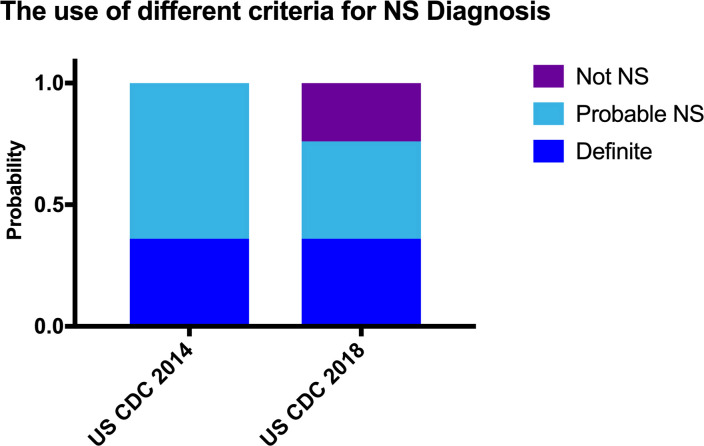
Methods: Patient data (2007-2016) were extracted from hospital records, centralised laboratory data and Northern Territory Centre for Disease Control records. Clinical records of patients with clinically suspected NS were reviewed. A diagnosis of NS was made based on the 2014 US CDC criteria. Results were also recategorized based on the 2018 US CDC criteria.
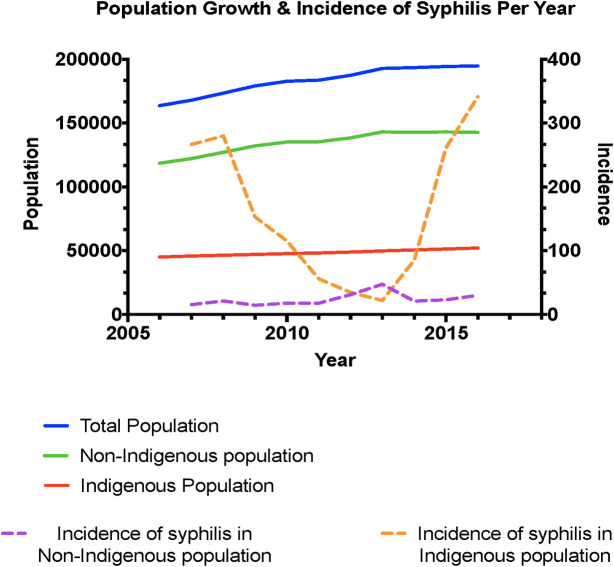
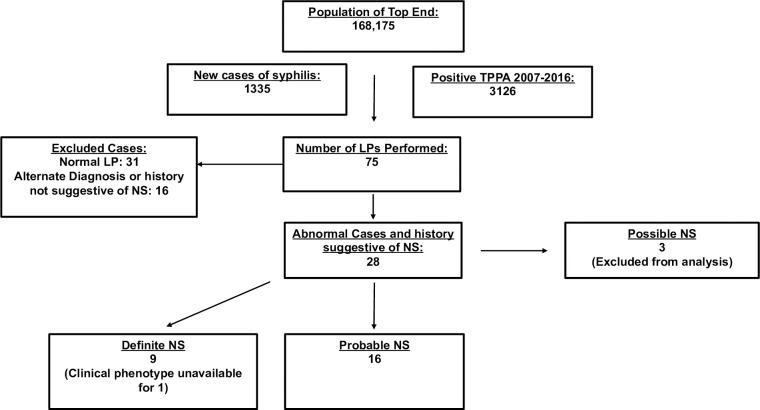
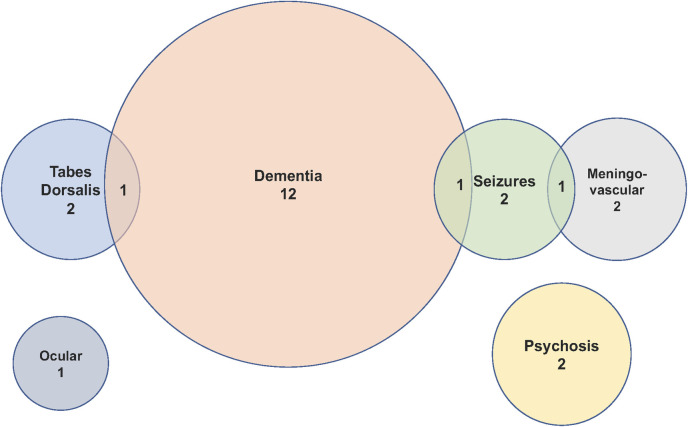
Results: The population of the "Top End" is 185,570, of whom 26.2% are Indigenous. A positive TPPA was recorded in 3126 individuals. A total of 75 (2.4%) of TPPA positive patients had a lumbar puncture (LP), of whom 25 (35%) were diagnosed with NS (9 definite, 16 probable). Dementia was the most common manifestation (58.3%), followed by epilepsy (16.7%), psychosis (12.5%), tabes dorsalis (12.5%) and meningovascular syphilis (8.3%). 63% of probable NS cases were not treated appropriately due to a negative CSF VDRL. Despite increased specificity of the 2018 US CDC criteria, 70% of patient in the probable NS group were not treated appropriately. The overall annual incidence [95%CI] of NS was 2.47[1.28-4.31] per 100 000py in the Indigenous population and 0.95[0.50-1.62] in the non-Indigenous population (rate ratio = 2.60 [1.19-5.70];p = 0.017).
Conclusion: Neurosyphilis is frequently reported in the NT, particularly in Indigenous populations. Disturbingly, 60% of probable neurosyphilis patients based on the 2014 criteria, and 70% based on the 2018 criteria with were not treated appropriately. It is critical that clinicians should be aware of the diagnosis of NS and treat patients appropriately.
Conflict of interest statement
The authors have declared that no competing interests exist.
Figures
References
-
- Center for Diesease Control. Sexually Transmitted Disease Surveillance 2017. 2017 [cited 2018 11.17.2018]; Available from: https://www.cdc.gov/std/stats17/tables/1.htm.
-
- Welfare AGAIoHa. ncidence of sexually transmissible infections and blood-borne viruses. 2018 [cited 2018 11.17.2018]; Available from: https://www.aihw.gov.au/reports/australias-health/australias-health-2018....
-
- ECDC. European Centre for Disease Prevention and Control. Annual Epidemiological Report 2016 –Syphilis. 2016 [cited 2018 11.17.2018]; Available from: http://ecdc.europa.eu/en/healthtopics/Syphilis/Pages/Annual-epidemiologi....
-
- Newman L, Rowley J, Vander Hoorn S, Wijesooriya NS, Unemo M, Low N, et al. Global Estimates of the Prevalence and Incidence of Four Curable Sexually Transmitted Infections in 2012 Based on Systematic Review and Global Reporting. PLoS One. 2015;10(12):e0143304 10.1371/journal.pone.0143304 - DOI - PMC - PubMed
Publication types
MeSH terms
Substances
Grants and funding
LinkOut - more resources
Full Text Sources
Research Materials
Miscellaneous
