. 2020 Oct 7;15(10):e0240169.
doi: 10.1371/journal.pone.0240169. eCollection 2020.

The SRG rat, a Sprague-Dawley Rag2/Il2rg double-knockout validated for human tumor oncology studies

Affiliations

The SRG rat, a Sprague-Dawley Rag2/Il2rg double-knockout validated for human tumor oncology studies

Fallon K Noto et al. PLoS One. .

Abstract

We have created the immunodeficient SRG rat, a Sprague-Dawley Rag2/Il2rg double knockout that lacks mature B cells, T cells, and circulating NK cells. This model has been tested and validated for use in oncology (SRG OncoRat®). The SRG rat demonstrates efficient tumor take rates and growth kinetics with different human cancer cell lines and PDXs. Although multiple immunodeficient rodent strains are available, some important human cancer cell lines exhibit poor tumor growth and high variability in those models. The VCaP prostate cancer model is one such cell line that engrafts unreliably and grows irregularly in existing models but displays over 90% engraftment rate in the SRG rat with uniform growth kinetics. Since rats can support much larger tumors than mice, the SRG rat is an attractive host for PDX establishment. Surgically resected NSCLC tissue from nine patients were implanted in SRG rats, seven of which engrafted and grew for an overall success rate of 78%. These developed into a large tumor volume, over 20,000 mm3 in the first passage, which would provide an ample source of tissue for characterization and/or subsequent passage into NSG mice for drug efficacy studies. Molecular characterization and histological analyses were performed for three PDX lines and showed high concordance between passages 1, 2 and 3 (P1, P2, P3), and the original patient sample. Our data suggest the SRG OncoRat is a valuable tool for establishing PDX banks and thus serves as an alternative to current PDX mouse models hindered by low engraftment rates, slow tumor growth kinetics, and multiple passages to develop adequate tissue banks.


Conflict of interest statement

Dr. Goutham Narla is on the scientific advisory board for HERA Biolabs. This does not alter our adherence to PLOS ONE policies on sharing data and materials.

Figures
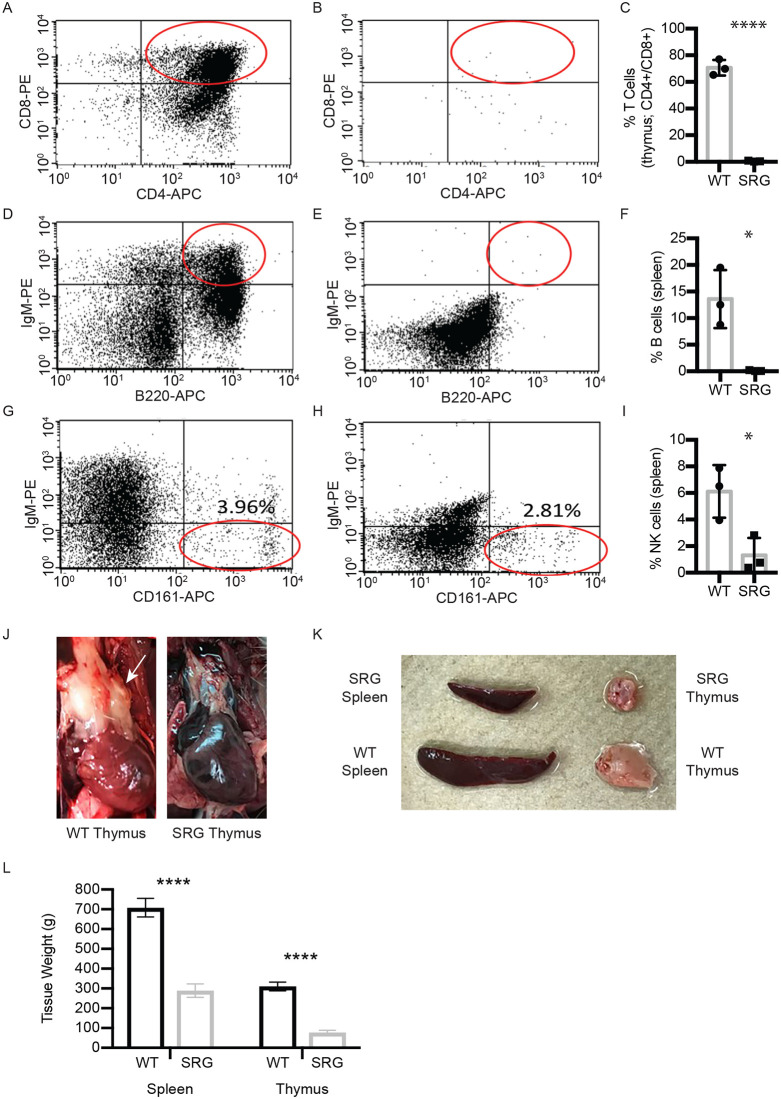
Fig 1
Fig 1. Immunophenotyping of thymocytes and splenocytes in the SRG rat.
A-C) CD4+/CD8+ mature T cells in A) wild type control and B) SRG rat thymocytes. C) Quantification of data, n = 3, error ± SD. (Unpaired t-test, p-values: **** < 0.0001). CD4+/CD8+ mature T cells are absent from SRG thymocytes, compared to a wild-type control. The lack of thymus tissue in the SRG rat results in a low recovery of viable thymocytes. D-F) CD45R (B220)+/IgM+ cells in D) wild-type spleen and E) the SRG spleen. F) Quantification of data, n = 3, error ± SD. (Unpaired t-test, p-values: * < 0.05). Compared to B cells in a wild-type spleen, the SRG spleen contains no mature B cells as demonstrated by lack of CD45R (B220)+/IgM+ cells. G-I) NK cells in G) wild-type rat spleen and H) SRG rat spleen. I) Quantification of data, n = 3, error ± SD. (Unpaired t-test, p-values: * < 0.05). NK cells in the SRG rat spleen (H) are similar to or less than the amount of NK cells in the wild-type rat. The Il2rg knockout in the SRG rat results in significantly fewer NK cells than the single Rag2 knockout rat [8]. J) Image of wild-type Sprague Dawley versus SRG thymus. K) Images of wild-type Sprague Dawley and SRG rat spleen. L) Quantitative comparison of wild-type Sprague Dawley versus SRG spleen and thymus at 8 weeks of age. Data represent average of 3 from each strain with SEM (Unpaired t-test, p-values: **** < 0.0001).
Fig 2
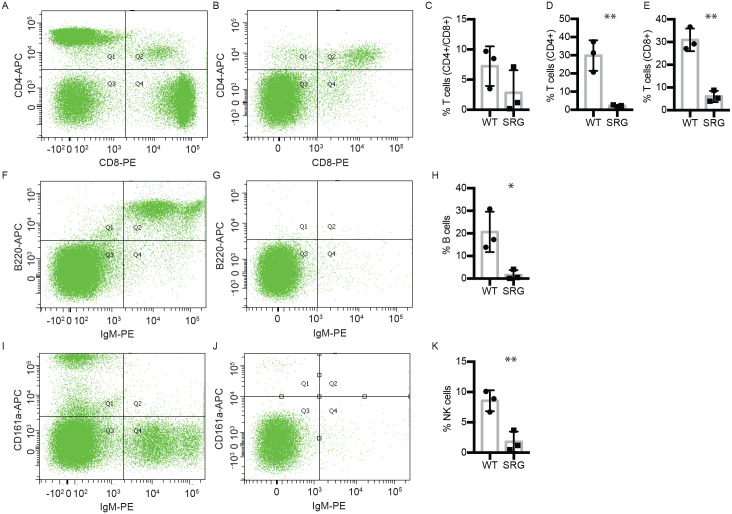
Fig 2. Immunophenotyping of peripheral blood.
Flow cytometry dot plots show representative data from one WT and one SRG rat each. A-E) T cells in peripheral blood in A) wild-type rat and B) SRG rat. C-E) Quantification of data T cell populations, n = 3, error ±SD. (Unpaired t-test, p-values: ** < 0.01). T cells are significantly reduced in peripheral blood of the SRG rat (B; 1.6% CD4+, 5.3% CD8+, 1.2% CD4+/CD8+) compared to wild-type rat (A; 37.4% CD4+, 36.6% CD8+, 3.5% CD4+/CD8+). F-H) Circulating mature B cells in F) wild-type rat and G) SRG rat. The SRG rat is completely devoid of circulating mature B cells (G) compared to wild-type (F). H) Quantification of data, n = 3, error ± SD. (Unpaired t-test, p-values: * < 0.05). I-K) NK cells in the I) wild-type rat (10.1% CD161a+) and J) SRG rat (0.5% CD161a+). K) Quantification of data, n = 3, error ± SD. (Unpaired t-test, p-values: ** <0.01). Compared to NK cells in the wild-type rat (I; 10.1% CD161a+), the SRG rat has significantly reduced circulating NK cells (J; 0.5% CD161a+).
Fig 3
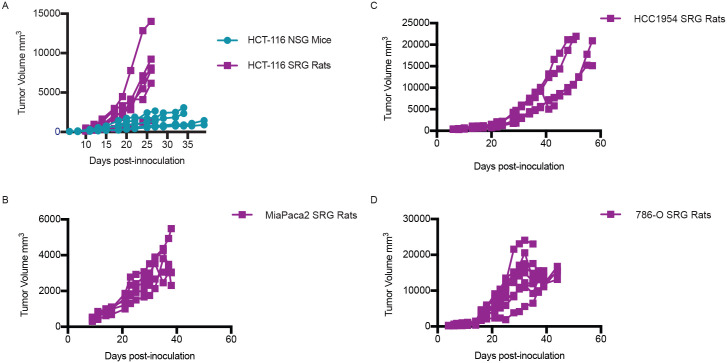
Fig 3. Xenograft models in the SRG rat and NSG mouse.
A) Tumor growth curve in NSG mice and SRG rats inoculated with 2x10⁶ HCT-116 cells subcutaneously in the hind flank. Tumor width and length were measured three times weekly to calculate volume. B) Tumor growth curve in SRG rats inoculated with 5 x10⁶ MIA-PaCa-2 cells. C) Tumor growth curve in SRG rats inoculated with 5 x10⁶ HCC1954 cells. D) Tumor growth curve in SRG rats inoculated with 10 x106 786-O cells.
Fig 4
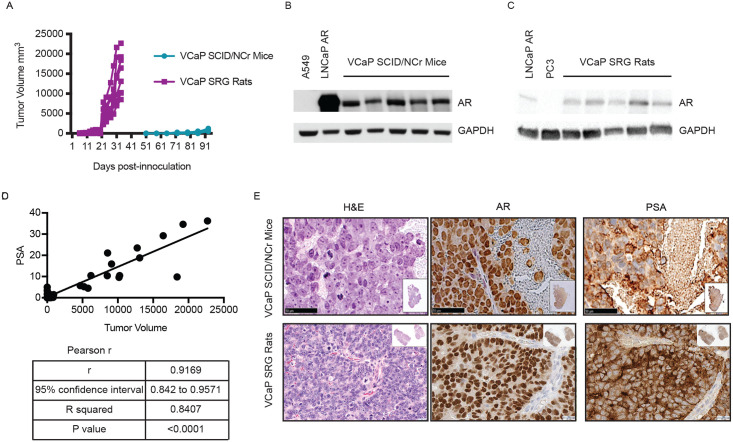
Fig 4. VCaP xenograft model in SCID/NCr mouse and SRG rat.
SCID/NCr mice and SRG rats were inoculated with 5x10⁶ and 10x106 VCaP cells, respectively, subcutaneously in the hind flank. Tumor width and length were measured three times weekly to calculate volume. A) Tumor kinetics in the SRG rat vs. SCID/NCr mouse. Each line represents tumor growth in an individual SRG rat or SCID/NCr mouse. B) Western blotting for AR in tumor tissue from the SCID/NCr mice. C) Western blotting for AR in tumor tissue from the SRG rat. D) Compilation of PSA in the serum of SRG rat inoculated with VCaP cells correlates with tumor volume. E) H&E staining and IHC staining for AR and PSA in VCaP tumor tissue from SCID/NCr mice and SRG rat.
Fig 5
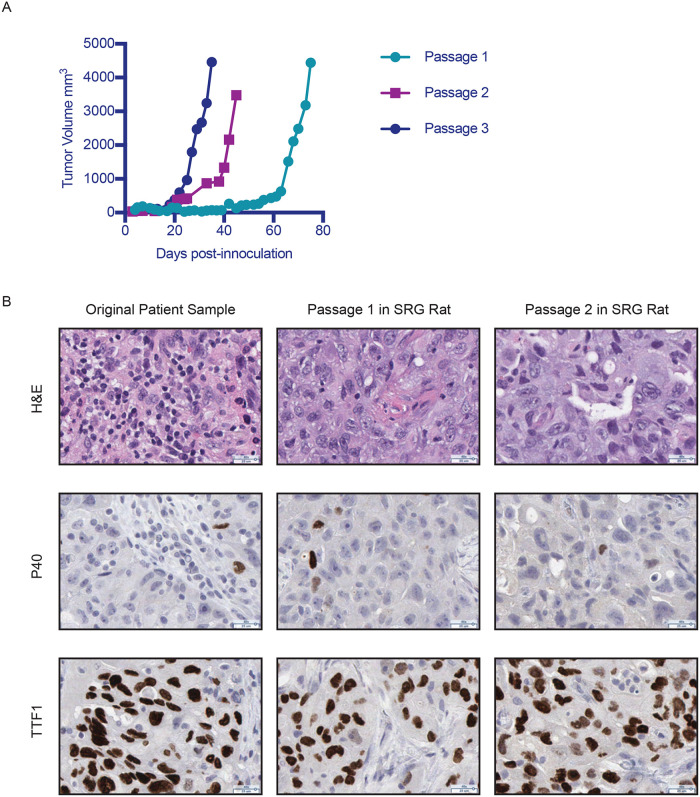
Fig 5. PDX model in the SRG rat.
Patient derived lung tumor was implanted into SRG rats. A) Tumor growth curve shows multiple passages of the patient derived lung tumor from one patient and subsequent passages in the SRG rat. P1 is the initial passage in vivo in SRG rats. B) IHC staining for H&E, P40, and TTF1 in original patient tumor sample (3010), passage 1 of the same sample in SRG rat, and passage 2 of the same sample in SRG rat.

References

    1. Cao X., Shores E. W., Hu-Li J., Anver M. R., Kelsall B. L., Russell S. M., et al. (1995) Defective lymphoid development in mice lacking expression of the common cytokine receptor gamma chain, Immunity. 2, 223–38. 10.1016/1074-7613(95)90047-0 - DOI - PubMed
    1. Ishikawa F., Yasukawa M., Lyons B., Yoshida S., Miyamoto T., Yoshimoto G., et al. (2005) Development of functional human blood and immune systems in NOD/SCID/IL2 receptor {gamma} chain(null) mice, Blood. 106, 1565–73. 10.1182/blood-2005-02-0516 - DOI - PMC - PubMed
    1. Shinkai Y., Rathbun G., Lam K. P., Oltz E. M., Stewart V., Mendelsohn M., et al. (1992) RAG-2-deficient mice lack mature lymphocytes owing to inability to initiate V(D)J rearrangement, Cell. 68, 855–67. 10.1016/0092-8674(92)90029-c - DOI - PubMed
    1. Shultz L. D., Lyons B. L., Burzenski L. M., Gott B., Chen X., Chaleff S., et al. (2005) Human lymphoid and myeloid cell development in NOD/LtSz-scid IL2R gamma null mice engrafted with mobilized human hemopoietic stem cells, J Immunol. 174, 6477–89. 10.4049/jimmunol.174.10.6477 - DOI - PubMed
    1. Jung C. J., Menoret S., Brusselle L., Tesson L., Usal C., Chenouard V., et al. (2016) Comparative Analysis of piggyBac, CRISPR/Cas9 and TALEN Mediated BAC Transgenesis in the Zygote for the Generation of Humanized SIRPA Rats, Sci Rep. 6, 31455 10.1038/srep31455 - DOI - PMC - PubMed

Publication types

MeSH terms

Substances