


Intelligence, educational attainment, and brain structure in those at familial high-risk for schizophrenia or bipolar disorder
- PMID: 33027543
- PMCID: PMC8675411
- DOI: 10.1002/hbm.25206
Intelligence, educational attainment, and brain structure in those at familial high-risk for schizophrenia or bipolar disorder
Abstract
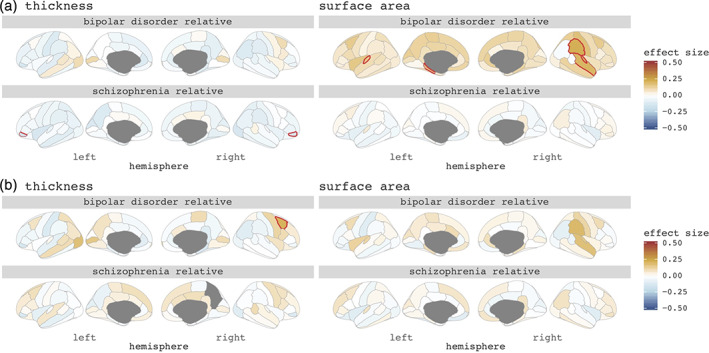
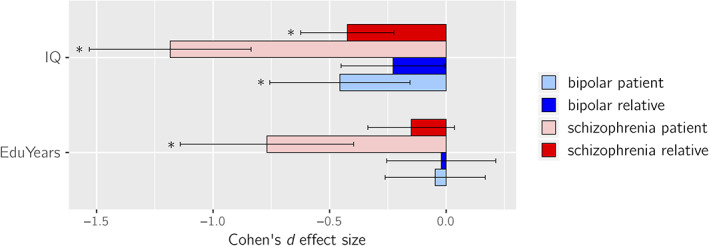
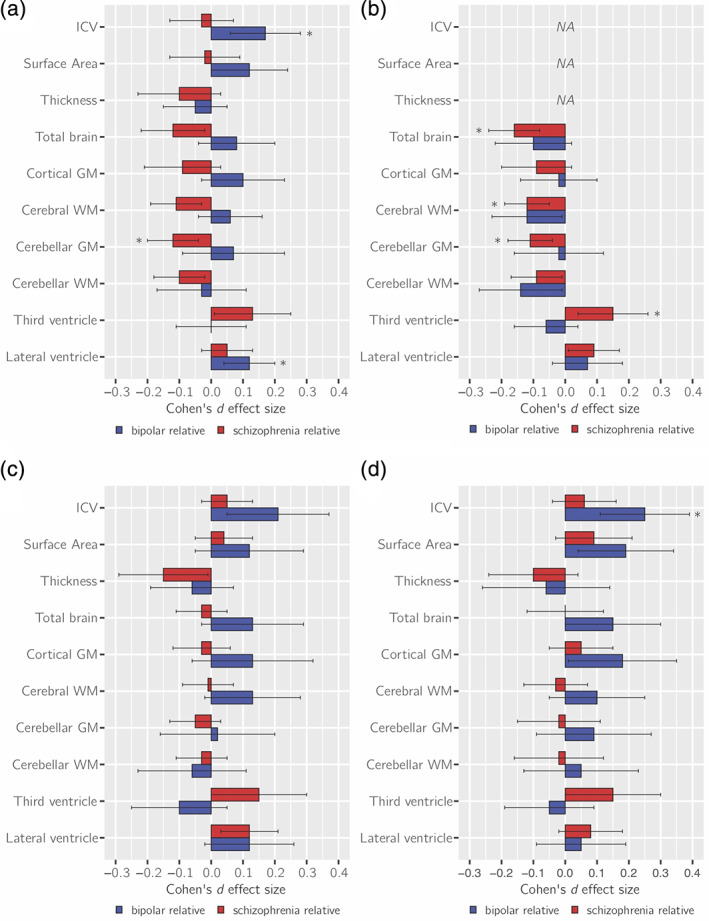
First-degree relatives of patients diagnosed with schizophrenia (SZ-FDRs) show similar patterns of brain abnormalities and cognitive alterations to patients, albeit with smaller effect sizes. First-degree relatives of patients diagnosed with bipolar disorder (BD-FDRs) show divergent patterns; on average, intracranial volume is larger compared to controls, and findings on cognitive alterations in BD-FDRs are inconsistent. Here, we performed a meta-analysis of global and regional brain measures (cortical and subcortical), current IQ, and educational attainment in 5,795 individuals (1,103 SZ-FDRs, 867 BD-FDRs, 2,190 controls, 942 schizophrenia patients, 693 bipolar patients) from 36 schizophrenia and/or bipolar disorder family cohorts, with standardized methods. Compared to controls, SZ-FDRs showed a pattern of widespread thinner cortex, while BD-FDRs had widespread larger cortical surface area. IQ was lower in SZ-FDRs (d = -0.42, p = 3 × 10⁻⁵ ), with weak evidence of IQ reductions among BD-FDRs (d = -0.23, p = .045). Both relative groups had similar educational attainment compared to controls. When adjusting for IQ or educational attainment, the group-effects on brain measures changed, albeit modestly. Changes were in the expected direction, with less pronounced brain abnormalities in SZ-FDRs and more pronounced effects in BD-FDRs. To conclude, SZ-FDRs and BD-FDRs show a differential pattern of structural brain abnormalities. In contrast, both had lower IQ scores and similar school achievements compared to controls. Given that brain differences between SZ-FDRs and BD-FDRs remain after adjusting for IQ or educational attainment, we suggest that differential brain developmental processes underlying predisposition for schizophrenia or bipolar disorder are likely independent of general cognitive impairment.
Keywords: bipolar disorder; education; intelligence; neuroimaging; relatives; schizophrenia.
© 2020 The Authors. Human Brain Mapping published by Wiley Periodicals LLC.
Conflict of interest statement
Dr Yalin has been an investigator in clinical studies conducted together with Janssen‐Cilag, Corcept Therapeutics, and COMPASS Pathways in the last 3 years. Dr Cannon reports that he is a consultant to Boerhinger Ingelheim Pharmaceuticals and Lundbeck A/S. Dr Meyer‐Lindenberg has received consultant fees from Boehringer Ingelheim, BrainsWay, Elsevier, Lundbeck International Neuroscience Foundation, and Science Advances. Drs Ching, Jahanshad, and Thompson received partial research support from Biogen, Inc. (Boston, MA) for work unrelated to the topic of this manuscript. Dr Vieta has received grants and served as consultant, advisor or CME speaker for the following entities (work unrelated to the topic of this manuscript): AB‐Biotics, Abbott, Allergan, Angelini, Dainippon Sumitomo Pharma, Galenica, Janssen, Lundbeck, Novartis, Otsuka, Sage, Sanofi‐Aventis, and Takeda. The remaining authors report no biomedical financial interests or potential conflicts of interest.
Figures
References
-
- Benjamini, Y. , & Hochberg, Y. (1995). Controlling the false discovery rate: A practical and powerful approach to multiple testing. Journal of the Royal Statistical Society, 57(1), 289–300. 10.2307/2346101 - DOI
Publication types
MeSH terms
Grants and funding
- I01 CX000227/CX/CSRD VA/United States
- 32003B_156914/SNSF_/Swiss National Science Foundation/Switzerland
- G0901310/MRC_/Medical Research Council/United Kingdom
- U54EB020403/NH/NIH HHS/United States
- R01 MH116147/MH/NIMH NIH HHS/United States
- R01MH121246/NH/NIH HHS/United States
- U01 MH108150/MH/NIMH NIH HHS/United States
- I01CX000227/VA/VA/United States
- P41 EB015922/EB/NIBIB NIH HHS/United States
- 091630/WT_/Wellcome Trust/United Kingdom
- P41 EB027061/EB/NIBIB NIH HHS/United States
- 064971/WT_/Wellcome Trust/United Kingdom
- R01 MH118695/MH/NIMH NIH HHS/United States
- 1S10OD017974-01/NH/NIH HHS/United States
- S10 OD017974/OD/NIH HHS/United States
- R01 MH111671/MH/NIMH NIH HHS/United States
- NIHR200756/DH_/Department of Health/United Kingdom
- P30 NS076408/NS/NINDS NIH HHS/United States
- R01 MH129742/MH/NIMH NIH HHS/United States
- R01 MH113619/MH/NIMH NIH HHS/United States
- P30 NS076408/NH/NIH HHS/United States
- T32 AG058507/AG/NIA NIH HHS/United States
- P41 EB015922/NH/NIH HHS/United States
- U54 EB020403/EB/NIBIB NIH HHS/United States
- R01 MH117601/MH/NIMH NIH HHS/United States
- T32AG058507/AG/NIA NIH HHS/United States
- R03 MH105808/NH/NIH HHS/United States
- 085475/B/08/Z/WT_/Wellcome Trust/United Kingdom
- R01 MH121246/MH/NIMH NIH HHS/United States
- WT_/Wellcome Trust/United Kingdom
- 103703/WT_/Wellcome Trust/United Kingdom
- 106469, 142255/CIHR/Canada
- R01 MH116147/NH/NIH HHS/United States
- G0801418/MRC_/Medical Research Council/United Kingdom
- 085475/Z/08/Z/WT_/Wellcome Trust/United Kingdom
- R01 MH117601/NH/NIH HHS/United States
- R01 MH111671/NH/NIH HHS/United States
- MR/L010305/1/MRC_/Medical Research Council/United Kingdom
- R03 MH105808/MH/NIMH NIH HHS/United States
- R01 MH085667/MH/NIMH NIH HHS/United States
- R01 MH052857/MH/NIMH NIH HHS/United States
- R01 MH080912/MH/NIMH NIH HHS/United States
