


Primary healthcare policy and vision for community pharmacy and pharmacists in the United States
- PMID: 33029264
- PMCID: PMC7523559
- DOI: 10.18549/PharmPract.2020.3.2160
Primary healthcare policy and vision for community pharmacy and pharmacists in the United States
Abstract
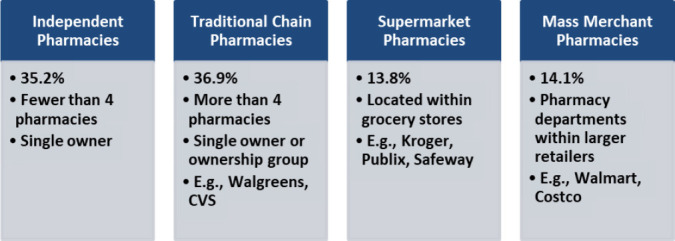
The United States (US) has a complex healthcare system with a mix of public, private, nonprofit, and for-profit insurers, healthcare institutions and organizations, and providers. Unlike other developed countries, there is not a single payer healthcare system or a national pharmaceutical benefits scheme/plan. Despite spending over USD 10,000 per capita in healthcare, the US is among the worst performers compared to other developed countries in outcomes including life expectancy at birth, infant mortality, safety during childbirth, and unmanaged chronic conditions (e.g., asthma, diabetes). Primary care is delivered by physicians and advanced practice providers (i.e., nurse practitioners and physician assistants) in a variety of settings including large health systems, federally qualified health centers or free clinics that provide care to the underserved, or specific facilities for veterans or American Indian and Alaska native peoples. Since 2010, primary care delivery has shifted toward providing patient-centered, coordinated, comprehensive care focused on providing proactive, rather than reactive, population health management, and on the quality, versus volume, of care. Community pharmacy comprises a mix of independently owned, chain, supermarket and mass merchant pharmacies. Community pharmacies provide services such as immunizations, medication therapy management, medication packaging, medication synchronization, point-of-care testing and, in specific states where legislation has been passed, hormonal contraception, opioid reversal agents, and smoking cessation services. There has been criticism regarding the lack of standard terminology for services such as medication synchronization and medication therapy management, their components and how they should be provided, which hampers comparability across studies. One of the main challenges for pharmacists in the US is the lack of provider status at the federal level. This means that pharmacists are not allowed to use existing fee-for-service health insurance billing codes to receive reimbursement for non-dispensing services. In addition, despite there being regulatory infrastructure in multiple states, the extent of service implementation is either low or unknown. Research found that pharmacists face numerous barriers when providing some of these services. State fragmentation and the lack of a single pharmacy organization and vision for the profession are additional challenges.
Keywords: Ambulatory Care; Community Health Services; Community Pharmacy Services; Delivery of Health Care; Integrated; Pharmacies; Pharmacists; Primary Health Care; Professional Practice; United States.
Copyright: © Pharmacy Practice and the Authors.
Conflict of interest statement
CONFLICT OF INTEREST None.
Figures
References
-
- United States Census Bureau. U.S. and World population clock. [accessed Jul 22 2020]. Available at: https://www.census.gov/popclock/
-
- Peter G. Peterson Foundation. How does the U.S. healthcare system compare to other countries? [accessed Jul 22 2020]. Available at: https://www.pgpf.org/blog/2020/07/how-does-the-us-healthcare-system-comp... .
-
- Kaiser Family Foundation. Health insurance coverage of the total population. [accessed Jul 22 2020]. Available at: https://www.kff.org/other/state-indicator/total-population/? currentTime... .
-
- Government Printing Office. Medicare Prescription Drug, Improvement, and Modernization Act of 2003. [accessed Jun 30 2020]. Available at: http://www.gpo.gov/fdsys/pkg/PLAW-108publ173/pdf/PLAW-108publ173.pdf .
-
- Medicaid.gov. Prescription drugs. [accessed Sep 10 2020]. Available at: https://www.medicaid.gov/medicaid/prescription-drugs/index.html#:~:text=... .
LinkOut - more resources
Full Text Sources