


Gut microbiota composition in relation to intake of added sugar, sugar-sweetened beverages and artificially sweetened beverages in the Malmö Offspring Study
- PMID: 33030577
- PMCID: PMC8137620
- DOI: 10.1007/s00394-020-02392-0
Gut microbiota composition in relation to intake of added sugar, sugar-sweetened beverages and artificially sweetened beverages in the Malmö Offspring Study
Abstract
Purpose: It has been suggested that a high intake of sugar or sweeteners may result in an unfavorable microbiota composition; however, evidence is lacking. Hence, in this exploratory epidemiological study, we aim to examine if intake of added sugar, sugar-sweetened beverages (SSBs) or artificially sweetened beverages (ASBs) associate with the gut microbiota composition.
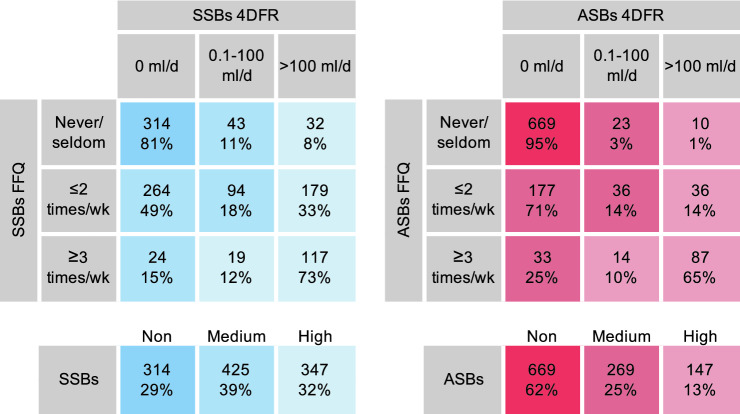
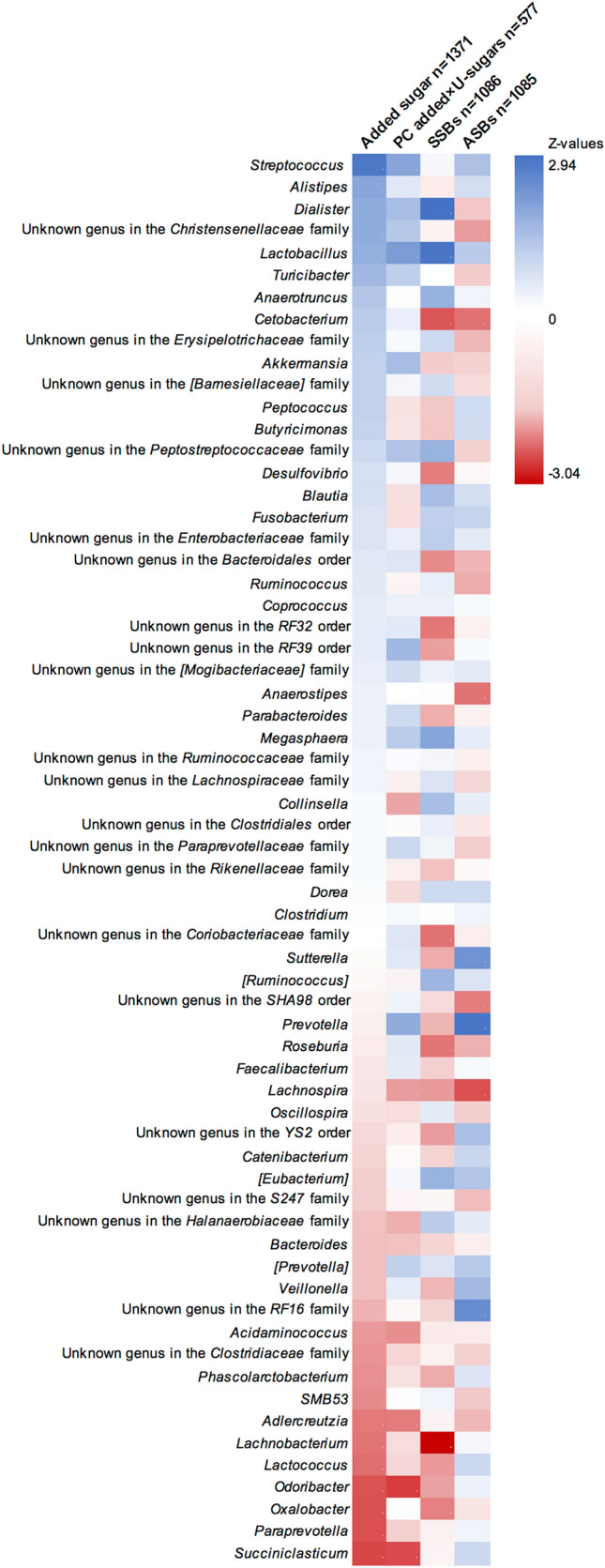
Methods: Participants (18-70 years) in the Malmö Offspring Study have provided blood, urine, and fecal samples and completed both web-based 4 day food records and short food frequency questionnaires. The gut microbiota was assessed by 16S rRNA sequencing, processed in QIIME and matched to Greengenes (v.13.8), giving 64 included genera after filtering. Intake of added sugar (n = 1371) (also supported by the overnight urinary sugar biomarker in a subgroup n = 577), SSBs (n = 1086) and ASBs (n = 1085) were examined as exposures in negative binomial regressions.
Results: Various genera nominally associated with intake of added sugar, SSBs, and ASBs. Only the negative association between SSB intake and Lachnobacterium remained significant after multiple testing correction. A positive association between SSB intake and the Firmicutes:Bacteroidetes ratio was also observed.
Conclusion: In this wide population, the cross-sectional associations between added sugar and sweet beverage intake and the gut microbiota are modest, but the results suggest that SSB intake is associated negatively with the genus Lachnobacterium and positively with the Firmicutes:Bacteroidetes ratio. Larger studies, preferably using metagenomic sequencing, are needed to further evaluate if a link exists between intake of sugars and sweeteners and the human gut microbiota.
Keywords: Added sugar; Artificially sweetened beverages; Gut microbiota; Sugar-sweetened beverages; Urinary sugars biomarker.
Conflict of interest statement
The authors declare no conflict of interest.
Figures
References
-
- Ramne S, Alves Dias J, Gonzalez-Padilla E, Olsson K, Lindahl B, Engstrom G, Ericson U, Johansson I, Sonestedt E. Association between added sugar intake and mortality is nonlinear and dependent on sugar source in 2 Swedish population-based prospective cohorts. Am J Clin Nutr. 2018 doi: 10.1093/ajcn/nqy268. - DOI - PubMed
-
- Mullee A, Romaguera D, Pearson-Stuttard J, Viallon V, Stepien M, Freisling H, Fagherazzi G, Mancini FR, Boutron-Ruault MC, Kuhn T, Kaaks R, Boeing H, Aleksandrova K, Tjonneland A, Halkjaer J, Overvad K, Weiderpass E, Skeie G, Parr CL, Quiros JR, Agudo A, Sanchez MJ, Amiano P, Cirera L, Ardanaz E, Khaw KT, Tong TYN, Schmidt JA, Trichopoulou A, Martimianaki G, Karakatsani A, Palli D, Agnoli C, Tumino R, Sacerdote C, Panico S, Bueno-de-Mesquita B, Verschuren WMM, Boer JMA, Vermeulen R, Ramne S, Sonestedt E, van Guelpen B, Holgersson PL, Tsilidis KK, Heath AK, Muller D, Riboli E, Gunter MJ, Murphy N. Association Between Soft Drink Consumption and Mortality in 10 European Countries. JAMA Int Med. 2019 doi: 10.1001/jamainternmed.2019.2478. - DOI - PMC - PubMed
MeSH terms
Substances
Grants and funding
LinkOut - more resources
Full Text Sources
