. 2021 Jun 1;113(6):691-698.
doi: 10.1093/jnci/djaa159.

Prevalence and Outcome of COVID-19 Infection in Cancer Patients: A National Veterans Affairs Study

Affiliations

Prevalence and Outcome of COVID-19 Infection in Cancer Patients: A National Veterans Affairs Study

Nathanael R Fillmore et al. J Natl Cancer Inst. .

Abstract

Background: Emerging data suggest variability in susceptibility and outcome to coronavirus disease 2019 (COVID-19) infection. Identifying risk factors associated with infection and outcomes in cancer patients is necessary to develop healthcare recommendations.

Methods: We analyzed electronic health records of the US Veterans Affairs Healthcare System and assessed the prevalence of COVID-19 infection in cancer patients. We evaluated the proportion of cancer patients tested for COVID-19 who were positive, as well as outcome attributable to COVID-19, and stratified by clinical characteristics including demographics, comorbidities, cancer treatment, and cancer type. All statistical tests are 2-sided.

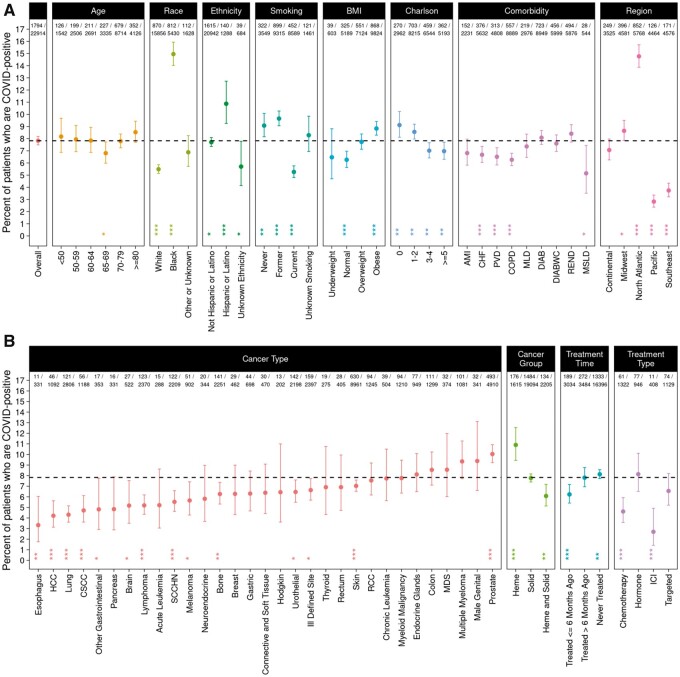
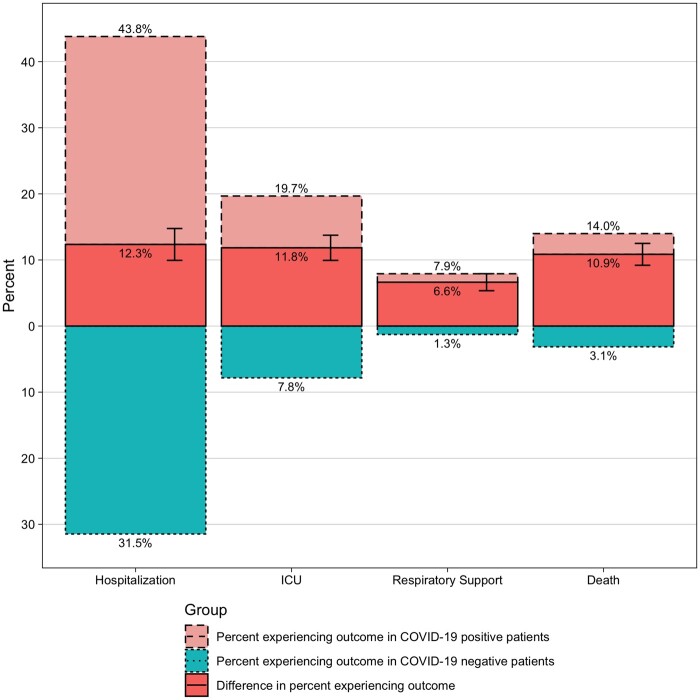
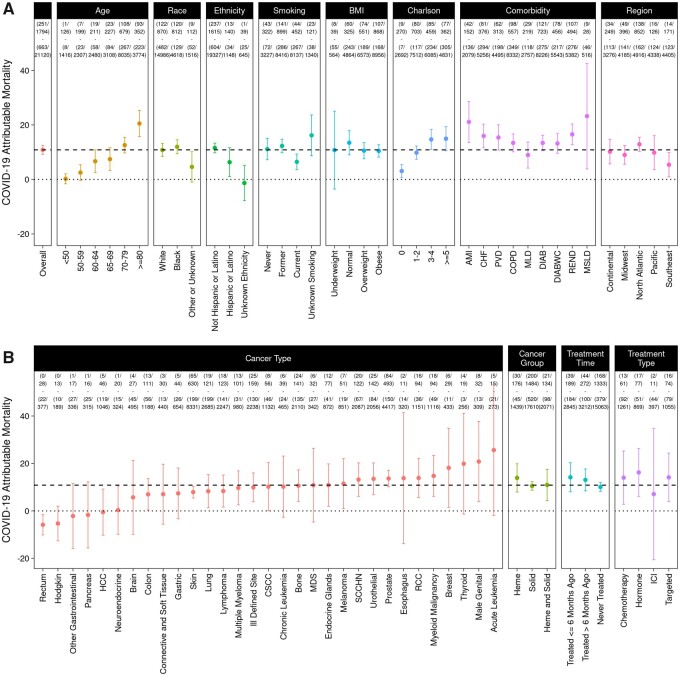
Results: Of 22 914 cancer patients tested for COVID-19, 1794 (7.8%) were positive. The prevalence of COVID-19 was similar across age. Higher prevalence was observed in African American (15.0%) compared with White (5.5%; P < .001) and in patients with hematologic malignancy compared with those with solid tumors (10.9% vs 7.8%; P < .001). Conversely, prevalence was lower in current smokers and patients who recently received cancer therapy (<6 months). The COVID-19-attributable mortality was 10.9%. Higher attributable mortality rates were observed in older patients, those with higher Charlson comorbidity score, and in certain cancer types. Recent (<6 months) or past treatment did not influence attributable mortality. Importantly, African American patients had 3.5-fold higher COVID-19-attributable hospitalization; however, they had similar attributable mortality as White patients.

Conclusion: Preexistence of cancer affects both susceptibility to COVID-19 infection and eventual outcome. The overall COVID-19-attributable mortality in cancer patients is affected by age, comorbidity, and specific cancer types; however, race or recent treatment including immunotherapy do not impact outcome.


Figures

Figure 1.
Figure 1.
COVID-19 prevalence among cancer patients. Percent of COVID-19–positive patients among cancer patients tested for COVID-19 is shown with Panel A showing overall data and data stratified by age, race, ethnicity, smoking, BMI, Charlson score, comorbidity, and region. Panel B shows data stratified by cancer type, cancer group, treatment time, and treatment type. The dashed line indicates the overall percent positive (7.8%). The 2 rows at top show the number of COVID-19–positive patients and the total number of cancer patients tested. In addition to the percent positive in each group, a 95% confidence interval and P value are shown, based on a χ2 test for difference in proportions (2-sided). *P < .05; **P < .01; ***P < .001. AMI = acute myocardial infarction; BMI = body mass index; CHF = congestive heart failure; COPD = chronic obstructive pulmonary disease; CSCC = cutaneous squamous cell carcinoma; DIAB = diabetes without complications; DIABWC = diabetes with complications; HCC = hepatocellular carcinoma; Heme = hematological malignancy; ICI = immune checkpoint inhibitor; MDS = myelodysplastic syndromes; MLD = mild liver disease; MSLD = moderate or severe liver disease; PVD = peripheral vascular disease; RCC = renal cell carcinoma; REND = renal disease; SCCHN = squamous cell carcinoma of the head and neck; Solid = solid tumor.
Figure 2.
Figure 2.
Outcome of cancer patients with COVID-19. Percent of patients experiencing hospitalization, ICU visits, respiratory support, and death in COVID-19–positive (light red) and –negative (light blue) cancer patients are represented. The COVID-19–attributable risk of experiencing each outcome (ie, the difference of the percent experiencing each outcome in COVID-19–positive compared with negative patients is also shown; dark red), along with 95% confidence intervals. ICU = intensive care unit.
Figure 3.
Figure 3.
COVID-19–attributable mortality among cancer patients. COVID-19–attributable mortality defined as the difference in the percent mortality in COVID-19–positive compared with negative patients is shown, along with 95% confidence intervals. Panel A shows overall data and data stratified by age, race, ethnicity, smoking, BMI, Charlson score, comorbidity, and region. Panel B shows data stratified by cancer type, cancer group, treatment time, and treatment type. The dashed line shows the COVID-19–attributable mortality in the overall cohort (14.4%), and the dotted line marks 0, the point where there is no COVID-19–attributable mortality. The 4 rows at top show the number of COVID-19–positive patients who died, the total number of COVID-19–positive patients, the number of COVID-19–negative patients who died, and the total number of COVID-19–negative patients. AMI = acute myocardial infarction; BMI = body mass index; CHF = congestive heart failure; COPD = chronic obstructive pulmonary disease; CSCC = cutaneous squamous cell carcinoma; DIAB = diabetes without complications; DIABWC = diabetes with complications; HCC = hepatocellular carcinoma; Heme = hematological malignancy; ICI = immune checkpoint inhibitor; ICU = intensive care unit; MDS = myelodysplastic syndromes; MLD = mild liver disease; MSLD = moderate or severe liver disease; PVD = peripheral vascular disease; RCC = renal cell carcinoma; REND = renal disease; SCCHN = squamous cell carcinoma of the head and neck; Solid = solid tumor.
Figure 4.
Figure 4.
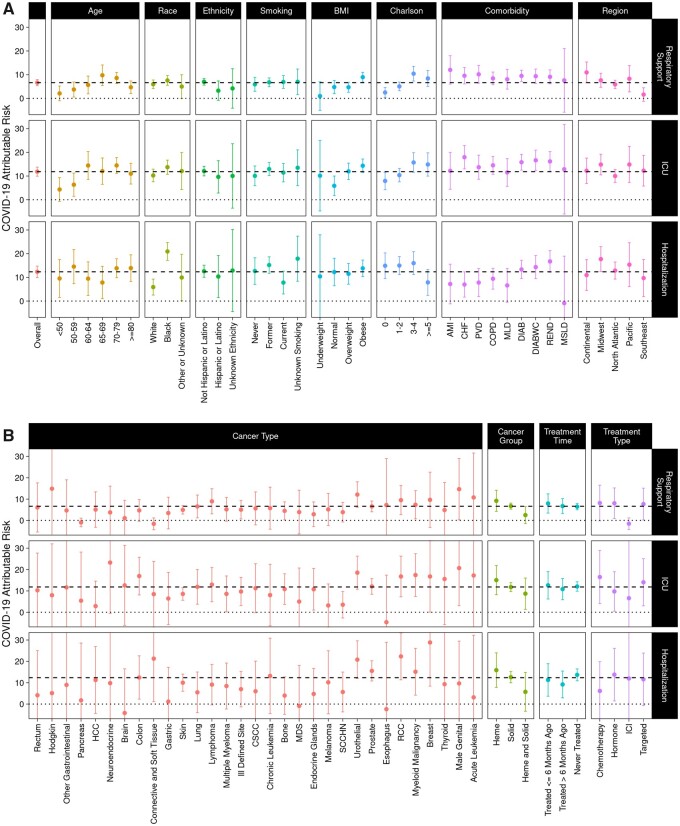
COVID-19–attributable hospitalizations, ICU admissions, and respiratory support among cancer patients. COVID-19–attributable hospitalizations, ICU admissions, and respiratory support, defined as the difference in the percent of COVID-19–positive patients experiencing each outcome minus the percent of COVID-19–negative patients experiencing each outcome, are shown. Panel A shows overall data and data stratified by age, race, ethnicity, smoking, BMI, Charlson score, comorbidity, and region. Panel B shows data stratified by cancer type, cancer group, treatment time, and treatment type. 95% confidence intervals are shown. The dashed line shows the COVID-19–attributable contribution in the overall cohort, and the dotted line marks 0, the point where there is no COVID-19–attributable contribution. AMI = acute myocardial infarction; BMI = body mass index; CHF = congestive heart failure; COPD = chronic obstructive pulmonary disease; CSCC = cutaneous squamous-cell carcinoma; DIAB = diabetes without complications; DIABWC = diabetes with complications; HCC = hepatocellular carcinoma; Heme = hematological malignancy; ICI = immune checkpoint inhibitor; ICU = intensive care unit; MDS = myelodysplastic syndromes; MLD = mild liver disease; MSLD = moderate or severe liver disease; PVD = peripheral vascular disease; RCC = renal cell carcinoma; REND = renal disease; SCCHN = squamous cell carcinoma of the head and neck; Solid = solid tumor.

References

    1. Zhu N, Zhang D, Wang W, et al. A novel coronavirus from patients with pneumonia in China, 2019. N Engl J Med. 2020;382(8):727-733. doi:10.1056/NEJMoa2001017. - PMC - PubMed
    1. Kumar A, Arora A, Sharma P, et al. Is diabetes mellitus associated with mortality and severity of COVID-19? A meta-analysis. Diabetes Metab Syndr. 2020;14(4):535-545. doi:10.1016/j.dsx.2020.04.044. - PMC - PubMed
    1. Goyal P, Choi JJ, Pinheiro LC, et al. Clinical characteristics of Covid-19 in New York City. N Engl J Med. 2020;382(24):2372-2374. doi:10.1056/NEJMc2010419. - PMC - PubMed
    1. Richardson S, Hirsch JS, Narasimhan M, et al. Presenting characteristics, comorbidities, and outcomes among 5700 patients hospitalized with COVID-19 in the New York City Area. JAMA. 2020;323(20):2052.doi:10.1001/jama.2020.6775. - PMC - PubMed
    1. Zhou F, Yu T, Du R, et al. Clinical course and risk factors for mortality of adult inpatients with COVID-19 in Wuhan, China: a retrospective cohort study. Lancet. 2020;395(10229):1054-1062. doi:10.1016/S0140-6736(20)30566-3. - PMC - PubMed

Publication types