. 2020 Oct 8;8(1):145.
doi: 10.1186/s40168-020-00923-9.

The interplay between host genetics and the gut microbiome reveals common and distinct microbiome features for complex human diseases

Affiliations

The interplay between host genetics and the gut microbiome reveals common and distinct microbiome features for complex human diseases

Fengzhe Xu et al. Microbiome. .

Abstract

Background: Interest in the interplay between host genetics and the gut microbiome in complex human diseases is increasing, with prior evidence mainly being derived from animal models. In addition, the shared and distinct microbiome features among complex human diseases remain largely unclear.

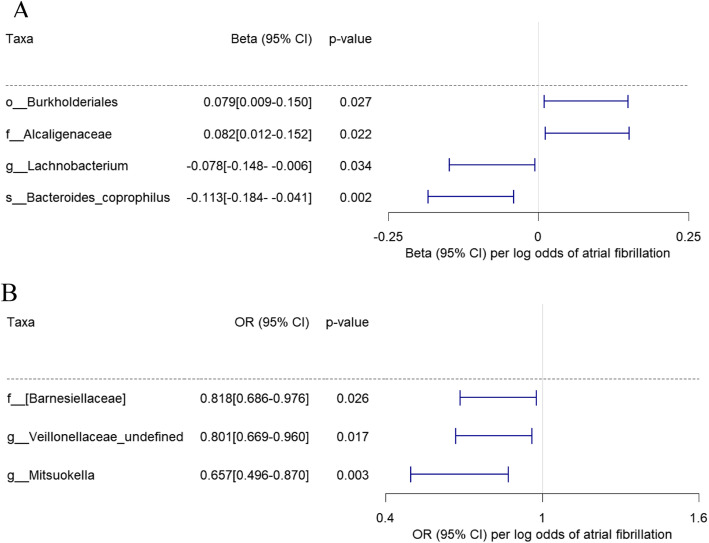
Results: This analysis was based on a Chinese population with 1475 participants. We estimated the SNP-based heritability, which suggested that Desulfovibrionaceae and Odoribacter had significant heritability estimates (0.456 and 0.476, respectively). We performed a microbiome genome-wide association study to identify host genetic variants associated with the gut microbiome. We then conducted bidirectional Mendelian randomization analyses to examine the potential causal associations between the gut microbiome and complex human diseases. We found that Saccharibacteria could potentially decrease the concentration of serum creatinine and increase the estimated glomerular filtration rate. On the other hand, atrial fibrillation, chronic kidney disease and prostate cancer, as predicted by host genetics, had potential causal effects on the abundance of some specific gut microbiota. For example, atrial fibrillation increased the abundance of Burkholderiales and Alcaligenaceae and decreased the abundance of Lachnobacterium, Bacteroides coprophilus, Barnesiellaceae, an undefined genus in the family Veillonellaceae and Mitsuokella. Further disease-microbiome feature analysis suggested that systemic lupus erythematosus and chronic myeloid leukaemia shared common gut microbiome features.

Conclusions: These results suggest that different complex human diseases share common and distinct gut microbiome features, which may help reshape our understanding of disease aetiology in humans. Video Abstract.

Keywords: Bidirectional Mendelian randomization analyses; Disease-microbiome features; Gut microbiome; Host genetics.


Conflict of interest statement

The authors declare no conflicts of interest.

Figures
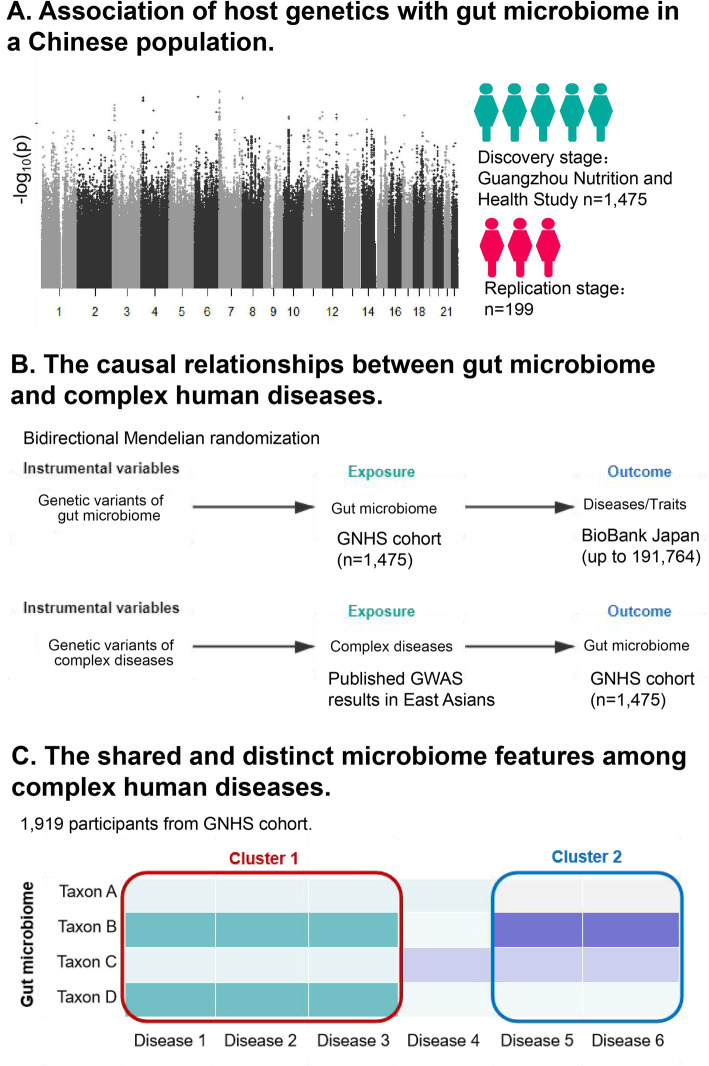
Fig. 1
Fig. 1
Study overview. The figure shows the highlights of our study. First, we performed a microbiome genome-wide association study in a Chinese population (step A). We validated significant genetic variants reported in previous studies and replicated our results in an independent cohort. Second, we investigated the causal relationship between the gut microbiome and complex human diseases using host genetics as instrumental variables for bidirectional Mendelian randomization (MR) analysis (step B). For the analysis of the effects of the gut microbiome on complex traits, we used publicly available GWAS summary statistics of complex traits (n = 58) and diseases (type 2 diabetes mellitus (T2DM), atrial fibrillation (AF), colorectal cancer (CRC) and rheumatoid arthritis) reported by BioBank Japan [–24]. For the reverse MR analyses, the diseases of interest included T2DM (cases: 7,109; non-cases: 86,022), AF (cases: 8,180; non-cases: 28,612), coronary artery disease (cases: 1,515; non-cases: 5019), chronic kidney disease (n = 71,149), Alzheimer’s disease (cases: 477; non-cases: 442), CRC (cases: 8027; non-cases: 22,577) and prostatic cancer (cases: 495; non-cases: 640) reported in the previous large-scale GWASs in East Asians [, –30]. Finally, we identified common and distinct gut microbiome features across different diseases (step C)
Fig. 2
Fig. 2
The SNP-based heritability of the gut microbiome. The plot shows the taxa with nominally significant heritability estimates (p < 0.05). *p < 0.05/n, where n is the effective number of independent taxa in each taxonomic level
Fig. 3
Fig. 3
Effect of host genetically predicted higher atrial fibrillation risk on the gut microbiome. a Causal association of atrial fibrillation with the abundance of Burkholderiales, Alcaligenaceae, Lachnobacterium and Bacteroides coprophilus. The magnitude of the effect of atrial fibrillation on taxa is dependent on changes in the abundance of bacteria (1-SD of the log-transformed abundance) per genetically determined higher log odds of atrial fibrillation. b Causal association of atrial fibrillation with the presence of Barnesiellaceae, an undefined genus in the family Veillonellaceae and Mitsuokella. The magnitude of the effect of atrial fibrillation on taxa is presented as an odds ratio increase in the log odds of atrial fibrillation
Fig. 4
Fig. 4
Association and cluster of diseases predicted by the gut microbiome. a Plot of clusters in the Guangzhou Nutrition and Health Study (GNHS) cohort (n = 1919). b Plot of cluster results in the replication cohort (n = 217). c Plot of 5 clusters in antibiotic-taking participants (n = 18). The optimal cluster was 5 in the GNHS cohort and 6 in the replication cohort. The clusters share consistent components between the two studies. In contrast, components are different between antibiotic-taking participants and control groups. Dimension1 (Dim1) and dimension2 (Dim2) explained 40.1% and 13.1% of the variance, respectively, in the GNHS cohort. The annotation for variables is as follows. AT African trypanosomiasis, AD Alzheimer’s disease, V1 amoebiasis, ALS amyotrophic lateral sclerosis, BC bladder cancer, CD Chagas disease, CML chronic myeloid leukaemia, CRC colorectal cancer, V2 hepatitis C, HD Huntington’s disease, HCM hypertrophic cardiomyopathy, V3 influenza A, PD Parkinson’s disease, V4 pathways in cancer, V5 Prion disease, PCa prostate cancer, RCC renal cell carcinoma, SLE systemic lupus erythematosus, V6 tuberculosis, T1DM type I diabetes mellitus, T2DM type II diabetes mellitus, V7 Vibrio cholerae infection. d. Gut microbiome-predicted network of relationships among different complex human diseases. The relationship between diseases is determined by SPIEC-EASI with non-normalized predicted abundance data. The diseases that shared the same edge had the gut microbiome-predicted correlation
Fig. 5
Fig. 5
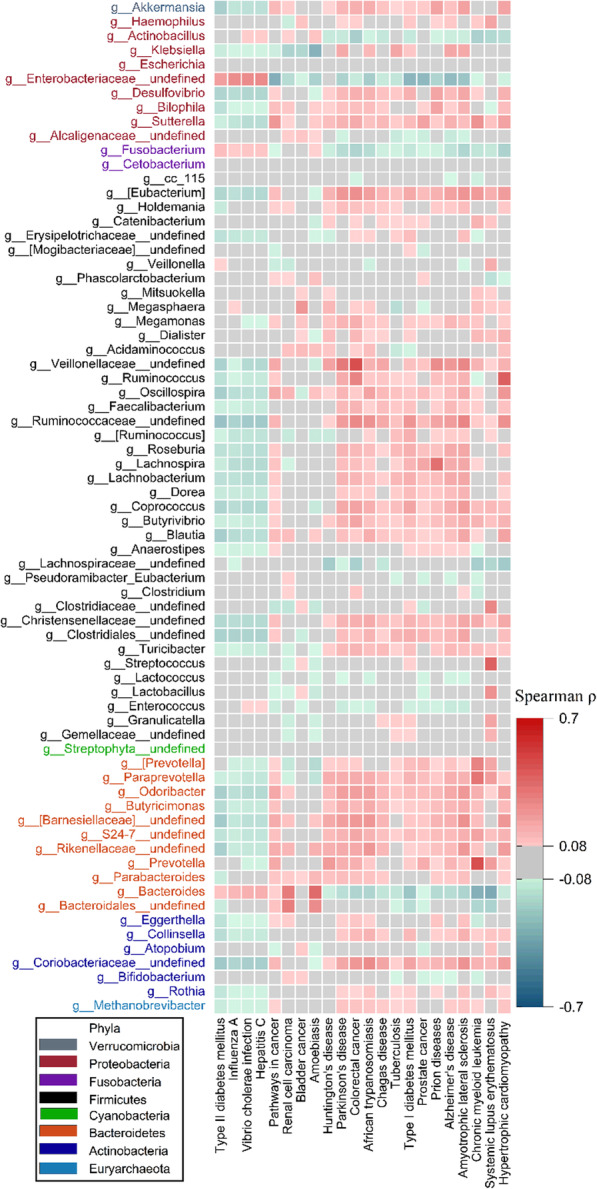
Correlation of complex human diseases with the gut microbiome. The heatmap shows Spearman’s correlation of predicted diseases and the gut microbiome at the genus level. The grey components show no significant correlation with Bonferroni correction (p > 0.05/(5.6*22), p > 0.0004)

References

    1. Awany D, Allali I, Dalvie S, Hemmings S, Mwaikono KS, Thomford NE, et al. Host and microbiome genome-wide association studies: current state and challenges. Front Genet. 2019;9:637. doi: 10.3389/fgene.2018.00637. - DOI - PMC - PubMed
    1. Bull MJ, Plummer NT. Part 1: The human gut microbiome in health and disease. Integr Med (Encinitas, Calif) 2014;13(6):17–22. - PMC - PubMed
    1. Lynch JB, Hsiao EY. Microbiomes as sources of emergent host phenotypes. Science. 2019;365(6460):1405–1409. doi: 10.1126/science.aay0240. - DOI - PubMed
    1. Allegretti JR, Mullish BH, Kelly C, Fischer M. The evolution of the use of faecal microbiota transplantation and emerging therapeutic indications. Lancet. 2019;394(10196):420–431. doi: 10.1016/S0140-6736(19)31266-8. - DOI - PubMed
    1. Wong SH, Yu J. Gut microbiota in colorectal cancer: mechanisms of action and clinical applications. Nat Rev Gastroenterol Hepatol. 2019. 10.1038/s41575-019-0209-8. - PubMed

Publication types

LinkOut - more resources