


[Self-applied sphenopalatine ganglion block for postdural puncture headache: four case reports]
- PMID: 33032805
- PMCID: PMC9373270
- DOI: 10.1016/j.bjan.2020.07.002
[Self-applied sphenopalatine ganglion block for postdural puncture headache: four case reports]
Abstract
Background and objectives: The Sphenopalatine Ganglion Block (SGB) is an effective, low-risk treatment option for Postdural Puncture Headache (PDPH) refractory to conservative management.
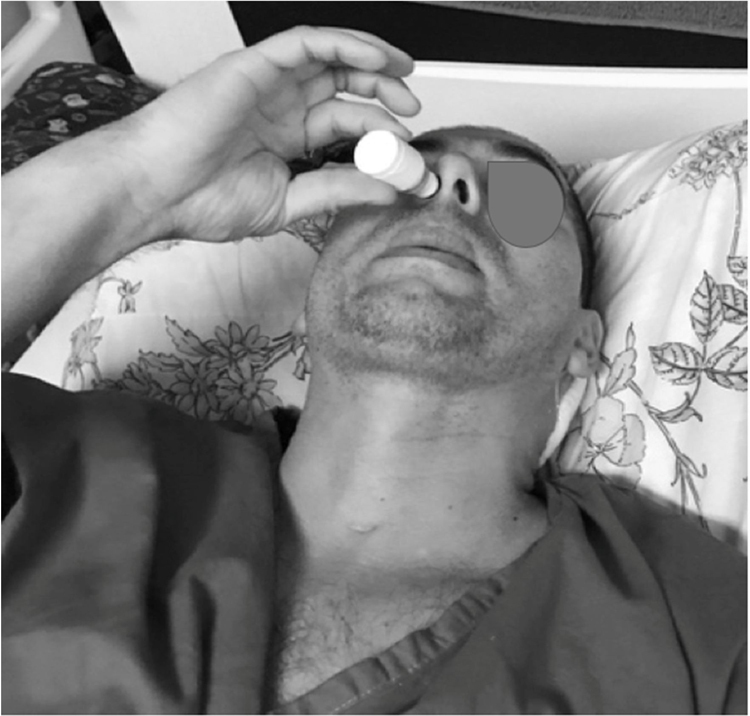
Case report: This report presents four complex cases of patients with headache related to low cerebrospinal fluid pressure. Three of them were successfully treated with the application of local anesthetic topical drops through the nasal cavity.
Conclusion: The novel approach described in this report has minimal risks of discomfort or injury to the nasal mucosa. It is quick to apply and can be administered by the patient himself.
Keywords: Bloqueio gânglio esfenopalatino; Cefaleia pós‐punção dural; Epidural blood patch; Lidocaine; Lidocaína; Manejo de dor; Pain management; Postdural puncture headache; Sphenopalatine ganglion block; Tampão sanguíneo peridural.
Copyright © 2020 Sociedade Brasileira de Anestesiologia. Publicado por Elsevier Editora Ltda. All rights reserved.
Figures
References
-
- Vincent M., Wang S. The International Classification of Headache Disorders, 3rd edition. Cephalalgia. 2018;38:1–211. - PubMed
-
- Narouze S. Epidural blood patch is an iatrogenic epidural hematoma: asymptomatic or symptomatic? This is the question. Reg Anesth Pain Med. 2019;0:1–4. - PubMed
-
- Koeva V., Bar-Or A., Gendron D., Backman S.B. Epidural blood patch in a patient with multiple sclerosis: Is it safe? Can J Anesth. 2013;60:479–483. - PubMed
-
- Makris A., Piperopoulos A., Karmaniolou I. Multiple sclerosis: Basic knowledge and new insights in perioperative management. J Anesth. 2014;28:267–278. - PubMed
Publication types
MeSH terms
Substances
LinkOut - more resources
Full Text Sources
Medical
