Review
. 2020 Dec:82:7-15.
doi: 10.1016/j.ejim.2020.09.025. Epub 2020 Oct 5.

Transthyretin amyloid cardiomyopathy: An uncharted territory awaiting discovery

Affiliations
Review

Transthyretin amyloid cardiomyopathy: An uncharted territory awaiting discovery

Aldostefano Porcari et al. Eur J Intern Med. 2020 Dec.

Abstract

Transthyretin amyloid cardiomyopathy (ATTR-AC) is an under-recognized and underdiagnosed disease. Although traditionally considered a rare condition, the epidemiology of the disease is rapidly changing due to the possibility of non-invasive diagnosis through cardiac scintigraphy with bone tracers and novel disease-modifying treatments providing survival advantages. Nevertheless, many questions and grey areas have to be addressed, such as the natural history of ATTR-AC, the role and implications of genotype-phenotype interactions, the best clinical management, prognostic stratification and the most appropriate treatments, including those already recommended for patients with heart failure. Clinicians have to cope with old beliefs and evolving concepts in ATTR-AC. A wide horizon of possibilities for physicians of many specialties is unfolding and awaits discovery.

Keywords: Cardiac amyloidosis; Disease-modifying therapies; Grey zones; Prognostic stratification; Transthyretin.


Conflict of interest statement

The authors declare they have no conflict of interest.

Figures
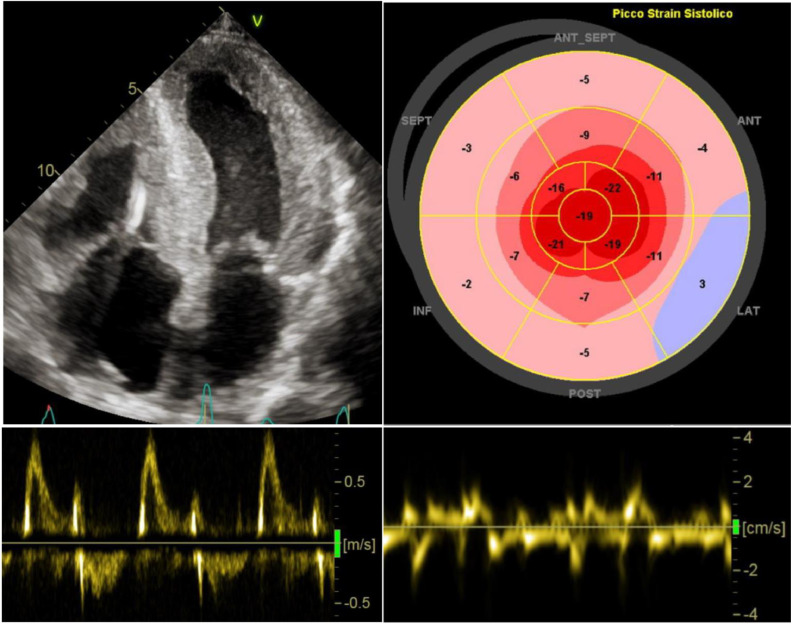
Fig. 1:
Fig. 1
Echocardiographic findings indicating high suspicion of cardiac amyloidosis. Diffuse, concentric cardiac hypertrophy of both ventricles with bi-atrial enlargement and thickened IAS. Power Doppler showing restrictive LV filling pattern. Severely impaired LV global longitudinal strain with apical sparing pattern upon speckle-tracking analysis. Global severe reduction of regional myocardial deformation of the basal inferior septum < 5 cm/s, suggesting advanced cardiac infiltration. Legend: LV, Left Ventricle; IAS, Interatrial Septum.
Fig. 2:
Fig. 2
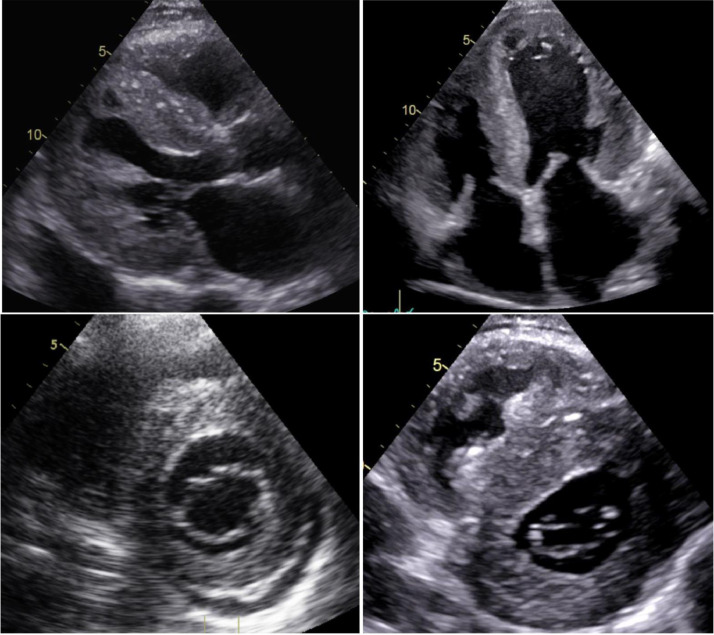
A 66-year-old man diagnosed with supposed hypertensive heart disease. Severe, concentric biventricular hypertrophy with granular sparkling appearance of the myocardium, thickened papillary muscles, bi-atrial enlargement and pericardial effusion. The regular size of the aortic root and the ascending aorta should have called into question the initial diagnosis of hypertensive heart disease. Thickened AV valves and IAS suggest long-standing infiltration. Legend: AV, atrioventricular; IAS, Interatrial Septum.
Fig. 3:
Fig. 3
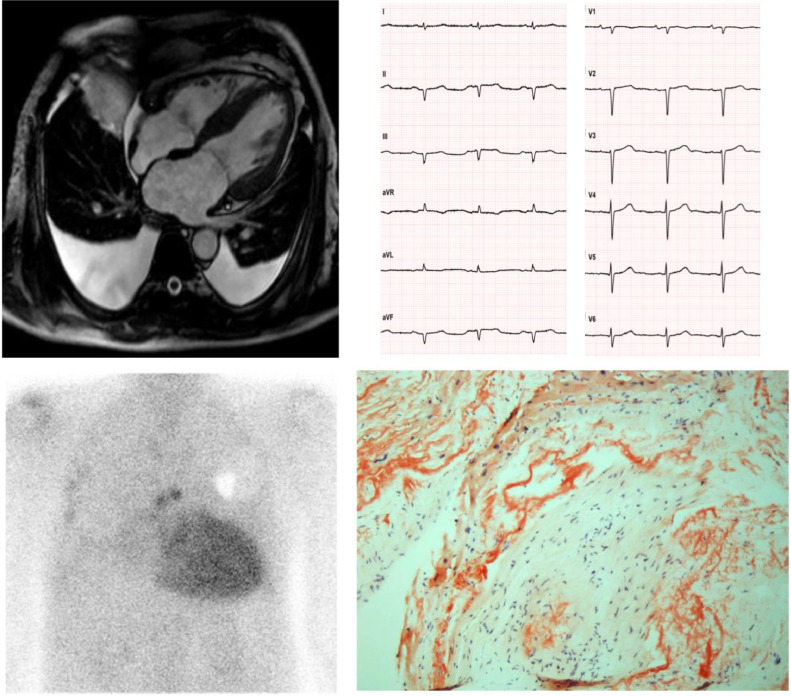
A 62-year-old man diagnosed with hypertrophic cardiomyopathy. The patient underwent a cardiological evaluation due to palpitations and a family history of sudden death (father died at 78). An ECG revealed low-voltage QRS in the peripheral leads, Q waves in the inferior leads and poor R wave progression in the precordial leads (‘pseudonecrosis’). A Holter ECG revealed paroxysmal AF and 3 consecutive ectopic ventricular beats >120 bpm. The echocardiogram and CMR showed LV hypertrophy (interventricular septum > 15 mm), left atrial dilatation and pericardial and bilateral pleural effusion. A diagnosis of hypertrophic cardiomyopathy was made, and the patient was implanted with an ICD for primary prevention of SCD. After 2 years, he was referred to our Cardiovascular Department for unexplained syncopal episodes. No arrhythmias were detected by the ICD. The patient complained of a one-year history of symptomatic bilateral carpal tunnel syndrome and discontinued anti-hypertensive drugs due to poor tolerability. An endomyocardial biopsy revealed diffuse amyloid fibrils upon Congo red staining (courtesy of Professor Rossana Bussani, MD, Institute of Pathological Anatomy and Histology, University of Trieste, Italy). Scintigraphy revealed high-grade (Perugini 3) cardiac accumulation of bone tracers, and after excluding a monoclonal component a diagnosis of ATTR-CA was made. Genetic testing revealed wild type transthyretin, and the patient was started on Tafamidis. Legend: AF, Atrial Fibrillation; CMR, Cardiac Magnetic Resonance; ECG, Electrocardiogram; ICD, Implantable Cardioverter Defibrillator; SCD, Sudden Cardiac Death.

References

    1. Maurer M.S., Elliott P., Comenzo R., Semigran M., Rapezzi C. Addressing Common Questions Encountered in the Diagnosis and Management of Cardiac Amyloidosis. Circulation. 2017;135:1357–1377. doi: 10.1161/CIRCULATIONAHA.116.024438. - DOI - PMC - PubMed
    1. Emdin M., Aimo A., Rapezzi C., Fontana M., Perfetto F., Seferović P.M. Treatment of cardiac transthyretin amyloidosis: an update. Eur Heart J. 2019;40:3699–3706. doi: 10.1093/eurheartj/ehz298. - DOI - PubMed
    1. Stakos D.A., Stamatelopoulos K., Bampatsias D., Sachse M., Zormpas E., Vlachogiannis N.I. The Alzheimer's Disease Amyloid-Beta Hypothesis in Cardiovascular Aging and Disease. J Am Coll Cardiol. 2020;75:952–967. doi: 10.1016/j.jacc.2019.12.033. - DOI - PMC - PubMed
    1. Rapezzi C., Lorenzini M., Longhi S., Milandri A., Gagliardi C., Bartolomei I. Cardiac amyloidosis: the great pretender. Heart Fail Rev. 2015;20:117–124. doi: 10.1007/s10741-015-9480-0. - DOI - PubMed
    1. Palladini G., Merlini G. Systemic amyloidoses: what an internist should know. Eur J Intern Med. 2013;24:729–739. doi: 10.1016/j.ejim.2013.10.007. - DOI - PubMed