


Infective endocarditis at a tertiary care hospital in South Korea
- PMID: 33033067
- PMCID: PMC7788257
- DOI: 10.1136/heartjnl-2020-317265
Infective endocarditis at a tertiary care hospital in South Korea
Abstract
Objective: The treatment of infective endocarditis (IE) has become more complex with the current myriad healthcare-associated factors and the regional differences in causative organisms. We aimed to investigate the overall trends, microbiological features, and outcomes of IE in South Korea.
Methods: A 12-year retrospective cohort study was performed. Poisson regression was used to estimate the time trends of IE incidence and mortality rate. Risk factors for in-hospital mortality were identified with multivariable logistic regression, and model comparison was performed to evaluate the predictive performance of notable risk factors. Kaplan-Meier survival analysis and Cox regression were performed to assess long-term prognosis.
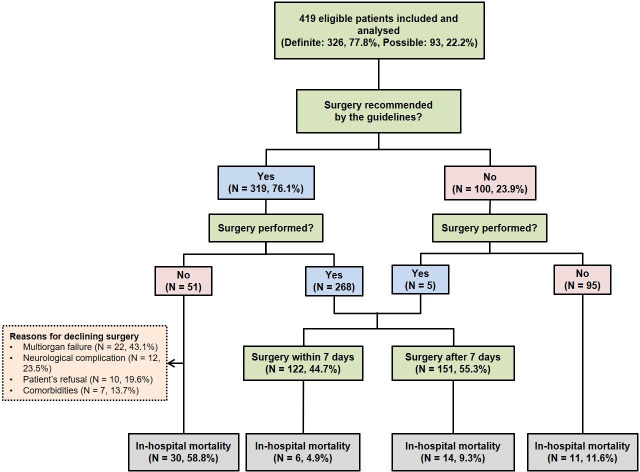
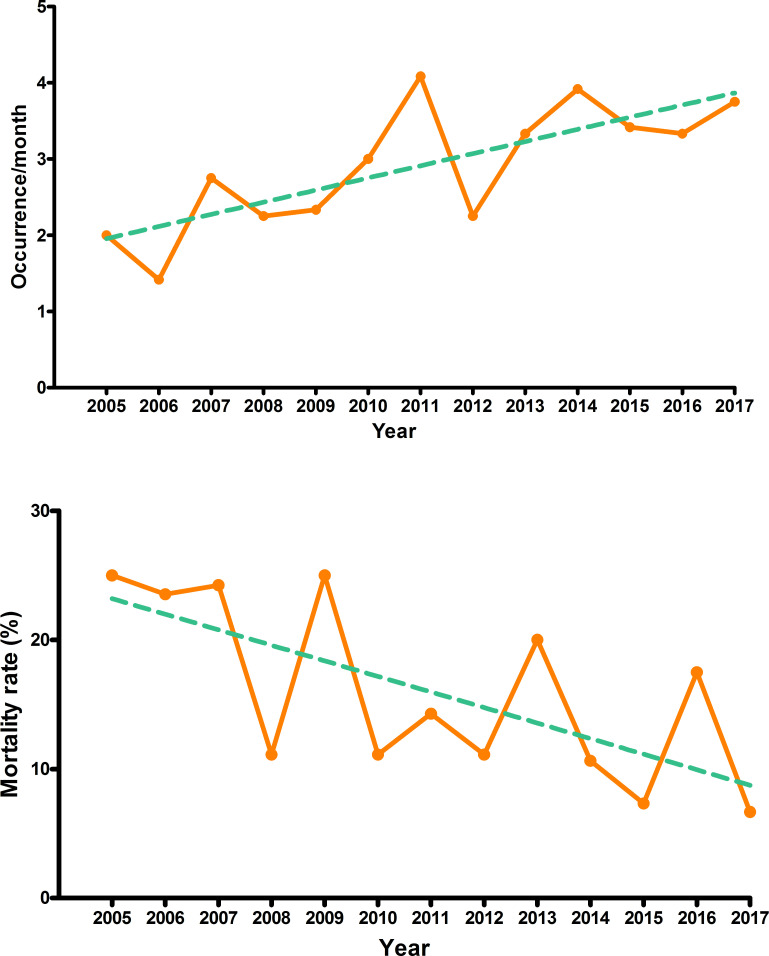
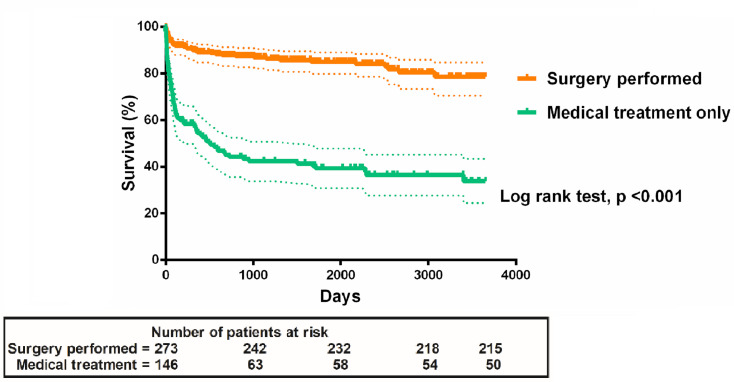
Results: We included 419 patients with IE, the incidence of which showed an increasing trend (relative risk 1.06, p=0.005), whereas mortality demonstrated a decreasing trend (incidence rate ratio 0.93, p=0.020). The in-hospital mortality rate was 14.6%. On multivariable logistic regression analysis, aortic valve endocarditis (OR 3.18, p=0.001), IE caused by Staphylococcus aureus (OR 2.32, p=0.026), neurological complications (OR 1.98, p=0.031), high Sequential Organ Failure Assessment score (OR 1.22, p=0.023) and high Charlson Comorbidity Index (OR 1.11, p=0.019) were predictors of in-hospital mortality. Surgical intervention for IE was a protective factor against in-hospital mortality (OR 0.25, p<0.001) and was associated with improved long-term prognosis compared with medical treatment only (p<0.001).
Conclusions: The incidence of IE is increasing in South Korea. Although the mortality rate has slightly decreased, it remains high. Surgery has a protective effect with respect to both in-hospital mortality and long-term prognosis in patients with IE.
Keywords: endocarditis; valve disease surgery.
© Author(s) (or their employer(s)) 2021. Re-use permitted under CC BY-NC. No commercial re-use. See rights and permissions. Published by BMJ.
Conflict of interest statement
Competing interests: None declared.
Figures
Comment in
-
Infective endocarditis: we could (and should) do better.Heart. 2021 Jan;107(2):96-98. doi: 10.1136/heartjnl-2020-317671. Epub 2020 Nov 2. Heart. 2021. PMID: 33139326 No abstract available.
References
-
- Baddour LM, Wilson WR, Bayer AS, et al. . Infective endocarditis in adults: diagnosis, antimicrobial therapy, and management of complications: a scientific statement for healthcare professionals from the American heart association. Circulation 2015;132:1435–86. 10.1161/CIR.0000000000000296 - DOI - PubMed
Publication types
MeSH terms
LinkOut - more resources
Full Text Sources
