


Multiple flow-related intracranial aneurysms in the setting of contralateral carotid occlusion: Coincidence or association?
- PMID: 33033778
- PMCID: PMC7511913
- DOI: 10.4103/bc.bc_1_20
Multiple flow-related intracranial aneurysms in the setting of contralateral carotid occlusion: Coincidence or association?
Abstract
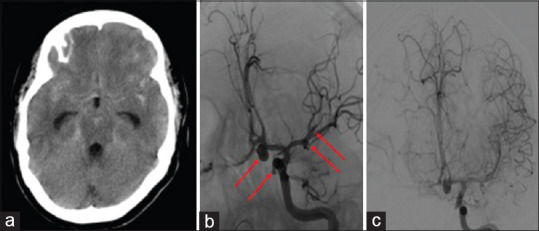
The prevalence of intracranial aneurysms (IAs) is higher in patients with internal carotid artery (ICA) stenosis, likely due to alterations in intracranial hemodynamics. Severe stenosis or occlusion of one ICA may result in increased demand and altered hemodynamics in the contralateral ICA, thus increasing the risk of contralateral IA formation. In this article, we discuss a relevant case and a comprehensive literature review as it pertains to the association of ICA stenosis and IA. Our patient was a 50-year-old female with a chronic asymptomatic right ICA occlusion who presented with diffuse subarachnoid hemorrhage. Emergent angiography revealed left-sided A1-A2 junction, paraclinoid, left middle cerebral artery (MCA) bifurcation, and left anterior temporal artery aneurysms. Brisk filling of the right anterior circulation through the anterior communicating artery was also identified, signifying increased demand on the left ICA circulation. Complete obliteration of all aneurysms was achieved with coil embolization and clipping. For our literature review, we searched the PubMed and EMBASE databases for case reports and case series, as well as references in previously published review articles that described patients with concurrent aneurysms and ICA stenosis. We selected articles that provided adequate information about the case presentations to compare aneurysm and patient characteristics. Our review revealed a higher number of patients with multiple aneurysms contralateral (25%) to rather than ipsilateral to (6%), the ICA stenosis. We discuss the pathogenesis and management of multiple flow-related IA in the context of the existing literature related to concurrent ICA stenosis and IA.
Keywords: Carotid stenosis; endovascular; flow-related aneurysm; intracranial aneurysm; neurosurgery; subarachnoid hemorrhage.
Copyright: © 2020 Brain Circulation.
Conflict of interest statement
There are no conflicts of interest.
Figures


References
-
- Vlak MH, Algra A, Brandenburg R, Rinkel GJ. Prevalence of unruptured intracranial aneurysms, with emphasis on sex, age, comorbidity, country, and time period: A systematic review and meta-analysis. Lancet Neurol. 2011;10:626–36. - PubMed
-
- Bederson JB, Awad IA, Wiebers DO, Piepgras D, Haley EC, Jr, Brott T, et al. Recommendations for the management of patients with unruptured intracranial aneurysms: A statement for healthcare professionals from the Stroke Council of the American Heart Association. Stroke. 2011;31:2742–50. - PubMed
-
- Johnston SC, Selvin S, Gress DR. The burden, trends, and demographics of mortality from subarachnoid hemorrhage. Neurology. 1998;50:1413–8. - PubMed
-
- Lin N, Cahill KS, Frerichs KU, Friedlander RM, Claus EB. Treatment of ruptured and unruptured cerebral aneurysms in the USA: A paradigm shift. J Neurointerv Surg. 2018;10:i69–i76. - PubMed
Publication types
LinkOut - more resources
Full Text Sources
Miscellaneous