. 2021 Feb 1;148(3):731-747.
doi: 10.1002/ijc.33332. Epub 2020 Oct 31.

Thyroid and androgen receptor signaling are antagonized by μ-Crystallin in prostate cancer

Affiliations

Thyroid and androgen receptor signaling are antagonized by μ-Crystallin in prostate cancer

Osman Aksoy et al. Int J Cancer. .

Abstract

Androgen deprivation therapy (ADT) remains a key approach in the treatment of prostate cancer (PCa). However, PCa inevitably relapses and becomes ADT resistant. Besides androgens, there is evidence that thyroid hormone thyroxine (T4) and its active form 3,5,3'-triiodo-L-thyronine (T3) are involved in the progression of PCa. Epidemiologic evidences show a higher incidence of PCa in men with elevated thyroid hormone levels. The thyroid hormone binding protein μ-Crystallin (CRYM) mediates intracellular thyroid hormone action by sequestering T3 and blocks its binding to cognate receptors (TRα/TRβ) in target tissues. We show in our study that low CRYM expression levels in PCa patients are associated with early biochemical recurrence and poor prognosis. Moreover, we found a disease stage-specific expression of CRYM in PCa. CRYM counteracted thyroid and androgen signaling and blocked intracellular choline uptake. CRYM inversely correlated with [18F]fluoromethylcholine (FMC) levels in positron emission tomography/magnetic resonance imaging of PCa patients. Our data suggest CRYM as a novel antagonist of T3- and androgen-mediated signaling in PCa. The role of CRYM could therefore be an essential control mechanism for the prevention of aggressive PCa growth.

Trial registration: ClinicalTrials.gov NCT02659527.

Keywords: PSMA-PET; androgen receptor; prostate cancer; thyroid hormone receptor; μ-Crystallin.


Conflict of interest statement

The authors declare no potential conflict of interest.

Figures
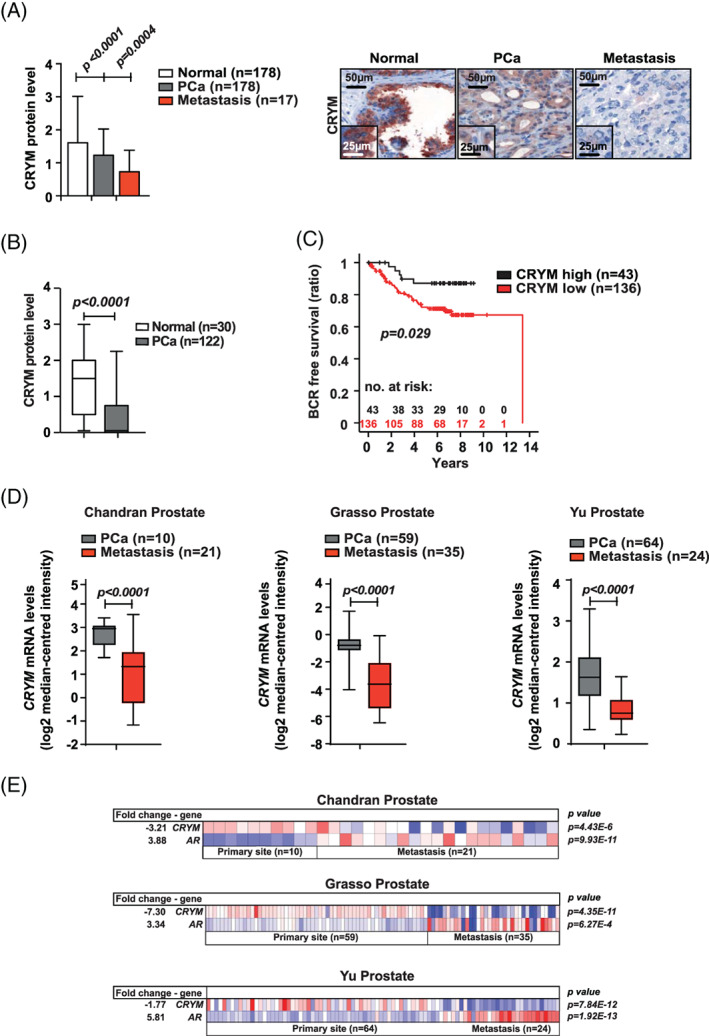
FIGURE 1
FIGURE 1
CRYM is stage‐dependently expressed in prostate cancer at the mRNA and protein level. A, CRYM protein levels assessed by IHC of healthy prostate tissue (n = 178), PCa (n = 178) and tissues derived from PCa metastases (n = 17). Representative staining for CRYM in healthy prostate, PCa and metastatic tissue is shown, scale bar 50 μm (low magnification), 25 μm (inlet, high magnification). B, IHC analysis of CRYM protein levels in non‐neoplastic prostate tissue (n = 30) and PCa (n = 122) in an independent cohort from Tuebingen. C, IHC CRYM protein levels in correlation to time for BCR in a Kaplan‐Meier analysis (P = .029). D, CRYM mRNA expression levels in PCa patients, analyzed from primary tumor samples and metastases. Data were extracted from the Oncomine Platform from the following studies: Chandran Prostate (left, P < .0001), Grasso Prostate (middle, P < .0001) and Yu Prostate (right, P < .0001). E, Heatmaps of human patient data depicting CRYM and AR mRNA levels in primary tumors and PCa metastases (log2 median‐centered intensity). Data were extracted from the Oncomine Platform from the following studies: Chandran Prostate (upper), Grasso Prostate (middle) and Yu Prostate (lower). BCR, biochemical recurrence; CRYM, μ‐Crystallin; IHC, immunohistochemistry; PCa, prostate cancer [Color figure can be viewed at wileyonlinelibrary.com]
FIGURE 2
FIGURE 2
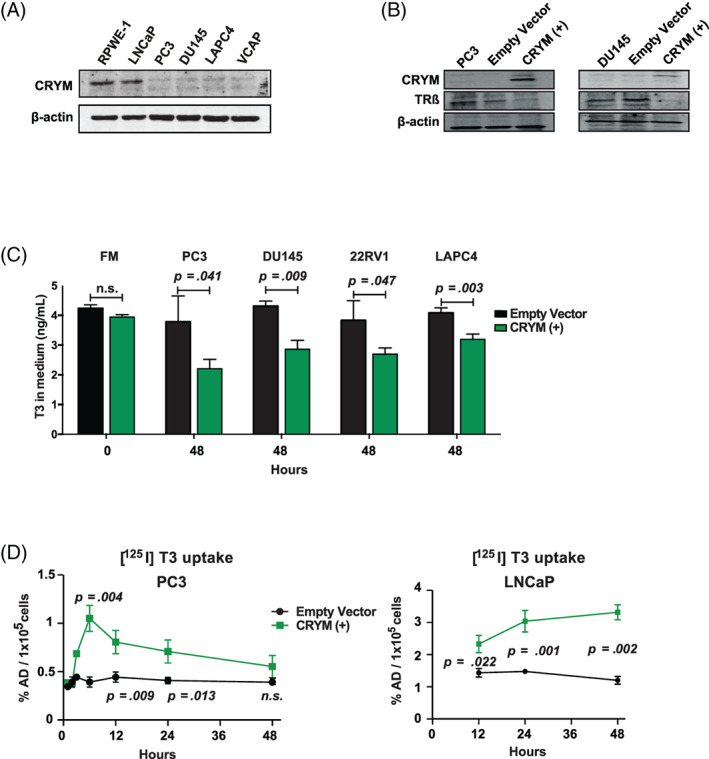
CRYM overexpression leads to a reduction of free T3. A, Immunoblot analysis of CRYM and TRβ in PCa cell lines RWPE‐1, LNCaP, PC3, DU145, LAPC4, VCAP. β‐Actin was used as loading control. B, CRYM and TRβ levels in PC3 and DU145 cells that were transiently transfected with EV or CRYM(+). C, Human PCa cells PC3, DU145, 22Rv1 and LAPC4 were transfected with a plasmid bearing the CRYM insert under the CMV promoter that coexpresses GFP (CRYM(+)) or empty vector (EV). T3 concentrations were determined across human PCa cells by analyzing with electrochemiluminescence immune assay (n = 3). FM (Full medium): RPMI medium supplemented with 10% FCS. D, Transiently transfected PC3 and LNCaP cells with EV or CRYM(+) were incubated with radioactively labeled T3 ([125I] T3) in hormone free medium for 48 hours, and intracellular radioactivity was determined by scintillation counting. CRYM, μ‐Crystallin; FCS, fetal calf serum; PCa, prostate cancer [Color figure can be viewed at wileyonlinelibrary.com]
FIGURE 3
FIGURE 3
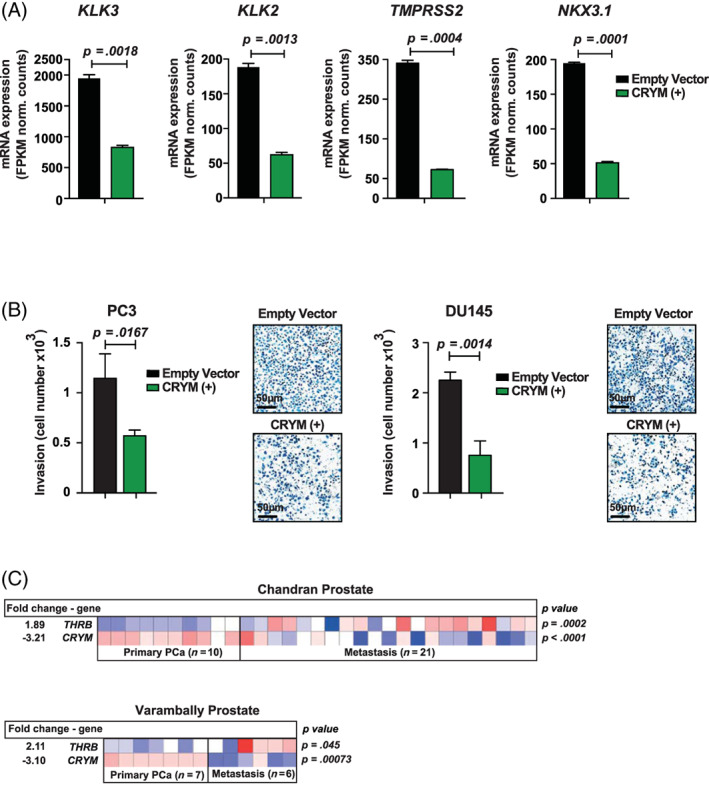
CRYM overexpression represses AR signaling and invasion in PCa cells. A, RNA‐seq analysis of LNCaP cells that were transiently transfected with EV or CRYM(+). AR responsive genes KLK3 (PSA) (P = .0018), KLK2 (P = .0013), TMPRSS2 (P = .0004) and NKX3.1 (P = .0001) are shown. B, Matrigel‐coated invasion chambers were used to test the invasive capacity of PCa cell lines PC3 and DU145 with and without CRYM(+) over 24 hours. Quantification and representative images are shown; scale bar = 50 μm. C, Heatmaps depicting THRB (TRβ) and CRYM mRNA levels in primary PCa and metastatic patient samples (log2 median‐centered intensity). Data were extracted from the Oncomine Platform from the Chandran Prostate (upper) and Varambally Prostate (lower) studies. AR, androgen receptor; CRYM, μ‐Crystallin; EV, empty vector; PCa, prostate cancer [Color figure can be viewed at wileyonlinelibrary.com]
FIGURE 4
FIGURE 4
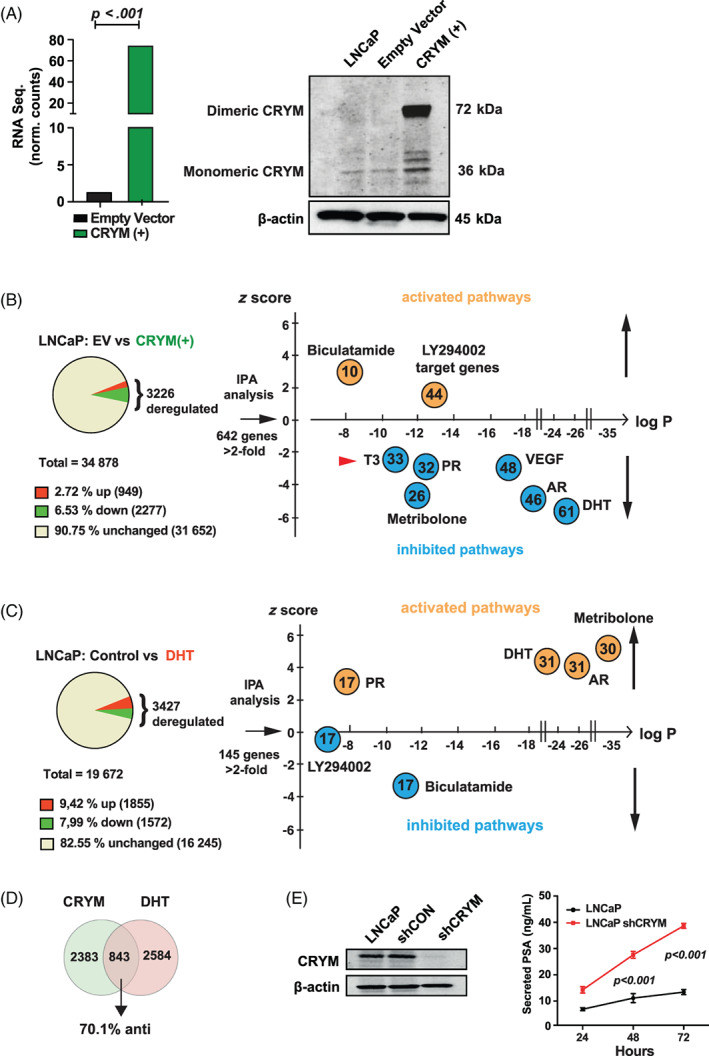
CRYM‐induced suppression of T3 and AR signaling. A, LNCaP cells expressing empty vector (EV) or CRYM(+) were analyzed by RNA‐seq and Immunoblot. B, LNCaP CRYM(+) and EV cells were compared using three biological replicates for each group. Single end 50 bp RNA‐seq was performed with an Illumina Hi‐Seq2000 platform and LNCaP CRYM(+) to EV cells were compared using three biological replicates for each group. CRYM overexpression was validated by RNA‐seq (73.7 vs 2.2 normalized counts, P < .001). Shown are enriched pathways according to IPA pathway analysis among the deregulated genes. C, Genes deregulated by androgen DHT in the same cell line LNCaP from a published dataset. Shown are enriched pathways according to IPA pathway analysis. 24 D, 843 genes overlapped among CRYM overexpression and DHT regulated genes; 70.1% of these were counter‐regulated (anti). Androgen‐responsive genes and AR‐regulated genes are enriched in LNCaP EV vs CRYM(+) and control vs DHT. E, CRYM knockdown in the LNCaP cell line generated using lentiviral‐transfected shRNAs (shCRYM) and a nontargeting control shRNA (shControl). CRYM reduction was confirmed by Immunoblot. PSA release levels were measured by a chemiluminescence immune assay. AR, androgen receptor; CRYM, μ‐Crystallin; DHT, dihydrotestosterone; EV, empty vector; IPA, ingenuity pathways analysis; PSA, prostate‐specific antigen [Color figure can be viewed at wileyonlinelibrary.com]
FIGURE 5
FIGURE 5
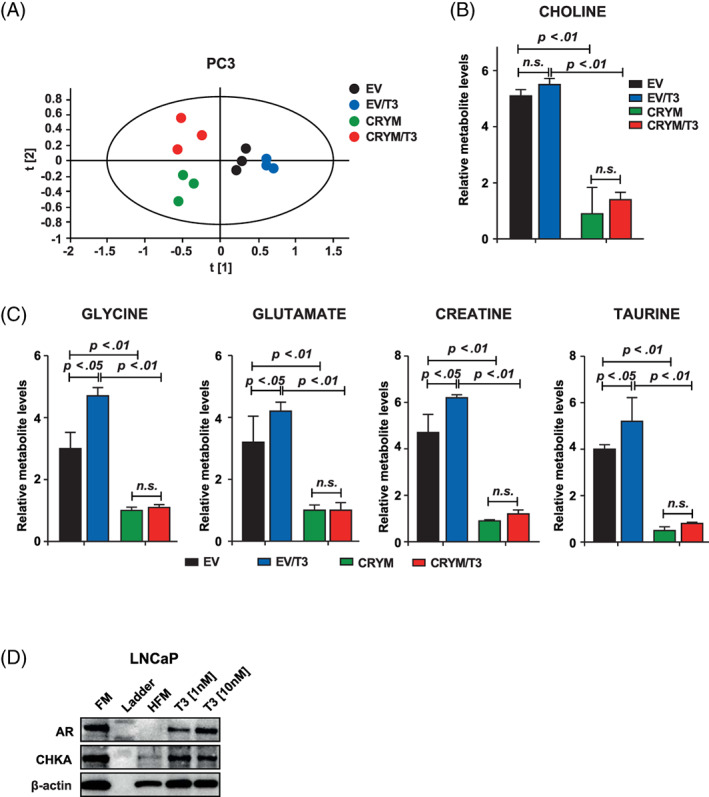
CRYM overexpression caused to the metabolic alterations in PCa. A, Score plot of partial least squares‐discriminant analysis (PLS‐DA) model of PC3 cell pellet extract fitted using 1H‐NMR spectral data. PC3 cells without CRYM overexpressing vector (right) were separated from PC3 cells with CRYM overexpressing vector (left) along the first component. B, Measurement of free choline in CRYM overexpression (P < .01) or EV in the presence of T3. C, Relative metabolite levels of glycine, glutamate, creatinine and taurine with and without T3 in LNCaP with overexpression of CRYM or EV measured by 1H‐NMR. D, Immunoblot analysis of AR and choline kinase α (CHKA) and β‐Actin as a control in RPMI 1640 medium with 10% FCS (FM), HFM and HFM with T3 supplementation (1 nM and 10 nM). CRYM, μ‐Crystallin; EV, empty vector; FCS, fetal calf serum; FM, full medium; PCa, prostate cancer [Color figure can be viewed at wileyonlinelibrary.com]
FIGURE 6
FIGURE 6
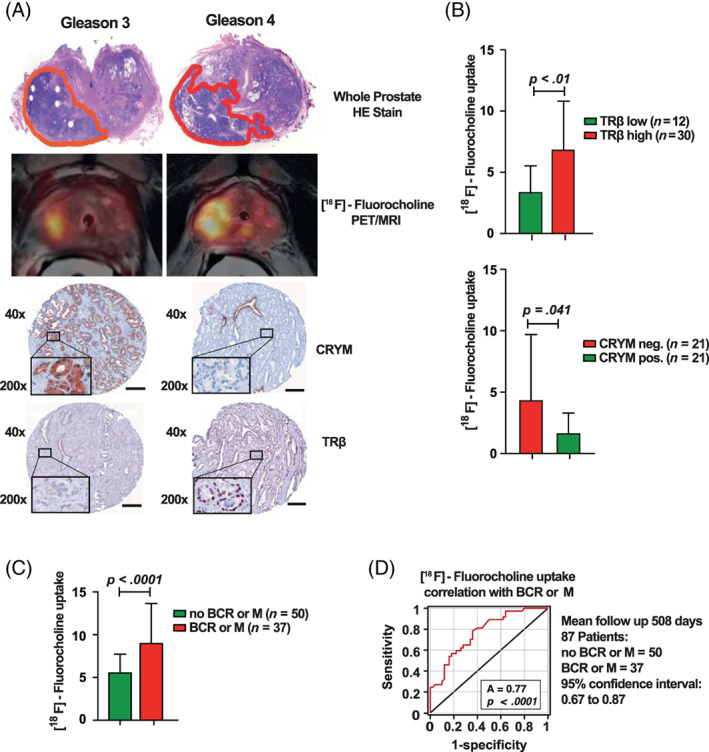
Noninvasive imaging using [18F]fluoromethylcholine (FMC) and PET is a surrogate marker for the activity of thyroid hormone metabolism in PCa. A, Hematoxylin Eosin (HE) whole mount sections of two different prostate cancer specimens on the left with a Gleason 3 lesion and on the right with a larger Gleason 4 lesion. Corresponding FMC PET/MRI of the same patient shows FMC uptake on the left (Gleason 3) and on the right (Gleason 4). IHC showing CRYM stainings positive in the Gleason 3 lesion on the left and TRβ stainings positive in the Gleason 4 lesion on the right (scale bar = 150 μm). B, Statistical evaluation of 42 PCa patients who underwent FMC PET/MRI prior to radical prostatectomy. CRYM and TRβ protein levels in tumors were analyzed using IHC. Choline uptake in tumor specimens with high TRβ expression (TRβ 2‐6 score; n = 30, P < .01) or no CRYM expression (n = 21, P = .041). C, Choline uptake correlated to BCR or metastases in receiver‐operating‐characteristics‐curve analysis (AUC = 0.77, P < .0001). D, 87 Patients with FMC PET/MRI and a mean follow‐up time of 508 days were divided into a group that developed BCR and/or metastasis (n = 37) and a group that did not (n = 50). The first group had significantly higher choline levels in FMC PET/MRI (P < .0001). AUC, area under the curve; BCR, biochemical recurrence; FMC, [18F]fluoromethylcholine; HE, hematoxylin eosin; IHC, immunohistochemistry; MRI, magnetic resonance imaging; PCa, prostate cancer; PET, positron emission tomography [Color figure can be viewed at wileyonlinelibrary.com]

References

    1. Huggins C, Hodges CV. Studies on prostate cancer. I. The effect of castration, of estrogen and of androgen injection on serum phosphatase in metastatic carcinoma of the prostate. Cancer Res. 1941;1:239‐297.
    1. Porkka KP, Visakorpi T. Molecular mechanisms of prostate cancer. Eur Urol. 2004;45(6):683‐691. - PubMed
    1. Haile S, Sadar MD. Androgen receptor and its splice variants in prostate cancer. Cell Mol Life Sci. 2011;68(24):3971‐3981. - PMC - PubMed
    1. Watson PA, Chen YF, Balbas MD, et al. Constitutively active androgen receptor splice variants expressed in castration‐resistant prostate cancer require full‐length androgen receptor. Proc Natl Acad Sci U S A. 2010;107(39):16759‐16765. - PMC - PubMed
    1. Visser WE, Wong WS, van Mullem AA, Friesema EC, Geyer J, Visser TJ. Study of the transport of thyroid hormone by transporters of the SLC10 family. Mol Cell Endocrinol. 2010;315(1‐2):138‐145. - PubMed

Publication types

MeSH terms

Associated data