Approach to the Patient with MODY-Monogenic Diabetes
- PMID: 33034350
- PMCID: PMC7765647
- DOI: 10.1210/clinem/dgaa710
Approach to the Patient with MODY-Monogenic Diabetes
Abstract
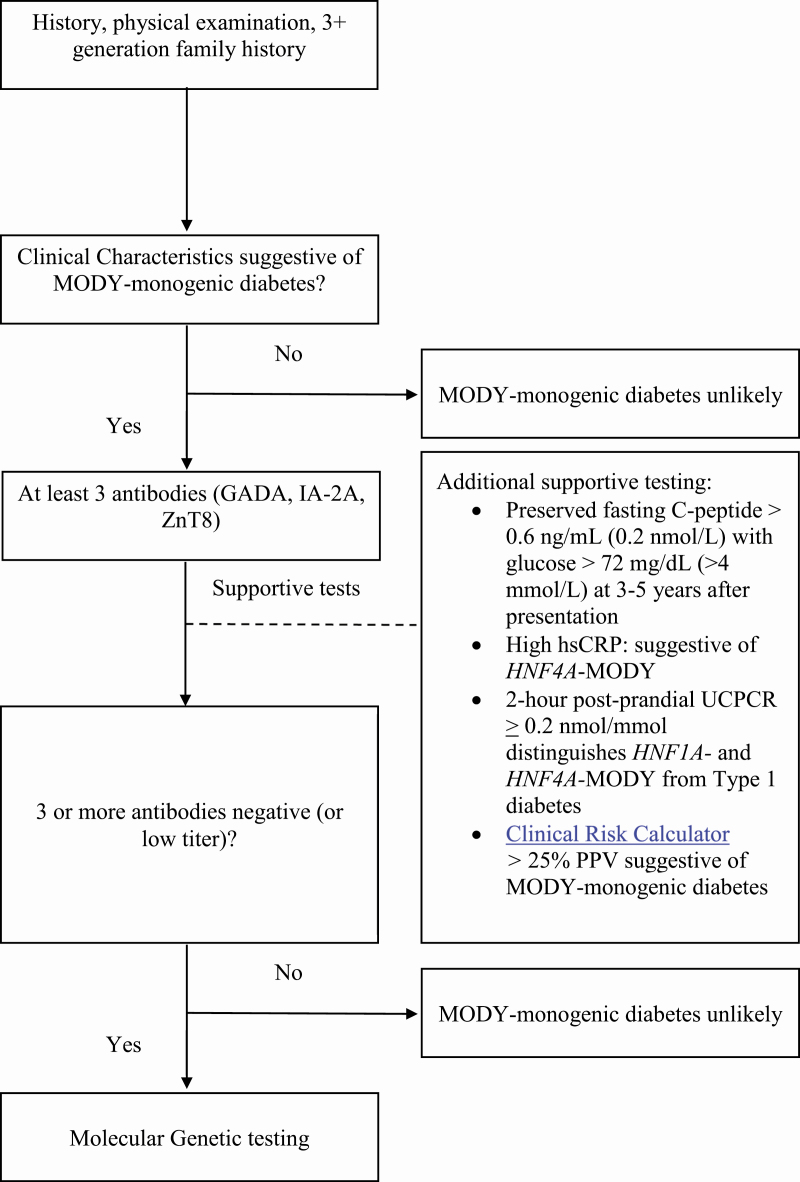
Maturity-onset diabetes of the young, or MODY-monogenic diabetes, is a not-so-rare collection of inherited disorders of non-autoimmune diabetes mellitus that remains insufficiently diagnosed despite increasing awareness. These cases are important to efficiently and accurately diagnose, given the clinical implications of syndromic features, cost-effective treatment regimen, and the potential impact on multiple family members. Proper recognition of the clinical manifestations, family history, and cost-effective lab and genetic testing provide the diagnosis. All patients must undergo a thorough history, physical examination, multigenerational family history, lab evaluation (glycated hemoglobin A1c [HbA1c], glutamic acid decarboxylase antibodies [GADA], islet antigen 2 antibodies [IA-2A], and zinc transporter 8 [ZnT8] antibodies). The presence of clinical features with 3 (or more) negative antibodies may be indicative of MODY-monogenic diabetes, and is followed by genetic testing. Molecular genetic testing should be performed before attempting specific treatments in most cases. Additional testing that is helpful in determining the risk of MODY-monogenic diabetes is the MODY clinical risk calculator (>25% post-test probability in patients not treated with insulin within 6 months of diagnosis should trigger genetic testing) and 2-hour postprandial (after largest meal of day) urinary C-peptide to creatinine ratio (with a ≥0.2 nmol/mmol to distinguish HNF1A- or 4A-MODY from type 1 diabetes). Treatment, as well as monitoring for microvascular and macrovascular complications, is determined by the specific variant that is identified. In addition to the diagnostic approach, this article will highlight recent therapeutic advancements when patients no longer respond to first-line therapy (historically sulfonylurea treatment in many variants).
Learning objectives: Upon completion of this educational activity, participants should be able to.
Target audience: This continuing medical education activity should be of substantial interest to endocrinologists and all health care professionals who care for people with diabetes mellitus.
Keywords: MODY; diagnosis; monitoring; pregnancy; treatment.
© The Author(s) 2020. Published by Oxford University Press on behalf of the Endocrine Society. All rights reserved. For permissions, please e-mail: journals.permissions@oup.com.
Figures
References
-
- MODY Probability Calculator // Diabetes Genes. https://www.diabetesgenes.org/mody-probability-calculator/. Accessed May 4, 2020.
-
- Besser RE, Shepherd MH, McDonald TJ, et al. Urinary C-peptide creatinine ratio is a practical outpatient tool for identifying hepatocyte nuclear factor 1-{alpha}/hepatocyte nuclear factor 4-{alpha} maturity-onset diabetes of the young from long-duration type 1 diabetes. Diabetes Care. 2011;34(2):286-291. - PMC - PubMed
-
- Shields BM, Hicks S, Shepherd MH, Colclough K, Hattersley AT, Ellard S. Maturity-onset diabetes of the young (MODY): how many cases are we missing? Diabetologia. 2010;53(12):2504-2508. - PubMed
-
- Pihoker C, Gilliam LK, Ellard S, et al. ; SEARCH for Diabetes in Youth Study Group . Prevalence, characteristics and clinical diagnosis of maturity onset diabetes of the young due to mutations in HNF1A, HNF4A, and glucokinase: results from the SEARCH for Diabetes in Youth. J Clin Endocrinol Metab. 2013;98(10):4055-4062. - PMC - PubMed
Publication types
MeSH terms
Substances
Supplementary concepts
Grants and funding
LinkOut - more resources
Full Text Sources
Medical
Miscellaneous