Review
. 2021 Jan 6:61:831-852.
doi: 10.1146/annurev-pharmtox-010919-023738. Epub 2020 Oct 9.

Antisense Drugs Make Sense for Neurological Diseases

Affiliations
Review

Antisense Drugs Make Sense for Neurological Diseases

C Frank Bennett et al. Annu Rev Pharmacol Toxicol. .

Abstract

The genetic basis for most inherited neurodegenerative diseases has been identified, yet there are limited disease-modifying therapies for these patients. A new class of drugs-antisense oligonucleotides (ASOs)-show promise as a therapeutic platform for treating neurological diseases. ASOs are designed to bind to the RNAs either by promoting degradation of the targeted RNA or by elevating expression by RNA splicing. Intrathecal injection into the cerebral spinal fluid results in broad distribution of antisense drugs and long-term effects. Approval of nusinersen in 2016 demonstrated that effective treatments for neurodegenerative diseases can be identified and that treatments not only slow disease progression but also improve some symptoms. Antisense drugs are currently in development for amyotrophic lateral sclerosis, Huntington's disease, Alzheimer's disease, Parkinson's disease, and Angelman syndrome, and several drugs are in late-stage research for additional neurological diseases. This review highlights the advances in antisense technology as potential treatments for neurological diseases.

Keywords: Huntington's disease; amyotrophic lateral sclerosis; antisense oligonucleotide; neurodegenerative disease; siRNA; spinal muscular atrophy.


Figures
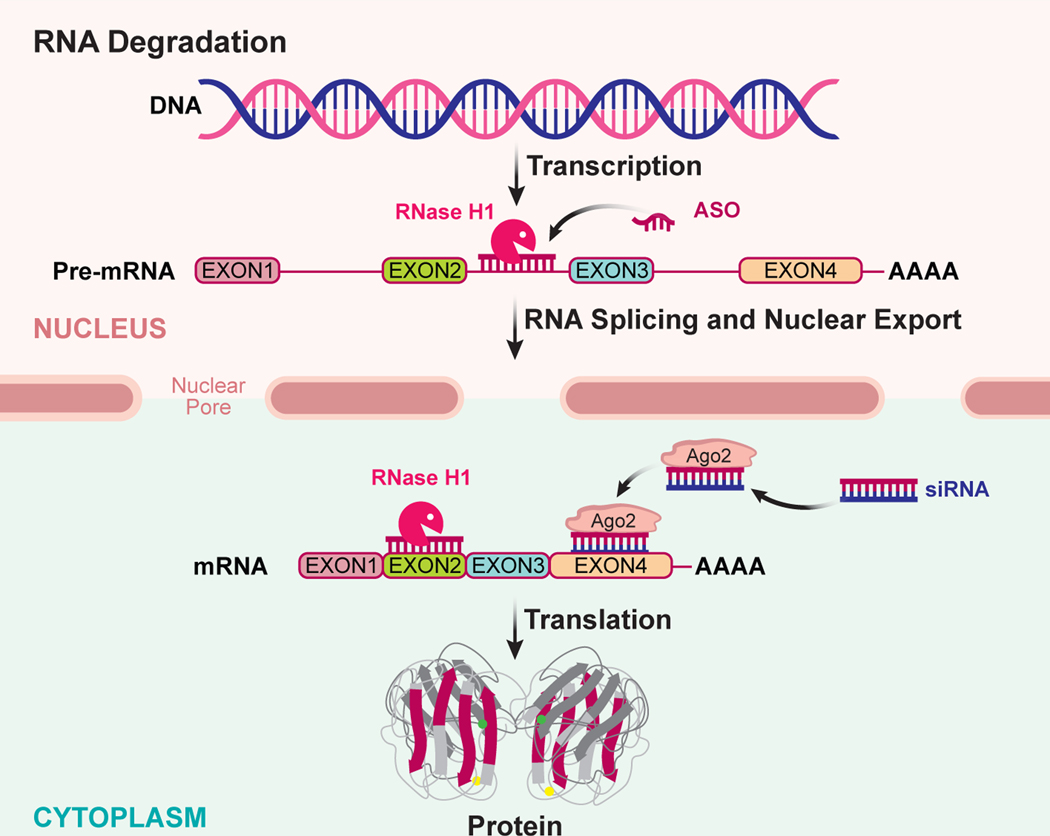
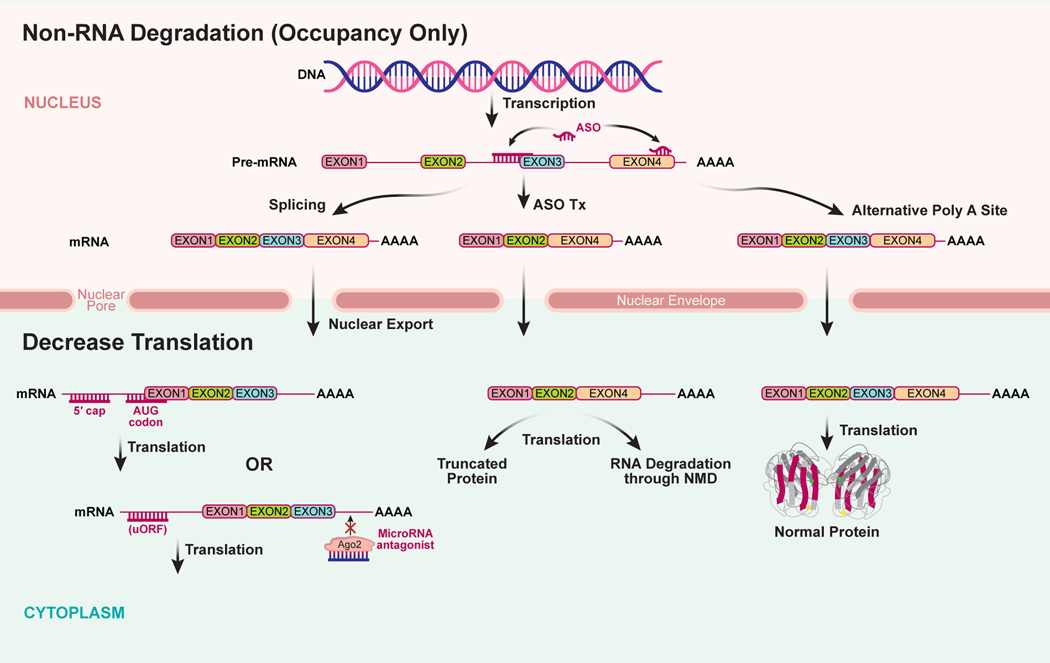
Figure 1:
Figure 1:
RNA degradation antisense mechanisms. RNA is transcribed from DNA into a precursor form (pre-mRNA) which undergoes several post-transcriptional processing events, such as splicing to remove intronic sequence forming the mature RNA (mRNA). The mRNA is exported out of the nucleus to the cytoplasm where it is translated into its protein product. Two broadly used antisense mechanisms result in selective degradation of the targeted RNA. Single stranded ASOs that work through the RNase H1 mechanism bind to the targeted RNA and recruit RNase H1 to the ASO-RNA heteroduplex in either the nucleus or cytoplasm. RNase H1 catalyzes the degradation of the RNA strand releasing the ASO to bind to another target RNA. A second common antisense mechanism, siRNA, utilizes double stranded RNA or RNA analogs which are dissociated within the cell and the antisense strand (also commonly referred to as the guide strand) binds to argonaute 2 (Ago2) protein in a facilitated manner. The antisense strand (guide RNA) bound to the Ago2 protein directs the complex to the targeted RNA through Watson-Crick base pairing to a complementary sequence in the targeted RNA. Ago2 cleaves the targeted RNA and after cleavage the Ago-2/RNA complex is released allowing it to bind and cleave additional target RNAs.
Figure 2:
Figure 2:
Non-RNA degradation antisense mechanisms (occupancy only). RNA is transcribed from DNA into a precursor form (pre-mRNA) which is undergoes several post-transcriptional processing events, such as splicing to remove intronic sequences and polyadenylation to form the mature RNA (mRNA). The mRNA is exported out of the nucleus to the cytoplasm where it is translated into its protein product. ASOs can be designed to modify RNA processing events in the nucleus such as modulate RNA splicing to exclude or include a protein coding exon. In some cases, excluding specific exons could result in a truncated protein product or alternatively, the RNA missing a specific exon is recognized by the cell as mis-spliced and is degraded by the non-sense mediated decay (NMD) pathway. ASOs can also be designed to alter polyadenylation site selection resulting in loss of RNA regulatory sequences in 3’-untranslated regions of the RNA. In the cytoplasm, ASOs can be designed to decrease translation of the RNA into proteins by binding to sequences in the 5’-untranslated region of the mRNA or by blocking microRNA binding to the RNA. ASOs can also be designed to block translation starting at an upstream open reading frame (uORF) or disrupt regulatory RNA structures resulting in an increase in protein translation.

References

    1. Huntington’sDiseaseCollaborativeResearchGroup. 1993. A novel gene containing a trinucleotide repeat that is expanded and unstable on Huntington’s disease chromosomes Cell 72:971–83 - PubMed
    1. Orr HT, Zoghbi HY. 2007. Trinucleotide repeat disorders. Annu Rev Neurosci 30:575–621 - PubMed
    1. DeJesus-Hernandez M, Mackenzie IR, Boeve BF, Boxer AL, Baker M, et al. 2011. Expanded GGGGCC hexanucleotide repeat in noncoding region of C9ORF72 causes chromosome 9p-linked FTD and ALS. Neuron 72:245–56 - PMC - PubMed
    1. Renton AE, Majounie E, Waite A, Simon-Sanchez J, Rollinson S, et al. 2011. A hexanucleotide repeat expansion in C9ORF72 is the cause of chromosome 9p21-linked ALS-FTD. Neuron 72:257–68 - PMC - PubMed
    1. Crooke ST, Witztum JL, Bennett CF, Baker BF. 2018. RNA-Targeted Therapeutics. Cell Metab 27:714–39 - PubMed

Publication types