. 2020 Dec:131:244-254.
doi: 10.1016/j.jpsychires.2020.09.020. Epub 2020 Sep 22.

The early impact of COVID-19 on mental health and community physical health services and their patients' mortality in Cambridgeshire and Peterborough, UK

Affiliations

The early impact of COVID-19 on mental health and community physical health services and their patients' mortality in Cambridgeshire and Peterborough, UK

Shanquan Chen et al. J Psychiatr Res. 2020 Dec.

Abstract

Background: COVID-19 has affected social interaction and healthcare worldwide.

Methods: We examined changes in presentations and referrals to the primary provider of mental health and community health services in Cambridgeshire and Peterborough, UK (population ~0·86 million), plus service activity and deaths. We conducted interrupted time series analyses with respect to the time of UK "lockdown", which was shortly before the peak of COVID-19 infections in this area. We examined changes in standardized mortality ratio for those with and without severe mental illness (SMI).

Results: Referrals and presentations to nearly all mental and physical health services dropped at lockdown, with evidence for changes in both supply (service provision) and demand (help-seeking). This was followed by an increase in demand for some services. This pattern was seen for all major forms of presentation to liaison psychiatry services, except for eating disorders, for which there was no evidence of change. Inpatient numbers fell, but new detentions under the Mental Health Act were unchanged. Many services shifted from face-to-face to remote contacts. Excess mortality was primarily in the over-70s. There was a much greater increase in mortality for patients with SMI, which was not explained by ethnicity.

Conclusions: COVID-19 has been associated with a system-wide drop in the use of mental health services, with some subsequent return in activity. "Supply" changes may have reduced access to mental health services for some. "Demand" changes may reflect a genuine reduction of need or a lack of help-seeking with pent-up demand. There has been a disproportionate increase in death among those with SMI during the pandemic.

Keywords: Alcohol and substance misuse; Anxiety; COVID-19/SARS-CoV-2 coronavirus pandemic; Depression; Mortality; Self-harm; Severe mental illness (SMI); Suicidality.


Conflict of interest statement

  1. Several authors (PBJ, BRU, AM, ETB, ESO, JBD, CFH, FJT, RNC) are CPFT clinicians involved in delivering some of the services discussed here and two (BRU, FJT) are clinical directors and therefore involved in managing them.

  2. PBJ is a scientific advisory board member for Janssen and Recordati.

  3. BRU is clinical director of the Windsor Unit at Fulbourn Hospital (CPFT), which delivers clinical trials in dementia/mild cognitive impairment for academic and commercial organisations without personal benefit, and is the clinical lead for dementia for the NIHR Clinical Research Network (CRN) in the East of England. His salary is part-funded by the NIHR CRN. He has been principal investigator on trials for Axovant, Lilly, and EIP Pharma; his institution has benefited from payment for research carried out but he has not personally received any money. His wife is the lead for mental health for Suffolk Clinical Commissioning Group.

  4. AM’s salary is part-funded by the Anna Freud National Centre for Children and Families, a mental health charity.

  5. ETB is a scientific advisory board member for Sosei Hepares, and was a half-time employee of GlaxoSmithKline until May 2019.

  6. RNC consults for Campden Instruments Ltd and receives royalties from Cambridge University Press, Cambridge Enterprise, and Routledge.

  7. SC, SB, EFO, JBD, CFH, FJT, JDA, MPS, and JRL have nothing else to disclose.

Figures
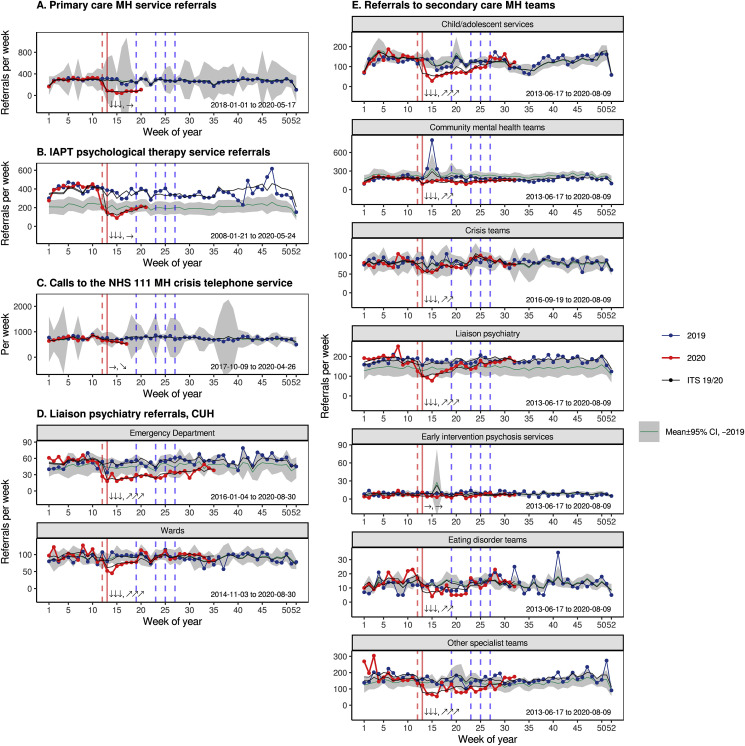
Fig. 1
Fig. 1
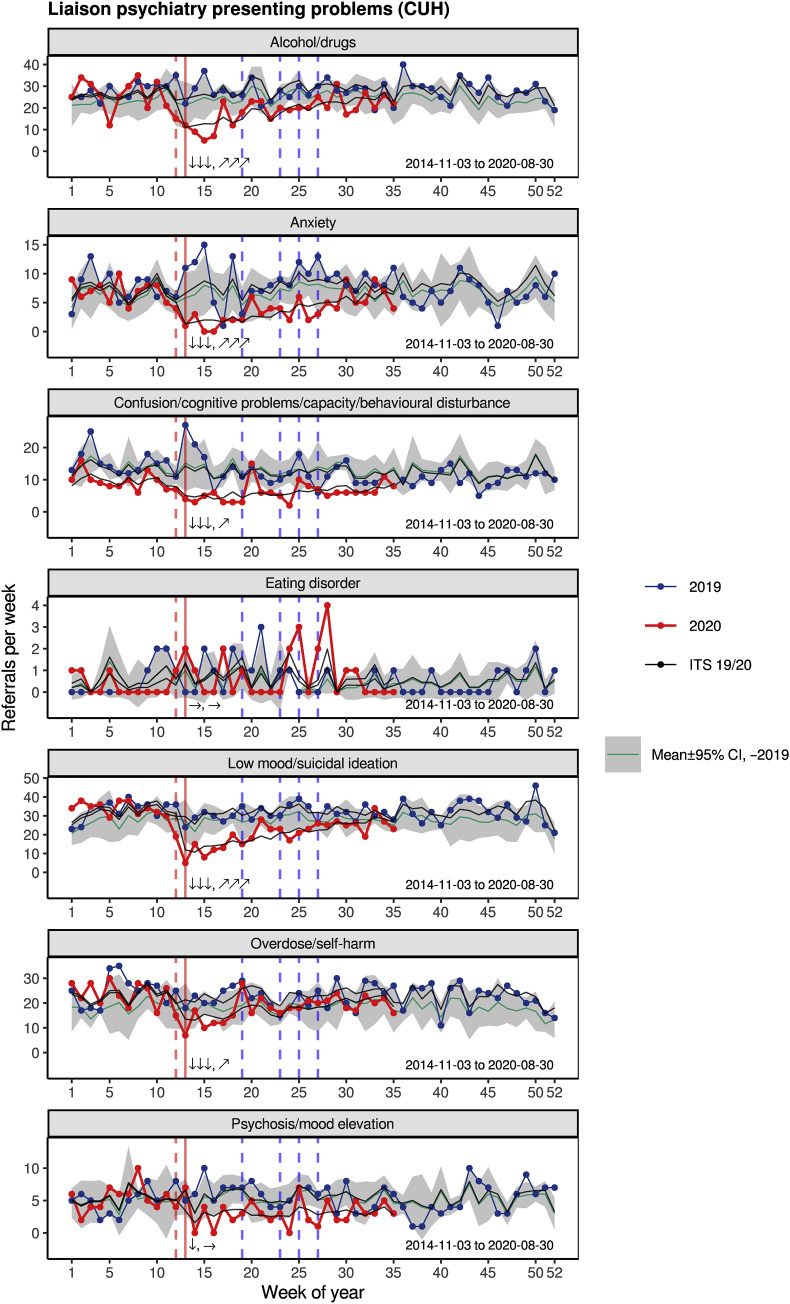
“Front door” mental health (MH) service activity. (A) Referrals to MH teams embedded in primary care. (B) Referrals (from professionals or patient self-referrals) to CPFT’s IAPT psychological therapy service. (C) Calls from patients to the NHS “111 option 2” mental health crisis telephone service. (D) Referrals to one of CPFT’s Liaison Psychiatry (LP) services, at CUH. (E) Referrals to secondary care MH teams, which may come from outside the Trust (e.g. from general practitioners to community/crisis/specialist teams, or from acute hospital staff to liaison psychiatry) or internally (e.g. from community teams to crisis teams or vice versa). Graphical conventions: The x axis shows week-of-year. The line and ribbon marked “Mean ± 95% CI …” indicate the mean and 95% confidence interval (CI), calculated separately for each week of the year, across all past years available to 2019 inclusive. Weekly data from 2019 to 2020 are shown individually. Vertical lines relate to 2020 and indicate UK social distancing then “lockdown” (red: 16 March, 23 March), followed by phases of “unlocking” in England (blue: 10 May, 1 June, 16 June, 4 July). The “ITS 19/20” lines show predictions from an interrupted time series (see Methods), fitted to data from all years and shown for 2019–2020. ITS effects of interest in relation to UK lockdown (solid vertical red line) are shown textually in the sequence “instantaneous effect, subsequent slope change”, with instantaneous effects shown as up/down arrows (two-tailed; increases ↑↑↑ p < 0·001, ↑↑ p < 0·01, ↑ p < 0·05; → no significant change; decreases ↓↓↓ p < 0·001, ↓↓ p < 0·01, ↓ p < 0·05) and subsequent changes in slope shown as sloping arrows (increases ↗↗↗ p < 0·001, ↗↗ p < 0·01, ↗ p < 0·05; → no significant change; decreases ↘↘↘ p < 0·001, ↘↘ p < 0·01, ↘ p < 0·05). The date range of available data is shown at the bottom of each figure. (For interpretation of the references to colour in this figure legend, the reader is referred to the Web version of this article.)
Fig. 2
Fig. 2
Presenting problems recorded at the time of first LP assessment at CUH. An individual referral may be associated with >1 problem (e.g. suicidal ideation plus overdose). Conventions as for Fig. 1.
Fig. 3
Fig. 3
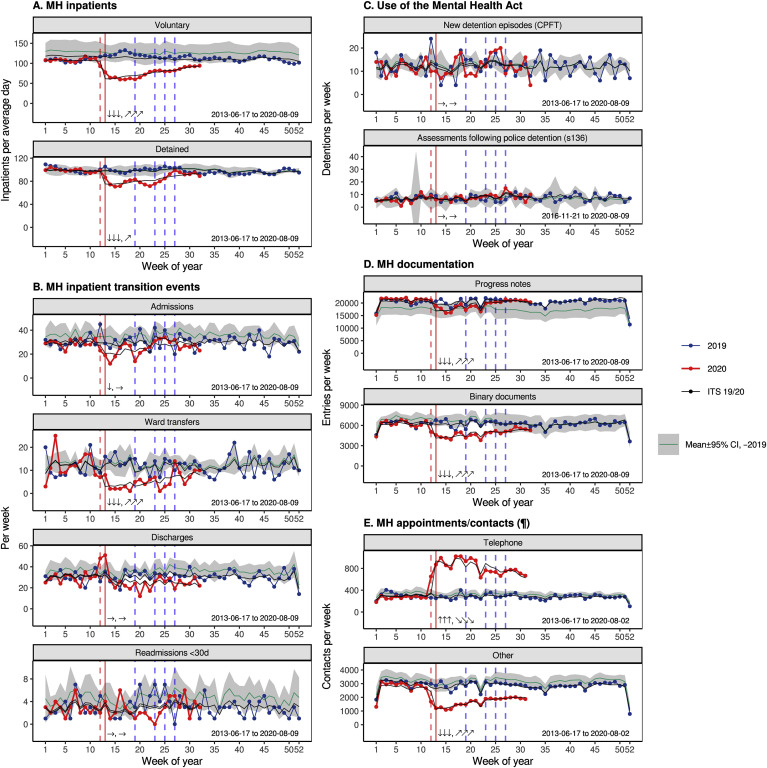
MH inpatient, Mental Health Act, and other service “activity” measures. (A) Number of inpatients on any given day (averaged over each week). (B) Admissions, ward transfers, discharges, and readmissions within 30 days. (C) New detention episodes under the MHA (any section) and assessments following police detention under s136. (D) Volume of documentation. Progress Notes are created by CPFT staff; binary documents may originate from CPFT staff or from others. (E) Booked appointments/contacts (not all contacts are thus recorded), split by telephone contact versus all other recorded kinds (e.g. first assessment, home visit). Conventions as for Fig. 1. (¶ Recent values may be underestimated due to recording lag, though data are truncated to allow for this; see Methods.)
Fig. 4
Fig. 4
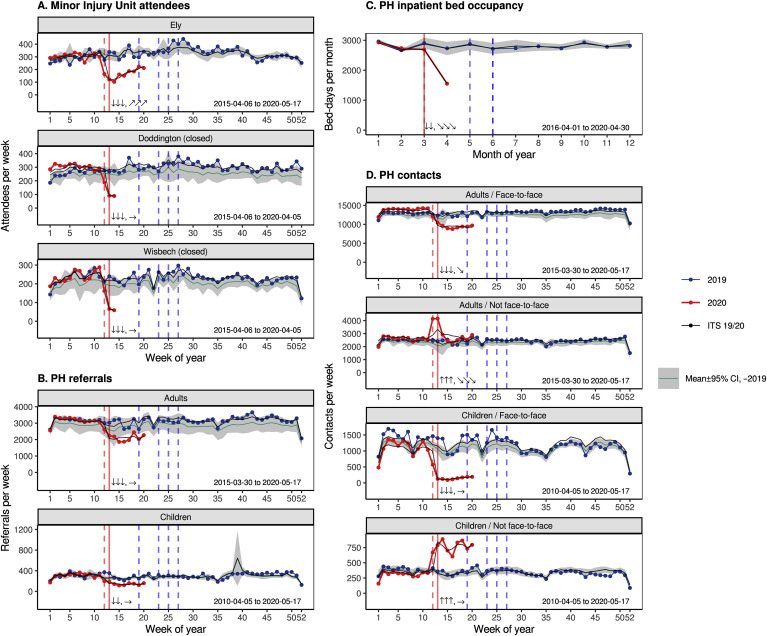
Physical health (PH) service activity. (A) Presentations to MIUs. Two units were closed while the other was expanded. (B) Referrals to PH services. (C) PH ward occupancy (as bed-days per month). The ITS was performed by month rather than week but was otherwise as for other analyses. (D) Recorded contacts, split by age group and whether the contacts were face-to-face or not. Conventions as for Fig. 1.
Fig. 5
Fig. 5
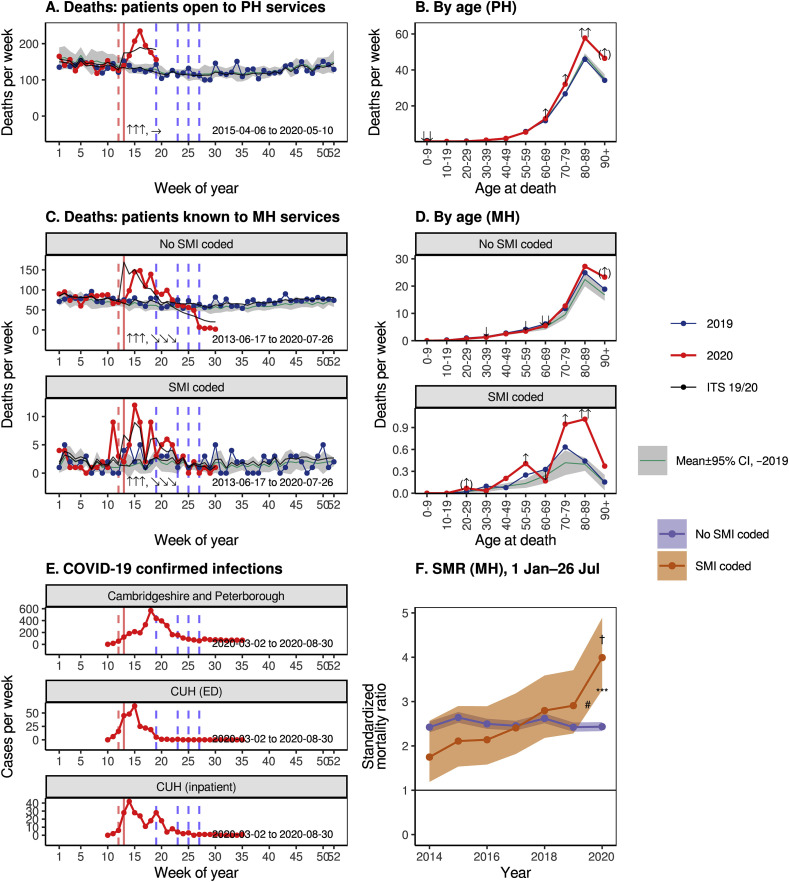
Confirmed COVID-19 cases for Cambridgeshire and Peterborough, and deaths of CPFT patients. Note that reporting of deaths is delayed, so recent data may be incomplete, but the data are truncated to allow for this (see Methods). (A) Deaths of patients with an open referral to PH services at the time of their death. (B) Deaths from A, by year and age band at death. Annotations show tests of the step change in 2020 from an ITS analysis within that age band (see Methods) [↑↑, ↓↓ indicate increases and decreases respectively with p < 0·01; ↑, ↓ p < 0·05; (↑), (↓) p < 0·1]. (C) Deaths of patients known to MH services, by previous presence of a coded diagnosis of an SMI. (D) Deaths from C, plotted as for B. (E) Confirmed COVID-19 cases for C&P as a whole and for CUH (ED and inpatients only). The C&P spike around week 17–18 is related to the expansion of population testing (see Supplementary Methods) (Mahase, 2020). (F) Age- and sex-standardized mortality ratios (SMRs, ±95% confidence interval) for patients known to MH services, split by the presence of a coded SMI diagnosis or not. SMRs increased from 2019 to 2020 for the SMI group (†p < 0·05). In 2020, the SMR was greater in the SMI group than the non-SMI group (differences for each year: ***p < 0·001). The increase in SMR from 2019 to 2020 was significantly greater in the SMI group than the non-SMI group (#p < 0·05 from ITS analysis; see Results). Note that SMRs are calculated for each year across dates available in 2020. This allows fair comparison with other years (given that deaths normally vary seasonally: compare A,C), though it may overestimate absolute SMRs slightly by comparing Jan–May CPFT figures with Jan–Dec population estimates. Conventions for A, C: as for Fig. 1.

References

    1. Banks J., Xu X. 2020. The mental health effects of the first two months of lockdown and social distancing during the Covid-19 pandemic in the UK. Published online June 10. - DOI
    1. Bernal J.L., Cummins S., Gasparrini A. Interrupted time series regression for the evaluation of public health interventions: a tutorial. Int. J. Epidemiol. 2017;46:348–355. - PMC - PubMed
    1. Dalgaard P. Second ed. Springer; 2008. Introductory Statistics with R.
    1. Garvin M.R., Alvarez C., Miller J.I. A mechanistic model and therapeutic interventions for COVID-19 involving a RAS-mediated bradykinin storm. eLife. 2020;9 doi: 10.7554/eLife.59177. - DOI - PMC - PubMed
    1. Gunnell D., Appleby L., Arensman E. Suicide risk and prevention during the COVID-19 pandemic. Lancet Psychiatr. 2020;7:468–471. - PMC - PubMed

Publication types

MeSH terms