


Testis Sparing Surgery in Pediatric Testicular Tumors
- PMID: 33036134
- PMCID: PMC7600997
- DOI: 10.3390/cancers12102867
Testis Sparing Surgery in Pediatric Testicular Tumors
Abstract
Objective: The purpose of this review is to evaluate the outcomes of testis sparing surgery (TSS) and to investigate under which circumstances TSS can be considered a safe treatment option in pediatric patients with testicular tumors.
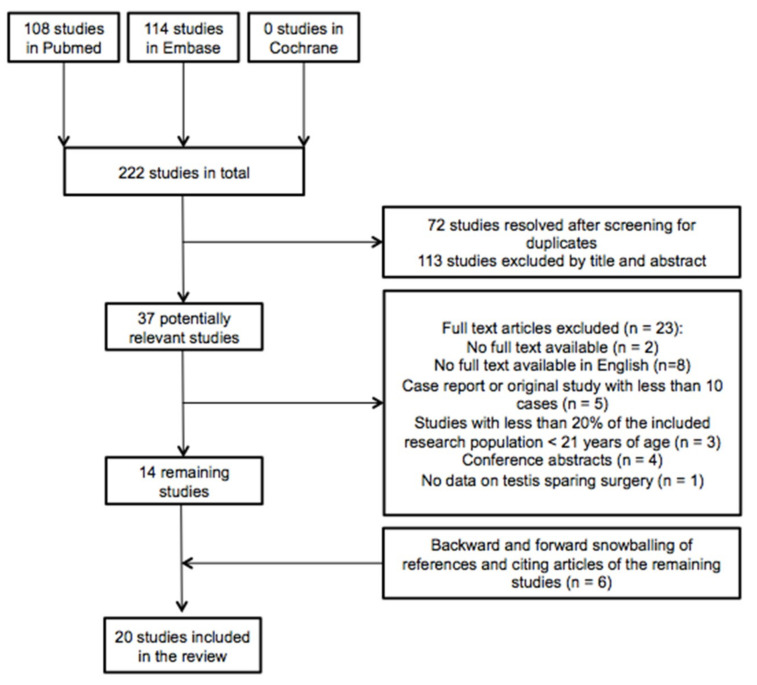
Methods: A database search was performed in Cochrane, Pubmed, and Embase for studies that focused on TSS as treatment for testicular tumors in the pediatric population, excluding reviews and single case reports.
Results: Twenty studies, describing the surgical treatment of 777 patients with testicular tumors, were included in the analysis. The majority of pediatric patients with benign germ cell tumors (GCTs) (mean age: 3.7 years) and sex cord-stromal tumors (SCSTs) (mean age: 6.6 years) were treated with TSS, 61.9% and 61.2%, respectively. No cases of testicular atrophy occurred. Four of the benign GCTs, i.e., three teratomas and one epidermoid cyst, recurred. No cases of recurrence were reported in patients with SCSTs. Of the 243 malignant GCTs (mean age: 4.2 years), only one patient had TSS (0.4%).
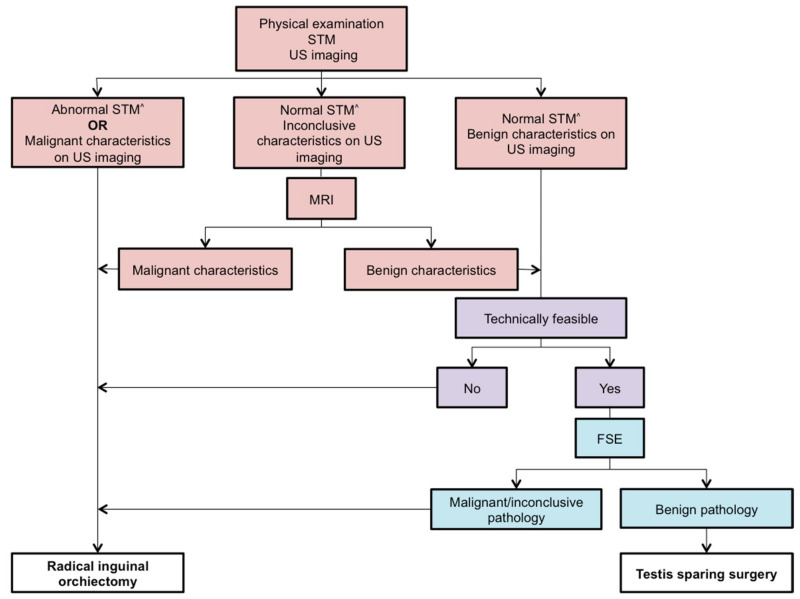
Conclusion: TSS is a safe treatment option for prepubertal patients less than 12 years of age with benign GCTs and low grade SCSTs.
Keywords: Testis sparing surgery; algorithm; germ cell tumor; pediatric; recurrence; testicular atrophy; testicular tumors.
Conflict of interest statement
The authors declare no conflict of interest.
Figures
References
-
- Looijenga L., Van der Kwast T.H., Grignon D., Egevad L., Kristiansen G., Kao C.S., Idrees M.T. Report From the International Society of Urological Pathology (ISUP) Consultation Conference on Molecular Pathology of Urogenital Cancers, IV: Current and Future Utilization of Molecular-Genetic Tests for Testicular Germ Cell Tumors. Am. J. Surg. Pathol. 2020;44:e66–e79. doi: 10.1097/PAS.0000000000001465. - DOI - PMC - PubMed
-
- Calaminus G., Schneider D.T., von Schweinitz D., Jürgens H., Infed N., Schönberger S., Olson T.A., Albers P., Vokuhl C., Stein R., et al. Age-Dependent Presentation and Clinical Course of 1465 Patients Aged 0 to Less than 18 Years with Ovarian or Testicular Germ Cell Tumors; Data of the MAKEI 96 Protocol Revisited in the Light of Prenatal Germ Cell Biology. Cancers. 2020;12:611. doi: 10.3390/cancers12030611. - DOI - PMC - PubMed
Publication types
LinkOut - more resources
Full Text Sources
