


Kineococcus vitellinus sp. nov., Kineococcus indalonis sp. nov. and Kineococcus siccus sp. nov., Isolated Nearby the Tabernas Desert (Almería, Spain)
- PMID: 33036385
- PMCID: PMC7601052
- DOI: 10.3390/microorganisms8101547
Kineococcus vitellinus sp. nov., Kineococcus indalonis sp. nov. and Kineococcus siccus sp. nov., Isolated Nearby the Tabernas Desert (Almería, Spain)
Abstract
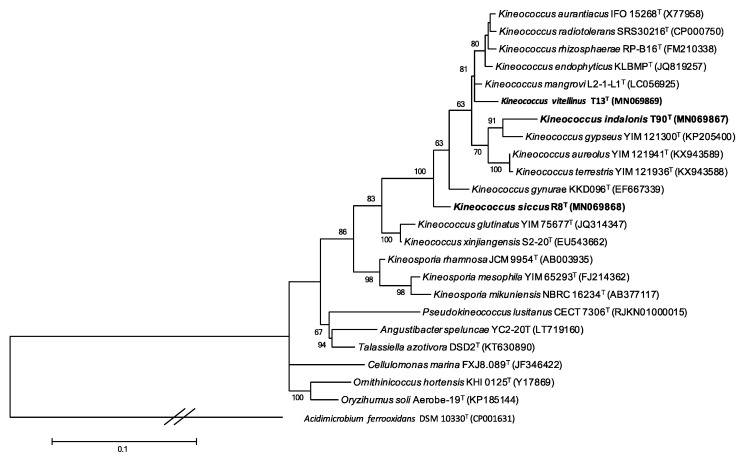
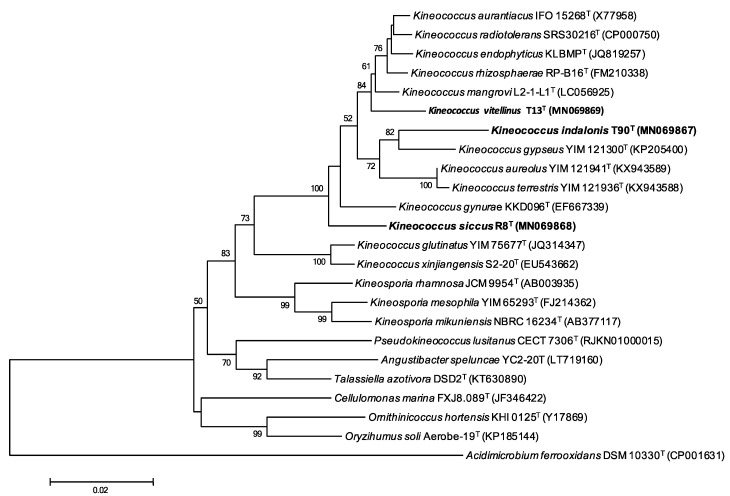
Three novel Gram-positive, aerobic, chemoheterotrophic, motile, non-endospore-forming, orange-pigmented bacteria designated strains T13T, T90T and R8T were isolated from the Tabernas Desert biocrust (Almería, Spain). Cells of the three strains were coccus-shaped and occurred singly, in pairs or clusters. The three strains were oxidase-negative and catalase-positive, and showed a mesophilic, neutrophilic and non-halophilic metabolism. Based on the 16S rRNA gene sequences, the closest neighbours of strains T13T, T90T and R8T were Kineococcus aurantiacus IFO 15268T, Kineococcus gypseus YIM 121300T and Kineococcus radiotolerans SRS 30216T (98.5%, 97.1% and 97.9% gene sequence similarity, respectively). The genomes were sequenced, and have been deposited in the GenBank/EMBL/DDBJ databases under the accession numbers JAAALL000000000, JAAALM000000000 and JAAALN000000000, respectively, for strains T13T, T90T and R8T. The average nucleotide identity (ANIb) and digital DNA-DNA hybridization (dDDH) values confirmed their adscription to three new species within the genus Kineococcus. The genomic G + C content of strains T13T, T90T and R8T ranged from 75.1% to 76.3%. The predominant fatty acid of all three strains was anteiso-C15:0. According to a polyphasic study, strains T13T, T90T and R8T are representatives of three new species in the genus Kineococcus, for which names Kineococcus vitellinus sp. nov. (type strain T13T = CECT 9936T = DSM 110024T), Kineococcus indalonis sp. nov. (type strain T90T = CECT 9938T = DSM 110026T) and Kineococcus siccus sp. nov. (type strain R8T = CECT 9937T = DSM 110025T) are proposed.
Keywords: Kineococcus indalonis; Kineococcus siccus; Kineococcus vitellinus; Tabernas Desert; biocrust; new taxa.
Conflict of interest statement
The authors declare no conflict of interest. The funders had no role in the design of the study; in the collection, analyses, or interpretation of data; in the writing of the manuscript; or in the decision to publish the results.
Figures
References
-
- Zhi X.Y., Li W.J., Stackebrandt E. An update of the structure and 16S rRNA gene sequence-based definition of higher ranks of the class Actinobacteria, with the proposal of two new suborders and four new families and emended descriptions of the existing higher taxa. Int. J. Syst. Evol. Microbiol. 2009;59:589–608. doi: 10.1099/ijs.0.65780-0. - DOI - PubMed
-
- Yokota A., Tamura T., Nishii T., Hasegawa T. Kineococcus aurantiacus gen. nov., sp. nov., a New Aerobic, Gram-Positive, Motile Coccus with meso-Diaminopimelic Acid and Arabinogalactan in the Cell Wall. Int. J. Syst. Bacteriol. 1993;43:52–57. doi: 10.1099/00207713-43-1-52. - DOI
Grants and funding
LinkOut - more resources
Full Text Sources
Molecular Biology Databases
