


Therapeutic Potential of Endothelial Colony-Forming Cells in Ischemic Disease: Strategies to Improve their Regenerative Efficacy
- PMID: 33036489
- PMCID: PMC7582994
- DOI: 10.3390/ijms21197406
Therapeutic Potential of Endothelial Colony-Forming Cells in Ischemic Disease: Strategies to Improve their Regenerative Efficacy
Abstract
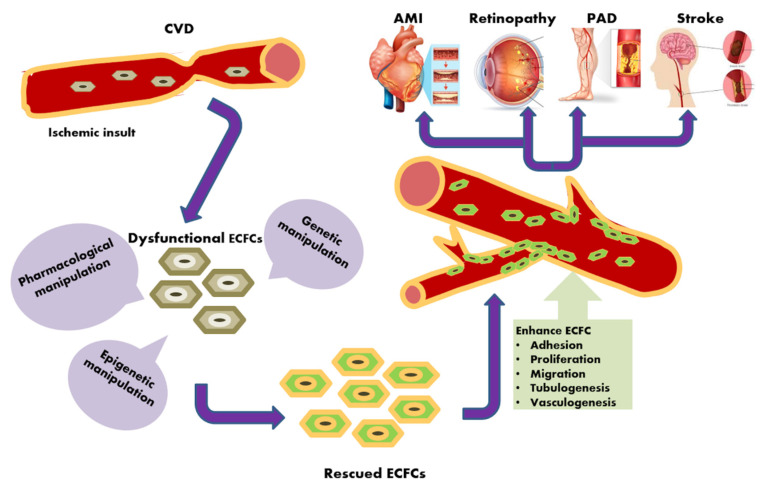
Cardiovascular disease (CVD) comprises a range of major clinical cardiac and circulatory diseases, which produce immense health and economic burdens worldwide. Currently, vascular regenerative surgery represents the most employed therapeutic option to treat ischemic disorders, even though not all the patients are amenable to surgical revascularization. Therefore, more efficient therapeutic approaches are urgently required to promote neovascularization. Therapeutic angiogenesis represents an emerging strategy that aims at reconstructing the damaged vascular network by stimulating local angiogenesis and/or promoting de novo blood vessel formation according to a process known as vasculogenesis. In turn, circulating endothelial colony-forming cells (ECFCs) represent truly endothelial precursors, which display high clonogenic potential and have the documented ability to originate de novo blood vessels in vivo. Therefore, ECFCs are regarded as the most promising cellular candidate to promote therapeutic angiogenesis in patients suffering from CVD. The current briefly summarizes the available information about the origin and characterization of ECFCs and then widely illustrates the preclinical studies that assessed their regenerative efficacy in a variety of ischemic disorders, including acute myocardial infarction, peripheral artery disease, ischemic brain disease, and retinopathy. Then, we describe the most common pharmacological, genetic, and epigenetic strategies employed to enhance the vasoreparative potential of autologous ECFCs by manipulating crucial pro-angiogenic signaling pathways, e.g., extracellular-signal regulated kinase/Akt, phosphoinositide 3-kinase, and Ca2+ signaling. We conclude by discussing the possibility of targeting circulating ECFCs to rescue their dysfunctional phenotype and promote neovascularization in the presence of CVD.
Keywords: cardiovascular disease; endothelial colony forming cells; genetic modification; ischemic disorders; pharmacological conditioning; signaling pathways; therapeutic angiogenesis.
Conflict of interest statement
The authors declare no conflict of interest.
Figures
References
-
- Benjamin E.J., Muntner P., Alonso A., Bittencourt M.S., Callaway C.W., Carson A.P., Chamberlain A.M., Chang A.R., Cheng S., Das S.R., et al. Heart Disease and Stroke Statistics-2019 Update: A Report From the American Heart Association. Circulation. 2019;139:e56–e528. doi: 10.1161/CIR.0000000000000659. - DOI - PubMed
Publication types
MeSH terms
Substances
Grants and funding
LinkOut - more resources
Full Text Sources
Miscellaneous
