. 2020 Oct 9;10(1):16934.
doi: 10.1038/s41598-020-73792-9.

MicroRNA-340-5p inhibits colon cancer cell migration via targeting of RhoA

Affiliations

MicroRNA-340-5p inhibits colon cancer cell migration via targeting of RhoA

Anwar Algaber et al. Sci Rep. .

Erratum in

Abstract

Colon cancer is the third most common cancer and a significant cause of cancer-related deaths worldwide. Metastasis is the most insidious aspect of cancer progression. Convincing data suggest that microRNAs (miRs) play a key function in colon cancer biology. We examined the role of miR-340-5p in regulating RhoA expression as well as cell migration and invasion in colon cancer cells. Levels of miR-340-5p and RhoA mRNA varied inversely in serum-free and serum-grown HT-29 and AZ-97 colon cancer cells. It was found transfection with miR-340-5p not only decreased expression of RhoA mRNA and protein levels in HT-29 cells but also reduced colon cancer cell migration and invasion. Bioinformatics analysis predicted one putative binding sites at the 3'-UTR of RhoA mRNA. Targeting this binding site with a specific blocker reversed mimic miR-340-5p-induced inhibition of RhoA activation and colon cancer cell migration and invasion. These novel results suggest that miR-340-5p is an important regulator of colon cancer cell motility via targeting of RhoA and further experiments are warranted to evaluate the role of miR-340-5p in colon cancer metastasis.


Conflict of interest statement

The authors declare no competing interests.

Figures

Figure 1
Figure 1
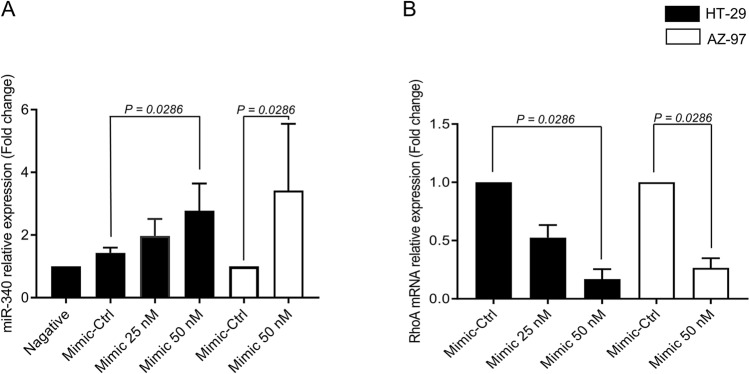
Gene expression of miR340-5p and RhoA in HT-29 and AZ-97 colon cancer cells lines. Expression of (A) miR-340-5p and (B) RhoA mRNAs and the housekeeping gene U6 were determined using qRT-PCR in serum-free and serum-grown HT-29 cells. Relative expressions were demonstrated using qRT-PCR where U6 was used as a housekeeping gene for mir-340-5p and beta-actin was used as a housekeeping gene for RhoA mRNA and expressions were determined using 2–ΔΔCT method. Data represent mean ± SEM and n = 4.
Figure 2
Figure 2
Mir-340-5p regulates RhoA mRNA expression in HT-29 and AZ-97 colon cancer cells. Transfection with Mimic-Ctrl (50 nM) or miR-40-5p mimic (25 nM and 50 nM) (A) upregulates miR-340-5p and (B) downregulates RhoA mRNA expression in colon cancer cells. Relative expressions were demonstrated using qRT-PCR where U6 was used as a housekeeping gene for mir-340-5p and beta-actin was used as a housekeeping gene for RhoA mRNA and expressions were determined using 2–ΔΔCT method. Data represents mean ± SEM and (n = 4).
Figure 3
Figure 3
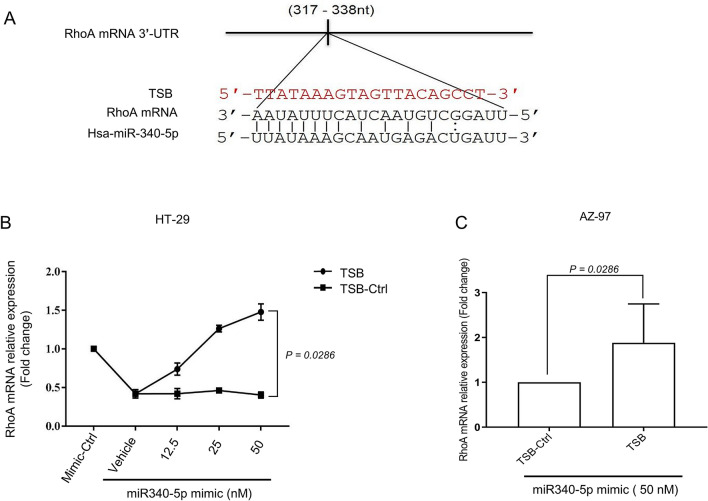
RhoA is a direct target of miR-340-5p. (A) Predicted target site of miR-340-5p in RhoA mRNA 3′-UTR sequence containing an (AAUAUUUC) motif. The seeding region of miR-340-5p complementary to (UUAUAAAG) was blocked using TSB (red sequence). (B) TSB dose-dependently reversed the inhibitory effect of miR-340-5p on RhoA mRNA expression in HT-29 colon cancer cells. (C) TSB dose-dependently reversed the inhibitory effect of miR-340-5p on RhoA mRNA expression in AZ-97 colon cancer cells. Data represent mean ± SEM and (n = 4).
Figure 4
Figure 4
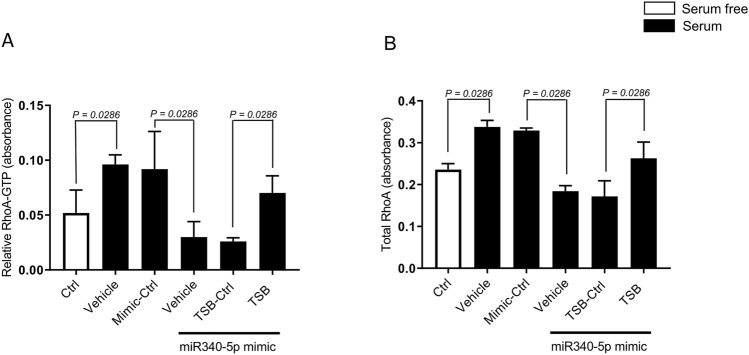
Mir-340-5p regulates colon cancer cell migration and RhoA activation. (A) RhoA-GTP activation was quantified using the G-LISA activation assay kit. (B) Total RhoA was measured by total RhoA assay kit. Cells were transfected with miR-340-5p mimic, mimic control, TSB control and TSB. Data represent mean ± SEM and n = 4.
Figure 5
Figure 5
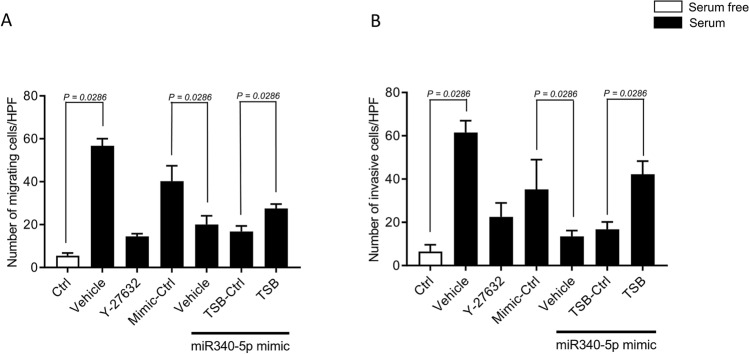
(A) Migration of colon cancer cells were stimulated by use of 10% FBS. Cells were counted microscopically using high power fields in five different fields. (B) Invasion of colon cancer cells were stimulated by use of 10% FBS. Cells were transfected with miR-340-5p mimic, mimic control, TSB control and TSB. In one group, cells were pre-incubated with the Rho kinase inhibitor Y-27632 (50 µM) for 30 min before loading into the inserts. Cells were counted microscopically using high power fields in five different fields. Data represent mean ± SEM and n = 4.

References

    1. Ferlay J, et al. Cancer incidence and mortality worldwide: sources, methods and major patterns in GLOBOCAN 2012. Int. J. Cancer. 2015;136:E359–386. doi: 10.1002/ijc.29210. - DOI - PubMed
    1. Valastyan S, Weinberg RA. Tumor metastasis: molecular insights and evolving paradigms. Cell. 2011;147:275–292. doi: 10.1016/j.cell.2011.09.024. - DOI - PMC - PubMed
    1. Xu L, et al. Screening and identification of significant genes related to tumor metastasis and PSMA in prostate cancer using microarray analysis. Oncol. Rep. 2013;30:1920–1928. doi: 10.3892/or.2013.2656. - DOI - PubMed
    1. Sit ST, Manser E. Rho GTPases and their role in organizing the actin cytoskeleton. J. Cell Sci. 2011;124:679–683. doi: 10.1242/jcs.064964. - DOI - PubMed
    1. Bozzuto G, Ruggieri P, Molinari A. Molecular aspects of tumor cell migration and invasion. Ann. Ist. Super Sanita. 2010;46:66–80. doi: 10.4415/ANN_10_01_09. - DOI - PubMed

Publication types