. 2021 Feb;87(2):173-184.
doi: 10.1007/s00280-020-04157-2. Epub 2020 Oct 11.

Cyclooxygenase activity mediates colorectal cancer cell resistance to the omega-3 polyunsaturated fatty acid eicosapentaenoic acid

Affiliations

Cyclooxygenase activity mediates colorectal cancer cell resistance to the omega-3 polyunsaturated fatty acid eicosapentaenoic acid

Milene Volpato et al. Cancer Chemother Pharmacol. 2021 Feb.

Erratum in

Abstract

Purpose: The naturally-occurring omega-3 polyunsaturated fatty acid eicosapentaenoic acid (EPA) is safe, well-tolerated and inexpensive, making it an attractive anti-cancer intervention. However, EPA has only modest anti-colorectal cancer (CRC) activity, when used alone. Both cyclooxygenase (COX) isoforms metabolise EPA and are over-expressed in CRC cells. We investigated whether COX inhibition increases the sensitivity of CRC cells to growth inhibition by EPA.

Methods: A panel of 18 human and mouse CRC cell lines was used to characterize the differential sensitivity of CRC cells to the growth inhibitory effects of EPA. The effect of CRISPR-Cas9 genetic deletion and pharmacological inhibition of COX-1 and COX-2 on the anti-cancer activity of EPA was determined using in vitro and in vivo models.

Results: Genetic ablation of both COX isoforms increased sensitivity of CT26 mouse CRC cells to growth inhibition by EPA in vitro and in vivo. The non-selective COX inhibitor aspirin and the selective COX-2 inhibitor celecoxib increased sensitivity of several human and mouse CRC cell lines to EPA in vitro. However, in a MC38 mouse CRC cell tumour model, with dosing that mirrored low-dose aspirin use in humans, thereby producing significant platelet COX-1 inhibition, there was ineffective intra-tumoral COX-2 inhibition by aspirin and no effect on EPA sensitivity of MC38 cell tumours.

Conclusion: Cyclooxygenase inhibition by non-steroidal anti-inflammatory drugs represents a therapeutic opportunity to augment the modest anti-CRC activity of EPA. However, intra-tumoral COX inhibition is likely to be critical for this drug-nutrient interaction and careful tissue pharmacodynamic profiling is required in subsequent pre-clinical and human studies.

Keywords: Aspirin; Cancer pharmacology; Celecoxib; Colorectal cancer; Cyclooxygenase; Drug metabolism; Eicosapentaenoic acid.


Conflict of interest statement

MAH has received honoraria from Bayer AG and SLA Pharma AG. MAH has previously received an unrestricted scientific grant from SLA Pharma AG unrelated to this work.

Figures
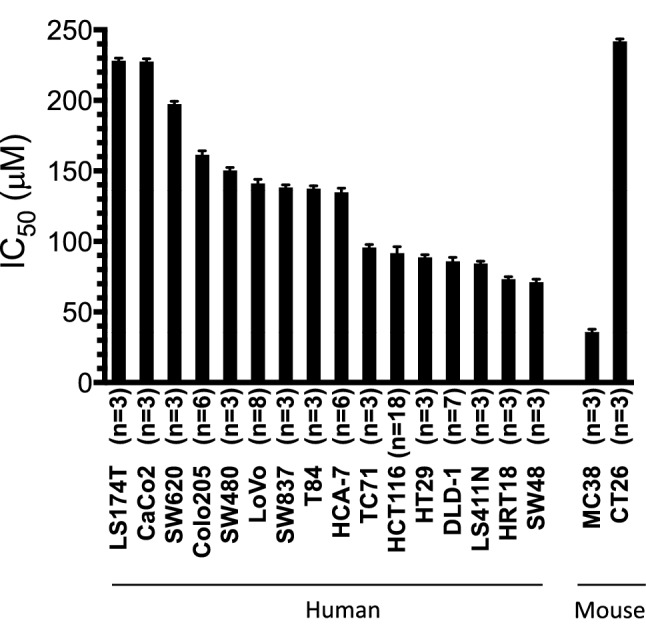
Fig. 1
Fig. 1
Colorectal cancer cell sensitivity to EPA in vitro. IC50 values for EPA after continuous exposure of human and mouse CRC cell lines to a range of EPA concentrations for 96 h. Data represent the mean ± SEM value for multiple independent replicates as indicated on the x axis. Human CRC cell lines are ordered according to decreasing mean IC50 value
Fig. 2
Fig. 2
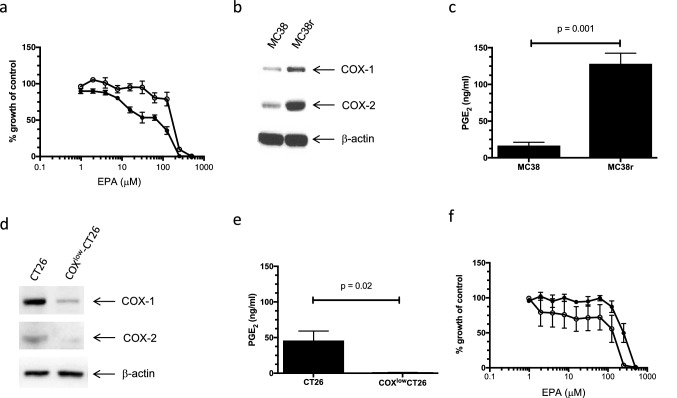
COX expression mediates EPA sensitivity of CRC cells in vitro. a MTT cell viability assay curves for the effect of EPA on MC38 (closed circles) and MC38r mouse CRC cells (open circles). Data represent the mean ± SEM % growth compared to untreated control cells for three independent replicates for each mouse CRC cell line. b Western blot analysis of COX isoform protein expression in MC38 and MC38r mouse CRC cells. c PGE2 levels in medium conditioned by MC38 and MC38r cells for 24 h. Data compared with Student’s t test. d Western blot analysis of COX isoform protein expression in CT26 and COXlow-CT26 mouse CRC cells. e PGE2 levels in medium conditioned by CT26 and COXlow-CT26 mouse CRC cells for 24 h. Data compared with Student’s t test. f MTT cell viability assay curves for the effect of EPA on CT26 (closed circles) and COXlow-CT26 mouse CRC cells (open circles). Data represent the mean ± SEM % growth compared to untreated control cells for three independent replicates for each mouse CRC cell line. Two-way ANOVA confirmed a significant increase in EPA sensitivity of COXlow-CT26 cells compared with CT26 mouse CRC cells (p = 0.03)
Fig. 3
Fig. 3
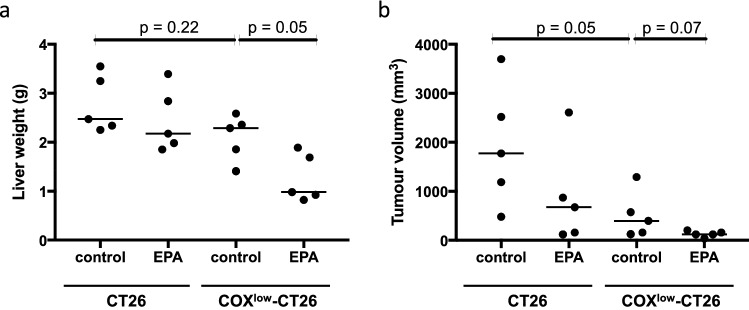
Reduced COX expression increases the sensitivity of mouse CT26 CRC cell tumours to EPA in vivo. a CT26 and COXlow-CT26 cell liver metastases in BALB/c mice. The horizontal line indicates the median liver weight at a sacrifice in each group. The reference normal liver weight of female BALB/c mice is 0.99 g (https://www.jax.org/). b Subcutaneous CT26 and COXlow-CT26 cell tumours in CD1 Nude mice receiving either control or EPA-containing diet (n = 5 per group). The horizontal line indicates the median tumour volume at a sacrifice in each group. Statistical significance was tested with the Mann–Whitney U test
Fig. 4
Fig. 4
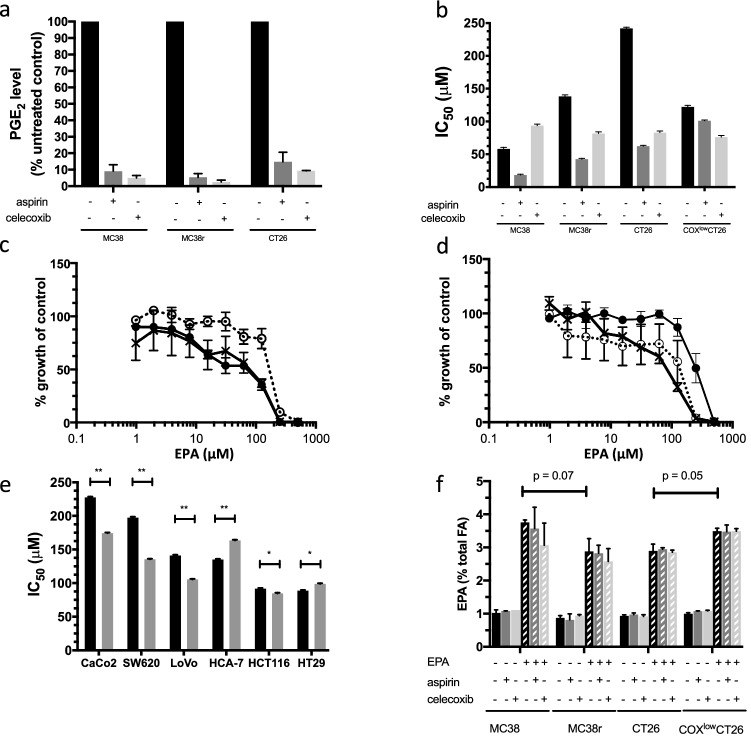
Aspirin increases EPA sensitivity of CRC cells in vitro. a PGE2 synthesis by mouse CRC cells in the presence or absence of aspirin (500 µM) or celecoxib (0.5 µM). Data represent the mean ± SEM % PGE2 level of three independent replicates compared with control cells. b Mouse CRC cell sensitivity to EPA in the presence or absence of aspirin (500 µM) or celecoxib (0.5 µM). Data represent the mean ± SEM IC50 values for three independent replicates. The differences in IC50 values for the combination treatments compared with EPA alone were statistically significant (Student’s t test p < 0.01). c Concentration–response relationship with EPA for MC38 (closed circles), MC38r (open circles) and aspirin-treated MC38r cells (crosses). Data are expressed as the mean ± SEM % growth compared with untreated control cells for three independent experiments. d Concentration–response relationship with EPA for CT26 cells (closed circles), COXlow-CT26 cells (open circles) and aspirin-treated CT26 cells (crosses). Data are expressed as the mean ± SEM % growth compared to untreated control cells for 3 independent experiments. e Response to EPA of human CRC cell lines in the presence or absence of aspirin (500 µM). Data represent the mean ± SEM IC50 value for 3 independent replicates. The differences in IC50 values for the combination treatments compared with EPA alone were all statistically significant (Student’s t test p < 0.05). f EPA content (expressed as the % total fatty acids) of mouse CRC cells with or without the addition of 5 µM EPA to the culture medium, in the presence or absence of either aspirin (500 µM) or celecoxib (0.5 µM). Data represent the mean + SEM % EPA level of 3 independent replicates. In the absence of an error bar, data represent n = 1 as other samples failed analysis for technical reasons
Fig. 5
Fig. 5
Aspirin treatment does not improve MC38 CRC cell tumour response to EPA in a mouse model that mimics low-dose aspirin use in humans. a Effect of oral aspirin dosing on levels of the urinary metabolites 11-dehydro-TXB2 and 6-keto-PGF in CD1 Nude mice with MC38 cell (black circles) or MC38r cell (grey circles) tumours. Urine was not obtained from all animals. The horizontal line indicates the median value for each group. Statistical significance was tested using the Mann–Whitney U test. b MC38 cell and c MC38r cell tumour volume in CD1 Nude mice receiving diets containing either EPA-TG (6.1%), aspirin (600 ppm), or a combination of EPA and aspirin, or control diet (n = 14 per group). The line indicates the median value for each group. Statistical significance was tested using the Mann–Whitney U test. d MC38 cell and e MC38r cell tumour PGE2 levels in animals fed either control or aspirin-containing diet. The line indicates the median value for each group. f COX-1 and COX-2 protein expression measured by immunohistochemistry in MC38 and MC38r tumours. The bars delineate the range of IHC scores obtained within a group and the bold line indicates the median score for each group
Fig. 6
Fig. 6
Effect of EPA and aspirin on human CRC cell tumour growth in vivo. a SW620 and b HCA-7 human CRC cells were grown as subcutaneous tumours in CD1 Nude mice provided with a control diet or a diet containing either EPA (6.1%), aspirin (600 ppm) or a combination of EPA and aspirin (n = 5 per group). The line indicates the median tumour volume for each group

References

    1. Lai HT, de Oliveira Otto MC, Lemaitre RN, McKnight B, Song X, King IB, Chaves PH, Odden MC, Newman AB, Siscovick DS, Mozaffarian D. Serial circulating omega 3 polyunsaturated fatty acids and healthy ageing among older adults in the Cardiovascular Health Study: prospective cohort study. BMJ. 2018;363:k4067. doi: 10.1136/bmj.k4067. - DOI - PMC - PubMed
    1. Keaney JF, Rosen CJ. VITAL signs for dietary supplementation to prevent cancer and heart disease. New Engl J Med. 2019;380(1):91–93. doi: 10.1056/NEJMe1814933. - DOI - PubMed
    1. Im DS. Omega-3 fatty acids in anti-inflammation (pro-resolution) and GPCRs. Prog Lipid Res. 2012;51(3):232–237. doi: 10.1016/j.plipres.2012.02.003. - DOI - PubMed
    1. Bhatt DL, Steg PG, Miller M, Brinton EA, Jacobson TA, Ketchum SB, Doyle RT, Jr, Juliano RA, Jiao L, Granowitz C, Tardif JC, Ballantyne CM, Investigators R-I. Cardiovascular risk reduction with icosapent ethyl for hypertriglyceridemia. N Engl J Med. 2019;380(1):11–22. doi: 10.1056/NEJMoa1812792. - DOI - PubMed
    1. West NJ, Clark SK, Phillips RK, Hutchinson JM, Leicester RJ, Belluzzi A, Hull MA. Eicosapentaenoic acid reduces rectal polyp number and size in familial adenomatous polyposis. Gut. 2010;59(7):918–925. doi: 10.1136/gut.2009.200642. - DOI - PubMed

Publication types

MeSH terms