


Phonological Awareness Trajectories: Young Spanish-English and Cantonese-English Bilinguals
- PMID: 33041372
- PMCID: PMC7546416
- DOI: 10.1111/lang.12352
Phonological Awareness Trajectories: Young Spanish-English and Cantonese-English Bilinguals
Abstract
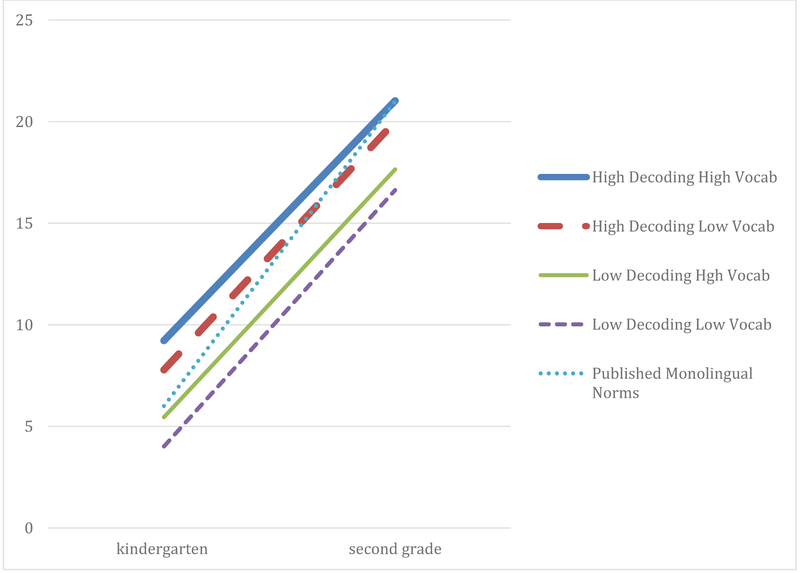
This study focused on the phonological awareness skills of 72 Spanish-English and 86 Cantonese-English bilinguals, all enrolled in bilingual and mainstream classrooms in the same schools. Bilinguals were assessed on phonological awareness, decoding, vocabulary, and knowledge of book reading each year from kindergarten until second grade. Individual growth modeling analysis revealed no difference in growth trajectories of English phonological awareness between (a) Spanish-English and Cantonese-English bilinguals and (b) children enrolled in bilingual and mainstream programs. Within-language decoding, vocabulary, and knowledge of book reading were associated with the estimated average initial levels of phonological awareness skills, while only knowledge of book reading had significant effects on the estimated growth trajectory of phonological awareness skills. These findings suggest that young bilinguals with different home languages may have similar growth trajectories in English phonological awareness skills during early elementary school years. The findings have implications for early educational practices.
Keywords: bilingual; children; language development; longitudinal; phonological awareness.
Figures

References
-
- Anthony JL, Lonigan CJ, Driscoll K, Phillips BM, & Burgess SR (2003). Phonological sensitivity: A quasi-parallel progression of word structure units and cognitive operations. Reading Research Quarterly, 38, 470–487. 10.1598/RRQ.38.4.3 - DOI
-
- Bialystok E, Luk G, & Kwan E (2005). Bilingualism, biliteracy, and learning to read: Interactions among languages and writing systems. Scientific Studies of Reading, 9, 43–61. 10.1207/s1532799xssr0901_4 - DOI
-
- Bialystok E, Majumder S, & Martin MM (2003). Developing phonological awareness: Is there a bilingual advantage? Applied Psycholinguistics, 24, 27–44. 10.1017/S014271640300002X - DOI
-
- Branum-Martin L, Tao S, Garnaat S, Bunta F, & Francis DJ (2012). Meta-analysis of bilingual phonological awareness: Language, age, and psycholinguistic grain size. Journal of Educational Psychology, 104, 932–944. 10.1037/a0027755 - DOI