


Mobility in Older Community-Dwelling Persons: A Narrative Review
- PMID: 33041836
- PMCID: PMC7522521
- DOI: 10.3389/fphys.2020.00881
Mobility in Older Community-Dwelling Persons: A Narrative Review
Abstract
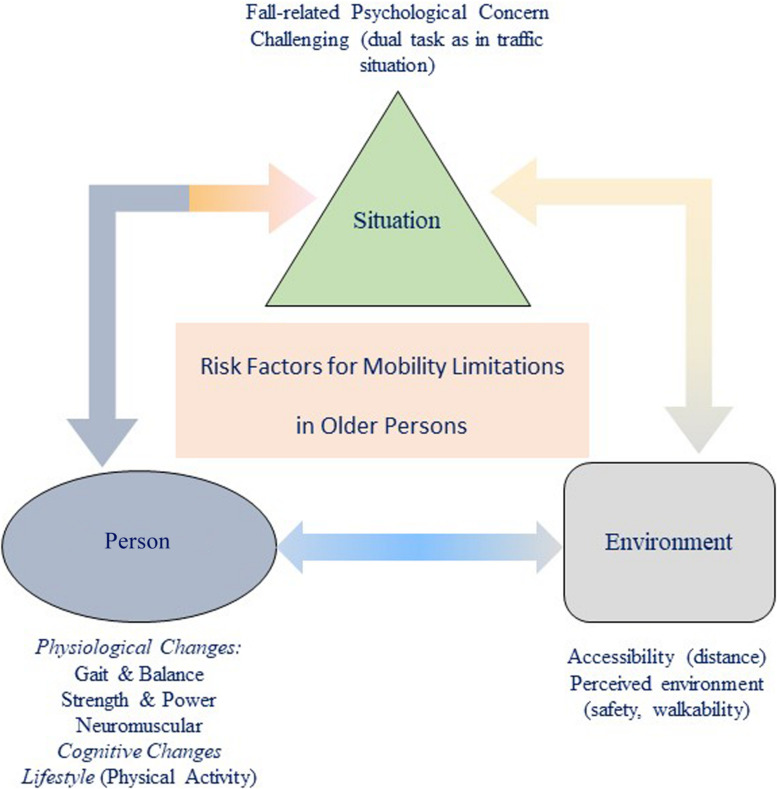
Due to the demographic changes and the increasing awareness of the role of physical function, mobility in older age is becoming an important topic. Mobility limitations have been reported as increasingly prevalent in older persons affecting about 35% of persons aged 70 and the majority of persons over 85 years. Mobility limitations have been associated with increased fall risk, hospitalization, a decreased quality of life, and even mortality. As concepts of mobility are multifactorial and complex, in this narrative review, definitions, physical factors, and their age-related changes associated with mobility will be presented. Also, areas of cognitive decline and their impact on mobility, as well as neuromuscular factors related to mobility will be addressed. Another section will relate psychological factors such as Fall-related psychological concerns and sedentary behavior to mobility. Assessment of mobility as well as effective exercise interventions are only shortly addressed. In the last part, gaps and future work on mobility in older persons are discussed.
Keywords: community-dwelling; gait; mobility; narrative review; older person; risk factors.
Copyright © 2020 Freiberger, Sieber and Kob.
Figures

References
-
- Ahmed T., French S. D., Belanger E., Guerra R. O., Zunzunegui M. V., Auais M. (2019). Gender Differences in Trajectories of Lower Extremity Function in Older Adults: Findings From the International Mobility in Aging Study. J. Am. Med. Dir. Assoc. 20 1199.e–1205.e. - PubMed
-
- Auais M., Alvarado B. E., Curcio C. L., Garcia A., Ylli A., Deshpande N. (2016). Fear of falling as a risk factor of mobility disability in older people at five diverse sites of the IMIAS study. Arch. Gerontol. Geriatr. 66 147–153. - PubMed
-
- Bean J. F., Leveille S. G., Kiely D. K., Bandinelli S., Guralnik J. M., Ferrucci L. (2003). A Comparison of Leg Power and Leg Strength Within the InCHIANTI Study: Which Influences Mobility More? J. Gerontol. A Biol. Sci. Med, Sci. 58 728–733. - PubMed
Publication types
LinkOut - more resources
Full Text Sources
