


Heart Rate Variability and Exceptional Longevity
- PMID: 33041862
- PMCID: PMC7527628
- DOI: 10.3389/fphys.2020.566399
Heart Rate Variability and Exceptional Longevity
Abstract
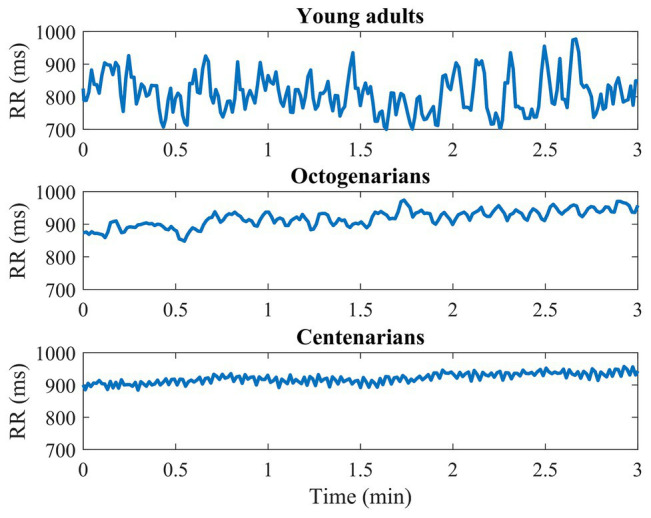
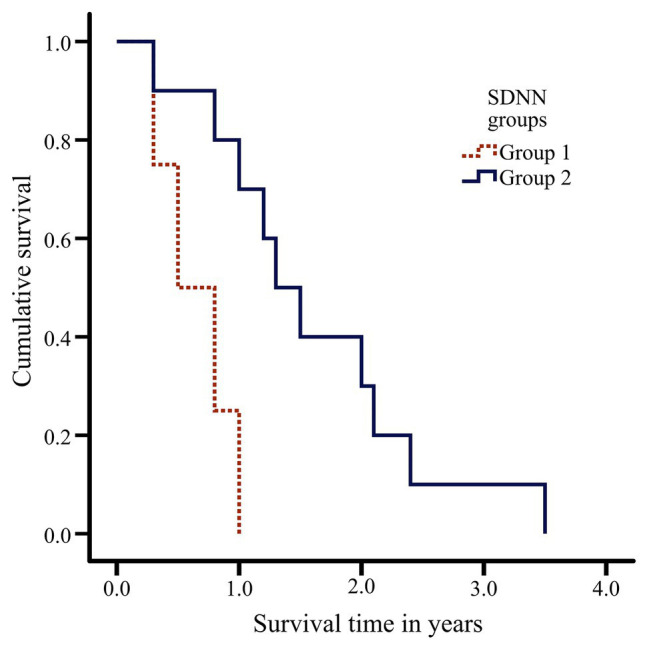
Centenarians are the paradigm of human extreme longevity and healthy aging, because they have postponed, if not avoided, mayor age-related diseases. The purpose of this study was to investigate potential differences in resting heart rate variability (HRV) between young adults, octogenarians, and centenarians and assess whether HRV variables are predictors of all-cause mortality in centenarians. To this end, three groups of participants: young adults (N = 20; 20.6 ± 2.3 years), octogenarians (N = 18; 84.1 ± 2.6 years), and centenarians (N = 17; 101.9 ± 1.9 years) were monitored for 15 min at rest (seated, without moving or talking) to measure RR intervals, from which HRV was evaluated. Our results showed a clear decrease with age in the main parasympathetic HRV variables, as well as in the standard deviation (SD) of the RR series [SD of normal-to-normal interval (SDNN)] and in low frequency (LF) heart rate (HR) oscillations, although differences between octogenarians and centenarians did not reach statistical significance. In 14 centenarians followed until death, only SDNN showed significant correlation (ρ = 0.536; p = 0.048) with survival prognosis. Additionally, SDNN <19 ms was associated with early mortality (≤1 year) in centenarians (Hazard Ratio = 5.72). In conclusion, HRV indices reflecting parasympathetic outflow as well as SDNN and LF all present an age-related reduction, which could be representative of a natural exhaustion of allostatic systems related to age. Moreover, low SDNN values (<19 ms) could be associated with early mortality in centenarians. HRV seems to play a role in exceptional longevity, which could be accounted for by centenarians' exposome.
Keywords: aging; autonomic nervous system; centenarians; electrocardiography; heart rate; heart rate variability; mortality; parasympathetic nervous system.
Copyright © 2020 Hernández-Vicente, Hernando, Santos-Lozano, Rodríguez-Romo, Vicente-Rodríguez, Pueyo, Bailón and Garatachea.
Figures
References
-
- Bailón R., Laguna P., Mainardi L., Sörnmo L. (2007). “Analysis of heart rate variability using time-varying frequency bands based on respiratory frequency.” in Annual International Conference of the IEEE Engineering in Medicine and Biology – Proceedings. August 22-26, 2007; 6675–6678. - PubMed
-
- Bailón R., Laouini G., Grao C., Orini M., Laguna P., Meste O. (2011). The integral pulse frequency modulation model with time-varying threshold: application to heart rate variability analysis during exercise stress testing. IEEE Trans. Biomed. Eng. 58, 642–652. 10.1109/TBME.2010.2095011, PMID: - DOI - PubMed
LinkOut - more resources
Full Text Sources
