


Influence of Air Quality on Pro-environmental Behavior of Chinese Residents: From the Perspective of Spatial Distance
- PMID: 33041930
- PMCID: PMC7522328
- DOI: 10.3389/fpsyg.2020.566046
Influence of Air Quality on Pro-environmental Behavior of Chinese Residents: From the Perspective of Spatial Distance
Abstract
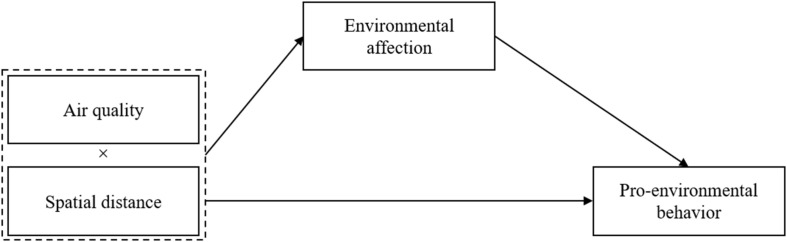
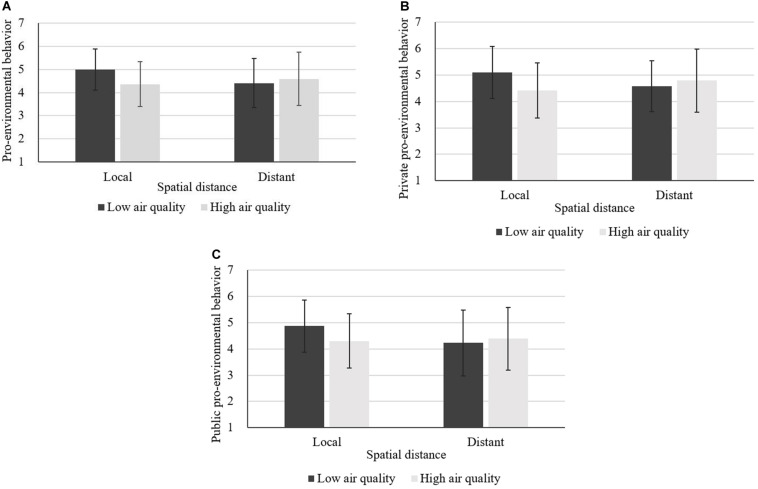
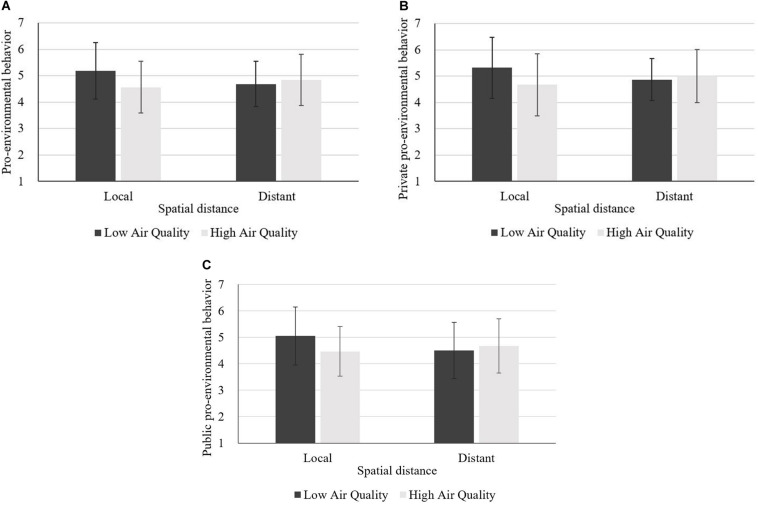
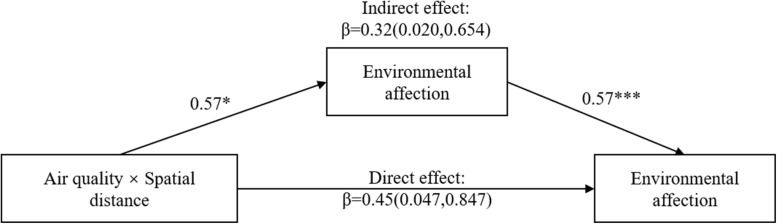
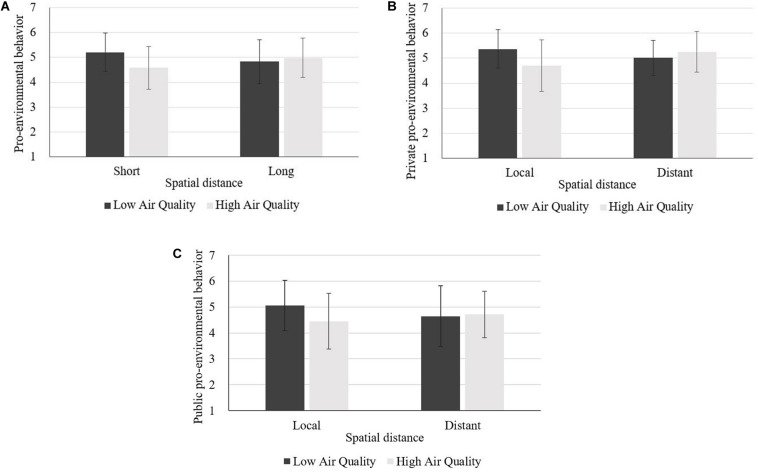
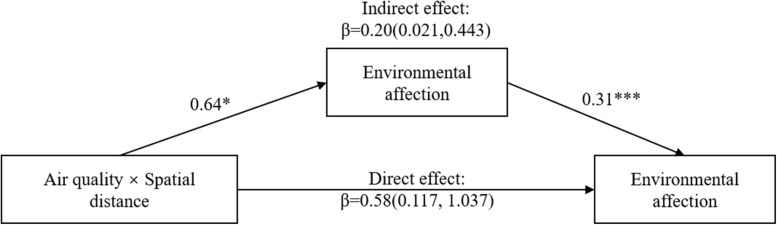
Although environmental issues have attracted public attention, there are still many people unwilling to make behavioral changes to solve the problem, which makes promoting pro-environmental behavior become an interesting research topic. This study discusses the influence of air quality on the pro-environmental behavior of Chinese residents from the perspective of spatial distance, providing a theoretical basis and practical application for improving pro-environmental behavior. Through three experiments, this study reveals that air pollution within the local spatial distance could make residents more willing to conduct pro-environmental behavior. In addition, we also find that air pollution within local spatial distance would stimulate residents' environmental affection and promote them to conduct pro-environmental behavior. That is, environmental affection plays a mediating role in the interactive effect of air quality and spatial distance on pro-environmental behavior.
Keywords: Chinese residents; air quality; environmental affection; pro-environmental behavior; spatial distance.
Copyright © 2020 Sheng, Dai and Pan.
Figures
References
-
- Agarwal J., Malhotra N. K. (2005). An integrated model of attitude and affect: theoretical foundation and an empirical investigation. J. Bus. Res. 58 483–493. 10.1016/s0148-2963(03)00138-3 - DOI
-
- Ajzen I. (1991). The theory of planned behavior. Organ. Behav. Hum. Decis. Process. 50 179–211. 10.1016/0749-5978(91)90020-T - DOI
-
- Barbaro N., Pickett S. M. (2016). Mindfully green: examining the effect of connectedness to nature on the relationship between mindfulness and engagement in pro-environmental behavior. Pers. Individ. Dif. 93 137–142. 10.1016/j.paid.2015.05.026 - DOI
-
- Bissing-Olson M. J., Fielding K. S., Iyer A. (2016). Experiences of pride, not guilt, predict pro-environmental behavior when pro-environmental descriptive norms are more positive. J. Environ. Psychol. 45 145–153. 10.1016/j.jenvp.2016.01.001 - DOI
LinkOut - more resources
Full Text Sources
