Review
. 2020 Sep 16:11:573032.
doi: 10.3389/fendo.2020.573032. eCollection 2020.

Cellular Senescence as the Pathogenic Hub of Diabetes-Related Wound Chronicity

Affiliations
Review

Cellular Senescence as the Pathogenic Hub of Diabetes-Related Wound Chronicity

Jorge A Berlanga-Acosta et al. Front Endocrinol (Lausanne). .

Abstract

Diabetes is constantly increasing at a rate that outpaces genetic variation and approaches to pandemic magnitude. Skin cells physiology and the cutaneous healing response are progressively undermined in diabetes which predisposes to lower limb ulceration, recidivism, and subsequent lower extremities amputation as a frightened complication. The molecular operators whereby diabetes reduces tissues resilience and hampers the repair mechanisms remain elusive. We have accrued the notion that diabetic environment embraces preconditioning factors that definitively propel premature cellular senescence, and that ulcer cells senescence impair the healing response. Hyperglycemia/oxidative stress/mitochondrial and DNA damage may act as major drivers sculpturing the senescent phenotype. We review here historical and recent evidences that substantiate the hypothesis that diabetic foot ulcers healing trajectory, is definitively impinged by a self-expanding and self-perpetuative senescent cells society that drives wound chronicity. This society may be fostered by a diabetic archetypal secretome that induces replicative senescence in dermal fibroblasts, endothelial cells, and keratinocytes. Mesenchymal stem cells are also susceptible to major diabetic senescence drivers, which accounts for the inability of these cells to appropriately assist in diabetics wound healing. Thus, the use of autologous stem cells has not translated in significant clinical outcomes. Novel and multifaceted therapeutic approaches are required to pharmacologically mitigate the diabetic cellular senescence operators and reduce the secondary multi-organs complications. The senescent cells society and its adjunctive secretome could be an ideal local target to manipulate diabetic ulcers and prevent wound chronification and acute recidivism. This futuristic goal demands harnessing the diabetic wound chronicity epigenomic signature.

Keywords: aging; chronic wounds; diabetic ulcers; proliferative senescence; senescence.


Figures

Figure 1
Figure 1
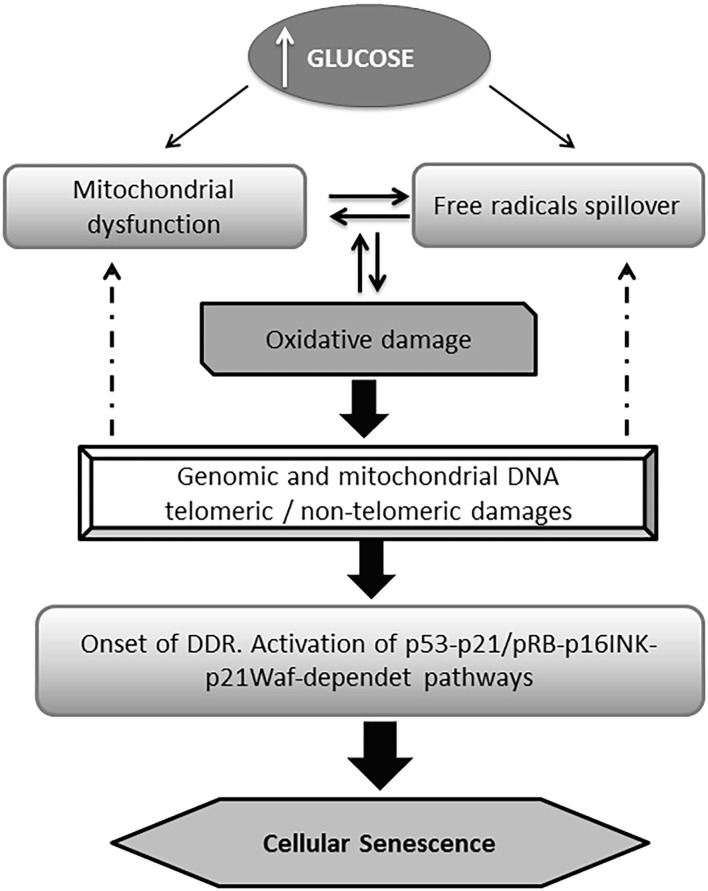
General pathway of glucose-induced senescence. Multiple evidences converge to indicate that high glucose drives premature senescence acting as a proximal trigger for a myriad of subsequent biochemical derangements. Hyperglycemia is ensued by an excessive mitochondrial production of reactive oxygen species (ROS) which in turn generates the typical pro-oxidative environment of diabetes. Alike, mitochondrial dysfunction derives from the ROS-mediated attack to its DNA, and the structural damage to respiratory chain proteins which generates a destructive vicious circuitry. Senescent burden can be multiplied in neighboring cells via the local oxidative milieu. The DNA chemical damage (telomeric and non-telomeric) induced by the impact of ROS is followed by the activation of the DNA damage responses (DDR) pathway; which in turn activates the p53 and/or the p16INK4A pathways. The later facilitates the accumulation of phosphorylated pRb eventually accounting for cell senescence program orchestration.
Figure 2
Figure 2
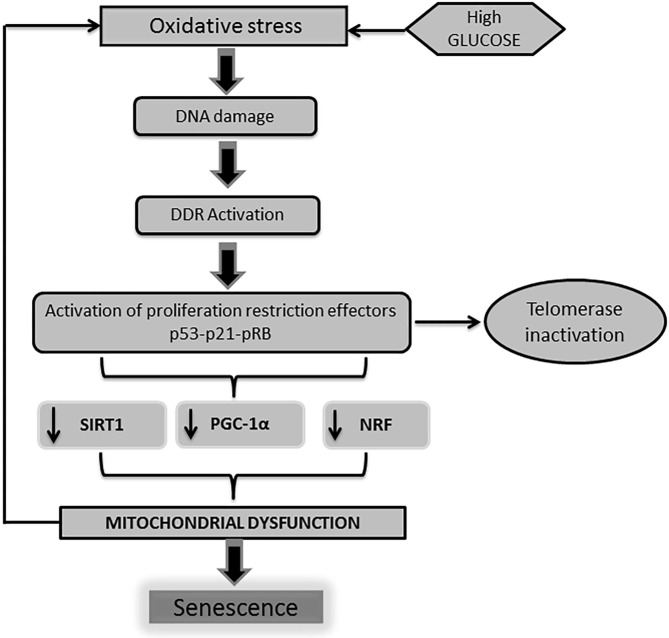
DNA damage is linked to mitochondrial physiology. As described earlier, high glucose levels trigger a cascade of events leading to the activation of professional inhibitors of cell cycle proliferation as p53-p21-pRB. The activation of p53 by DNA damage response (DDR) impacts on mitochondrial physiology and energy metabolism. Telomeric shortening negatively influences mitochondrial homeostasis. This mitochondrial failure mostly derives from the p53-mediated repression of peroxisome proliferator-activated receptor gamma co-activator 1α/β gene (PGC-1α/β) expression. Of note, PGC-1 is largely involved in mitochondrial biogenesis and function, including oxidative phosphorylation and reactive oxygen species (ROS) detoxification. Along with PGC-1 activity abrogation, other mitochondrial biogenesis regulators as nuclear respiratory factor (NRF) and SIRT-1 are also impaired. Here again, pathogenic vicious circles are established leading and amplification of cells senescence as a final outcome.
Figure 3
Figure 3
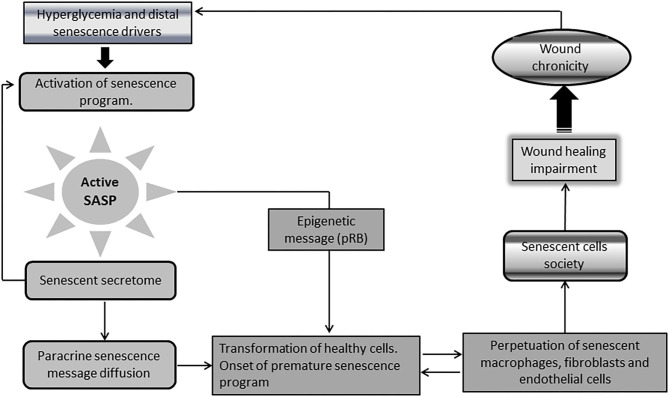
Chronic wounds and the society of senescent cells. A singular and distinctive marker for senescence cells is the onset of a pro-inflammatory program identified as senescence-associated secretory phenotype (SASP). Diabetic senescent cells SASP are typically endowed with inflammatory effectors and matrix degradative enzymes. The paracrine release of this secretome accounts for the diffusion of a progeroid message and ultimately engenders a threshold of senescent cells within the wound via transformation of normal neighbor cells into senescent cells. SASP also spread the epigenetic signature ingredients of senescence which further contributes to expand and perpetuate the so called “senescence cells society” Accordingly, irreversibility of senescence is largely dependent upon pRB epigenetic events. It is therefore plausible that epigenetic mechanisms contribute to shape a long-lasting epigenetic memory for SASP, and the perdurability of the senescent society. The society integrates within the wound bed to M1-polarized macrophages, as arrested fibroblasts, and endothelial cells that “contaminate” keratinocytes leading edge, thus impairing wound closure and promoting wound chronicity. Given that the diabetic chronic wound is constant source of inflammatory mediators and ROS, insulin resistance is amplified leading to more hyperglycemia. This is a major perpetuative pathogenic circuitry. These factors nurture the existence and perdurability of the.
Figure 4
Figure 4
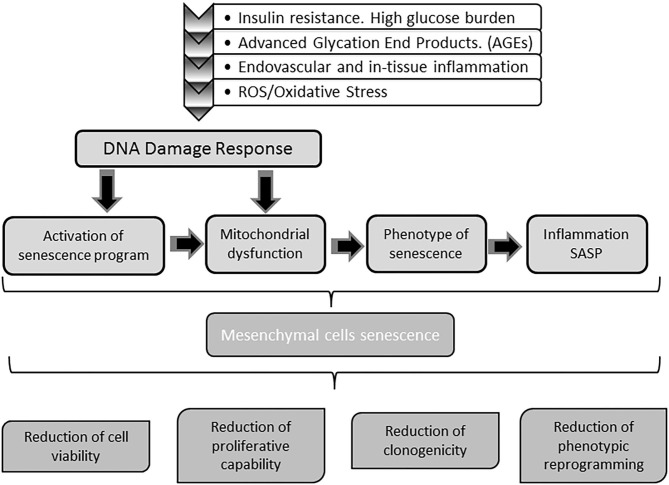
Impact of diabetes on stem cells physiology. Mesenchymal stem cells (MSC) are also targeted by the molecular gluco-oxidative hostile environment of diabetes. The mechanisms and pathways whereby MSC become senescent are the same senescent stressors buffeting differentiated somatic cells. Senescence of MSC impairs stem cells physiology and indirectly that of somatic cells in both mitotic and post-mitotic populations. Upon senescence, stem cells circulating pool is reduced and their ability to engraft injured tissues is also compromised. Concurrently, the capabilities of these cells to assist in wound repair as to participate in epithelial cells populations turnover is also impaired. Globally speaking, with diabetes MSC senescence the tissue's resilience based on the self-renewal potential are undermined.

References

    1. Kerner W, Bruckel J, German Diabetes A. Definition, classification and diagnosis of diabetes mellitus. Exp Clin Endocrinol Diabetes. (2014) 122:384–6. 10.1055/s-0034-1366278 - DOI - PubMed
    1. Skyler JS, Bakris GL, Bonifacio E, Darsow T, Eckel RH, Groop L, et al. . Differentiation of diabetes by pathophysiology, natural history, and prognosis. Diabetes. (2017) 66:241–55. 10.2337/db16-0806 - DOI - PMC - PubMed
    1. Deshpande AD, Harris-Hayes M, Schootman M. Epidemiology of diabetes and diabetes-related complications. Phys Ther. (2008) 88:1254–64. 10.2522/ptj.20080020 - DOI - PMC - PubMed
    1. Longo M, Bellastella G, Maiorino MI, Meier JJ, Esposito K, Giugliano D. Diabetes and aging: from treatment goals to pharmacologic therapy. Front Endocrinol. (2019) 10:45. 10.3389/fendo.2019.00045 - DOI - PMC - PubMed
    1. Schwartz SS, Epstein S, Corkey BE, Grant SFA, Gavin Iii, JR, Aguilar RB, et al. . A unified pathophysiological construct of diabetes and its complications. Trends Endocrinol Metab. (2017) 28:645–55. 10.1016/j.tem.2017.05.005 - DOI - PubMed

Publication types