Review
. 2020 Sep 15:11:2041.
doi: 10.3389/fmicb.2020.02041. eCollection 2020.

Microbial Biofilms: Human T-cell Leukemia Virus Type 1 First in Line for Viral Biofilm but Far Behind Bacterial Biofilms

Affiliations
Review

Microbial Biofilms: Human T-cell Leukemia Virus Type 1 First in Line for Viral Biofilm but Far Behind Bacterial Biofilms

Yousef Maali et al. Front Microbiol. .

Abstract

Human T-cell leukemia virus type 1 (HTLV-1) is a retrovirus associated with adult T-cell leukemia (ATL) and HTLV-1-associated myelopathy/tropical spastic paraparesis (HAM/TSP). To date, it is the unique published example of a virus able to form a biofilm at the surface of infected cells. Deeply studied in bacteria, bacterial biofilms represent multicellular assemblies of bacteria in contact with a surface and shielded by the extracellular matrix (ECM). Microbial lifestyle in biofilms, either viral or bacterial, is opposed structurally and physiologically to an isolated lifestyle, in which viruses or bacteria freely float in their environment. HTLV-1 biofilm formation is believed to be promoted by viral proteins, mainly Tax, through remodeling of the ECM of the infected cells. HTLV-1 biofilm has been linked to cell-to-cell transmission of the virus. However, in comparison to bacterial biofilms, very little is known on kinetics of viral biofilm formation or dissemination, but also on its pathophysiological roles, such as escape from immune detection or therapeutic strategies, as well as promotion of leukemogenesis. The switch between production of cell-free isolated virions and cell-associated viral biofilm, although not fully apprehended yet, remains a key step to understand HTLV-1 infection and pathogenesis.

Keywords: cell-cell transmission; extracellular matrix; human T-cell leukemia virus type 1; pathogenesis; viral biofilm.


Figures

Figure 1
Figure 1
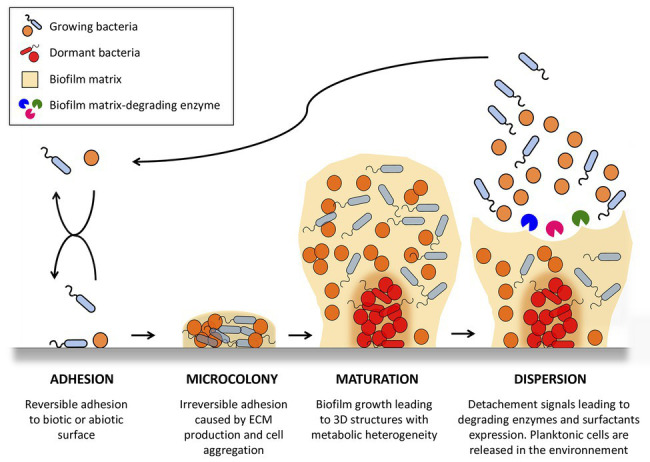
Stages of bacterial biofilm formation. One or more planktonic bacterial species adhere to an abiotic or biotic surface. Adhered bacteria grow as a multicellular community, forming microcolonies in which they proliferate and secrete matrix polymers. This microbial infrastructure results in the development of a 3D mature biofilm with heterogeneous physico-chemical conditions allowing the appearance of dormant state bacteria. Biofilms serve as bacterial reservoirs that are transmitted back to the environment to colonize new surfaces through biofilm detachment caused by intrinsic (biofilm matrix-degrading enzyme) and extrinsic (fluid shear) mechanisms. The figure was constructed using Servier Medical Art images.
Figure 2
Figure 2
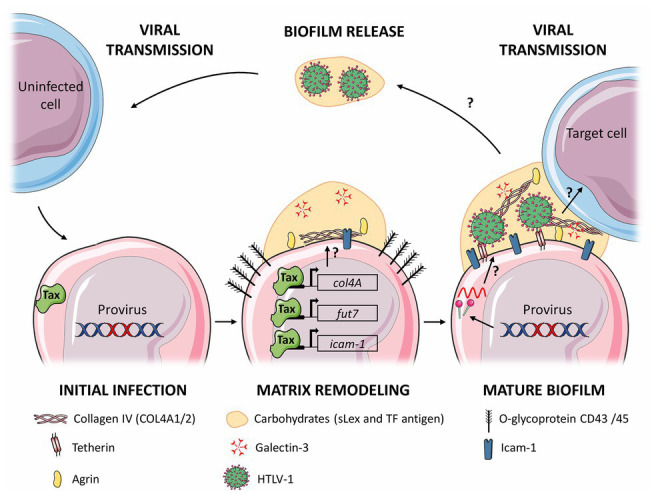
Proposed model for the stages of viral biofilm formation on human T-cell leukemia virus type 1 (HTLV-1) infected T cells. Following initial infection, viral expression (and in particular Tax expression) leads to remodeling of the extracellular matrix (ECM) components, such as carbohydrates (sialyl Lewis X), polymers components (Agrin and Collagen IV), linker proteins (Galectin-3 and Tetherin), and (Intercellular adhesion molecule-1, ICAM-1). Components whose expression is increased are underlined, and in bold when their expression is controlled by Tax. Production of viral particles embedded in the matrix forms the mature viral biofilm, which can be transmitted to a target cell by an unknown mechanism, or be released in the extracellular medium. The arrows with a question mark represent steps that remain to be determined. The figure was constructed using Servier Medical Art images.

References

    1. Abaitua F., Zia F. R., Hollinshead M., O’Hare P. (2013). Polarized cell migration during cell-to-cell transmission of herpes simplex virus in human skin keratinocytes. J. Virol. 87, 7921–7932. 10.1128/JVI.01172-13, PMID: - DOI - PMC - PubMed
    1. Agosto L. M., Uchil P. D., Mothes W. (2015). HIV cell-to-cell transmission: effects on pathogenesis and antiretroviral therapy. Trends Microbiol. 23, 289–295. 10.1016/j.tim.2015.02.003, PMID: - DOI - PMC - PubMed
    1. Alais S., Mahieux R., Dutartre H. (2015). Viral source-independent high susceptibility of dendritic cells to human T-cell leukemia virus type 1 infection compared to that of T lymphocytes. J. Virol. 89, 10580–10590. 10.1128/JVI.01799-15, PMID: - DOI - PMC - PubMed
    1. Alhede M., Bjarnsholt T., Givskov M., Alhede M. (2014). Pseudomonas aeruginosa biofilms: mechanisms of immune evasion. Adv. Appl. Microbiol. 86, 1–40. 10.1016/B978-0-12-800262-9.00001-9, PMID: - DOI - PubMed
    1. Armitano J., Méjean V., Jourlin-Castelli C. (2013). Aerotaxis governs floating biofilm formation in Shewanella oneidensis. Environ. Microbiol. 15, 3108–3118. 10.1111/1462-2920.12158, PMID: - DOI - PubMed