Review
. 2020 Sep 17:11:572865.
doi: 10.3389/fimmu.2020.572865. eCollection 2020.

Immunomodulation and Immune Escape Strategies of Gastrointestinal Helminths and Schistosomes

Affiliations
Review

Immunomodulation and Immune Escape Strategies of Gastrointestinal Helminths and Schistosomes

Marie Wiedemann et al. Front Immunol. .

Abstract

Parasitic worms (helminths) developed various immunoregulatory mechanisms to counteract the immune system of their host. The increasing identification and characterization of helminth-derived factors with strong immune modulatory activity provides novel insights into immune escape strategies of helminths. Such factors might be good targets to enhance anti-helminthic immune responses. In addition, immunosuppressive helminth-derived factors could be useful to develop new therapeutic strategies for treatment of chronic inflammatory conditions. This review will take an in depth look at the effects of immunomodulatory molecules produced by different helminths with a focus on schistosomes and mouse models of hookworm infections.

Keywords: Helminths; immunomodulation; nematode; parasites; schistosomes; trematode; type 2 immunity.


Figures

Figure 1
Figure 1
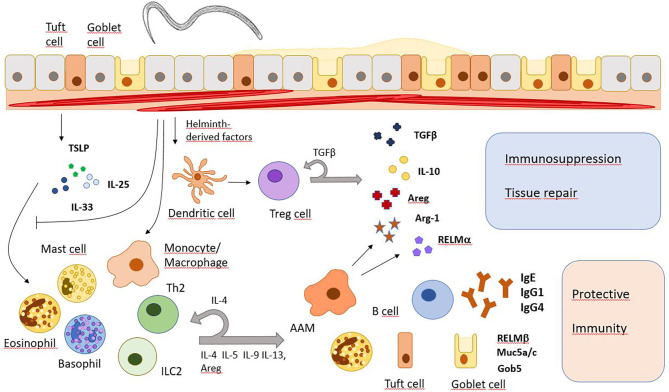
Major immune response pathways after helminth infection. Helminth infections induce the release of alarmins (IL-25, IL-33, TSLP) which subsequently promote immune responses that promote worm expulsion or granuloma formation but also tissue repair and immunosuppression. However, they also inhibit the IL-33 signaling pathway and modulate gene expression in monocytes/macrophages and T cells. Areg, amphiregulin; Arg-1, arginase 1; Gob5, a Calcium-activated chloride channel in goblet cells; Muc5a/c, mucins 5a and c; RELM, resistin-like molecule.
Figure 2
Figure 2
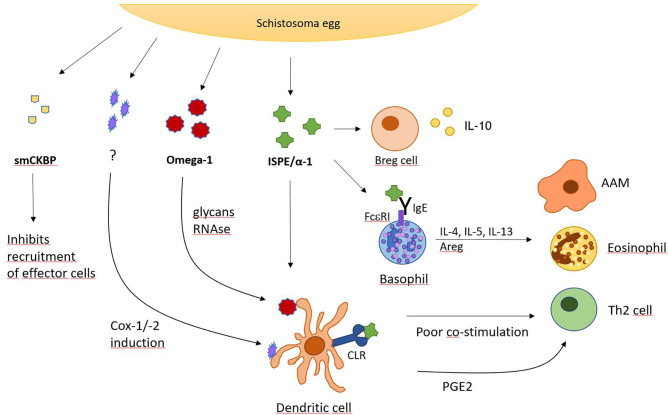
S. mansoni egg-derived factors with immunomodulatory activity. Overview of secreted factors from S. mansoni eggs and their action on indicated cell types. CLR, C-type lectin receptor; Cox, cyclooxygenase; PGE2, prostaglandin E2.

References

    1. Maizels RM, Smits HH, McSorley HJ. Modulation of host immunity by helminths: the expanding repertoire of parasite effector molecules. Immunity. (2018) 49:801–18. 10.1016/j.immuni.2018.10.016 - DOI - PMC - PubMed
    1. International Helminth Genomes Consortium . Comparative genomics of the major parasitic worms. Nat Genet. (2019) 51:163–74. 10.1038/s41588-018-0262-1 - DOI - PMC - PubMed
    1. McManus DP, Dunne DW, Sacko M, Utzinger J, Vennervald BJ, Zhou XN. Schistosomiasis. Nat Rev Dis Primers. (2018) 4:13 10.1038/s41572-018-0013-8 - DOI - PubMed
    1. Kim DG, Park JH, Kim JL, Jung BK, Jeon SJ, Lim H, et al. . Intestinal nematodes from small mammals captured near the demilitarized zone, Gyeonggi province, republic of Korea. Korean J Parasitol. (2015) 53:135–9. 10.3347/kjp.2015.53.1.135 - DOI - PMC - PubMed
    1. Camberis M, Le Gros G, Urban J, Jr. Animal model of Nippostrongylus brasiliensis and Heligmosomoides polygyrus. Curr Protoc Immunol. (2003) Chapter 19:Unit 19.12. 10.1002/0471142735.im1912s55 - DOI - PubMed

Publication types

LinkOut - more resources