


Accuracy of Commonly Used Age-Predicted Maximal Heart Rate Equations
- PMID: 33042384
- PMCID: PMC7523886
- DOI: 10.70252/XFSJ6815
Accuracy of Commonly Used Age-Predicted Maximal Heart Rate Equations
Abstract
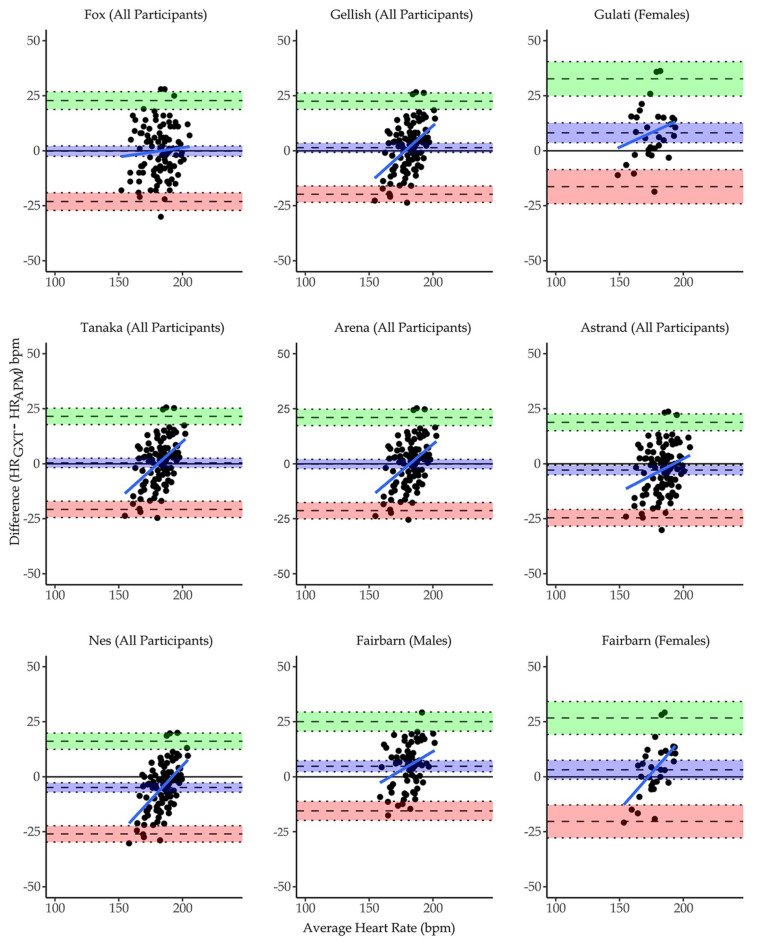
Age-predicted maximal heart rate (APMHR) is an essential measure for healthcare professionals in determining cardiovascular response to exercise testing, exertion, and prescription. Although multiple APMHR prediction equations have been validated for specific populations, the accuracy of each within a general population requires testing. We aimed to determine which APMHR equation (Fox, Gellish, Gulati, Tanaka, Arena, Astrand, Nes, Fairbarn) most accurately predicts max heart rate (HRmax) in a general population. HRmax from 99 graded treadmill exercise tests (GXT) were measured. GXTs ended upon volitional fatigue and were only included for analysis if RER > 1.10. Individual paired t-test were performed to determine if significant differences existed between measured and predicted HRmax, along with root mean square errors for each equation. Bland-Altman plots were constructed to determine agreement between equations and measured HRmax. Significant differences between measured and predicted HRmax were found for the Gulati, Astrand, Nes, and Fairbarn (male) equations (p < 0.05). Bland-Altman plots revealed wide limits of agreement for all nine APMHR equations, suggesting poor agreement between measured and predicted HRmax. Proportional bias indicates that prediction equations under and overestimated HRmax in individuals with lower and higher measured HRmax, respectively, with the exception of the Fox equation. All equations used in this study show poor agreement between measured HRmax and APMHR. The Fox equation may represent the best option for a general population as it is less likely to under or overestimate based on individual HRmax. Individuals should use data from GXTs to determine HRmax when applicable to ensure accuracy.
Keywords: Exercise testing; aerobic exercise; exercise intensity prescription.
Figures
References
-
- Riebe D, Ehrman JK, Liguori G, Magal M, editors. American College of Sports Medicine. ACSM’s guidelines for exercise testing and prescription. Tenth edition. Philadelphia: Wolters Kluwer; 2018.
-
- Astrand PO. Experimental Studies of Physical Working Capacity in Relation to Sex and Age. Copenhagen Denmark: Musksgaard; 1952.
-
- Azevedo LF, Perlingeiro PS, Brum PC, Braga AMW, Negrão CE, de Matos LDNJ. Exercise intensity optimization for men with high cardiorespiratory fitness. J Sports Sci. 2011;29(6):555–61. - PubMed
LinkOut - more resources
Full Text Sources
Other Literature Sources