


Study Protocol: A Cross-Sectional Examination of Socio-Demographic and Ecological Determinants of Nutrition and Disease Across Madagascar
- PMID: 33042943
- PMCID: PMC7527467
- DOI: 10.3389/fpubh.2020.00500
Study Protocol: A Cross-Sectional Examination of Socio-Demographic and Ecological Determinants of Nutrition and Disease Across Madagascar
Abstract
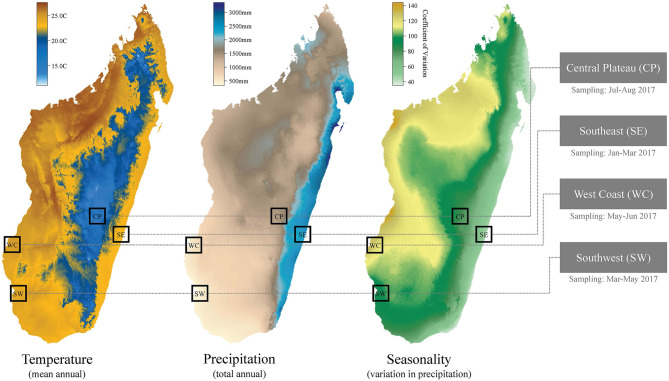
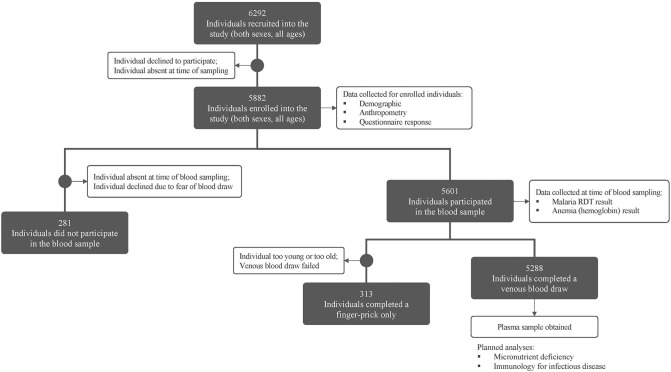
Madagascar has experienced significant environmental change since 1960, particularly through forest clearing for agricultural expansion. Climatic patterns are undergoing change in Madagascar as well, with increasing temperatures, droughts, and cyclonic activity. The impact of these environmental and climatic changes will pose threats to food availability, income generation, and local ecosystems, with significant potential effects on the spatial and temporal distribution of disease burden. This study seeks to describe the health status of a large sample of geographically and socially diverse Malagasy communities through multiple clinical measurements, detailed social surveys, and paired data on regional variation in local ecologies. With an increased understanding of the current patterns of variation in human health and nutrition, future studies will be better able to identify associations with climate and anticipate and mitigate the burdens expected from larger, longer-term changes. Our mixed-method approach included an observational cross-sectional study. Research subjects were men, women, and children from 1,125 households evenly distributed across 24 communities in four ecologically and socio-demographically distinct regions of Madagascar. For these 1,125 households, all persons of both sexes and all ages therein (for a total of 6,292 individuals) were recruited into the research study and a total of 5,882 individuals were enrolled. Through repeated social survey recalls and focus group meetings, we obtained social and demographic data, including broad categories of seasonal movements, and characterized the fluctuation of income generation, food production and dietary consumption. Through collection of clinical and biological samples for both point-of-care diagnoses and laboratory analyses, we obtained detailed occurrence (and importantly co-occurrence) data on micronutrient nutritional, infectious disease, and non-communicable disease status. Our research highlights the highly variable social, cultural, and environmental contexts of health conditions in Madagascar, and the tremendous inter-regional, inter-community, and intra-community variation in nutritional and disease status. More than 30% of the surveyed population was afflicted by anemia and 14% of the population had a current malaria infection. This type of rich metadata associated with a suite of biological samples and nutritional and disease outcome data should allow disentangling some of the underlying drivers of ill health across the changing landscapes of Madagascar.
Keywords: disease ecology; food security; infectious disease; malaria; micronutrient nutrition; migration; planetary health; seasonality.
Copyright © 2020 Golden, Rice, Randriamady, Vonona, Randrianasolo, Tafangy, Andrianantenaina, Arisco, Emile, Lainandrasana, Mahonjolaza, Raelson, Rakotoarilalao, Rakotomalala, Rasamison, Mahery, Tantely, Girod, Annapragada, Wesolowski, Winter, Hartl, Hazen and Metcalf.
Figures
References
-
- Bouley T, Midgley A, Shumake-Guillemot J, Golden CD, Ebi KL. Climate Change and Health Diagnostic: Madagascar. Risks and Opportunities for Climate-Smart Health and Nutrition Investment. Investing in Climate Change and Health Series. Washington, DC: World Bank; Report number: 121945. (2018)
-
- Harper GJ, Steininger MK, Tucker CJ, Juhn D, Hawkins F. Fifty years of deforestation and forest fragmentation in Madagascar. Environ Conserv. (2007) 34:325–33. 10.1017/S0376892907004262 - DOI
-
- Vieilledent G, Grinand C, Rakotomalala FA, Ranaivosoa R, Rakotoarijaona JR, Allnutt TF, et al. Combining global tree cover loss data with historical national forest cover maps to look at six decades of deforestation and forest fragmentation in Madagascar. Biol Conserv. (2018). 222:189–97. 10.1016/j.biocon.2018.04.008 - DOI
-
- Allnut TF, Asner GP, Golden CD, Powell GV. Mapping recent deforestation and forest disturbance in northeastern Madagascar. Trop Conserv Sci. (2013) 6:1–15. 10.1177/194008291300600101 - DOI
Publication types
MeSH terms
Grants and funding
LinkOut - more resources
Full Text Sources
