


Enhanced performance on a sentence comprehension task in congenitally blind adults
- PMID: 33043067
- PMCID: PMC7540612
- DOI: 10.1080/23273798.2019.1706753
Enhanced performance on a sentence comprehension task in congenitally blind adults
Abstract
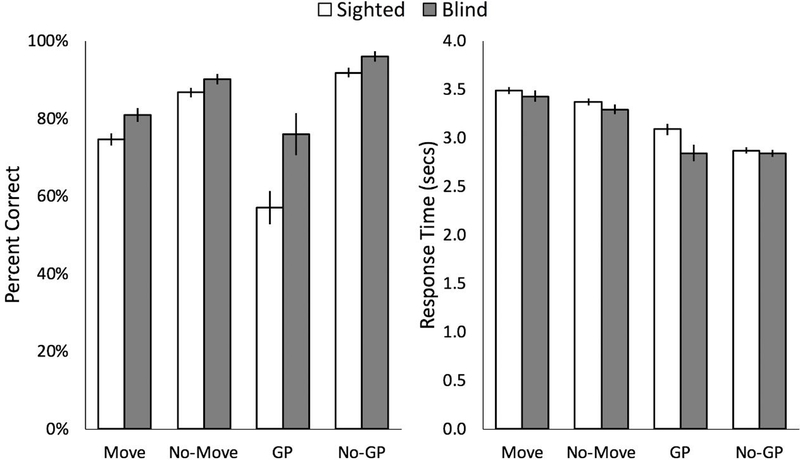
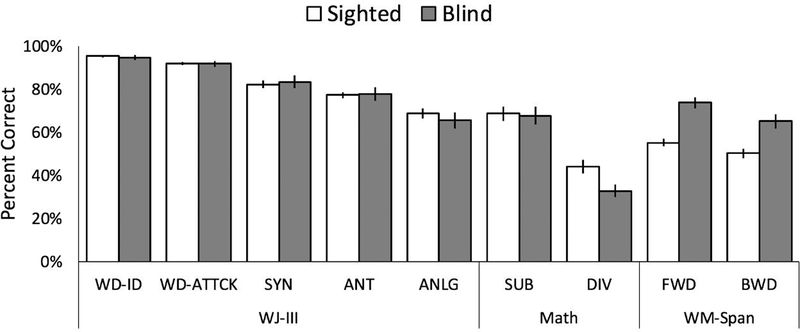
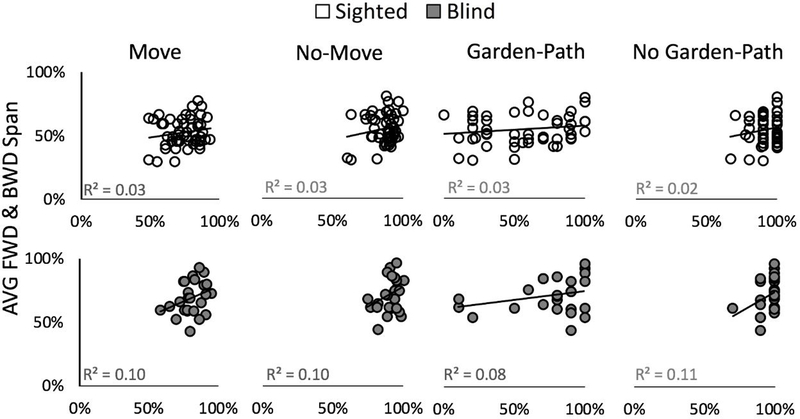
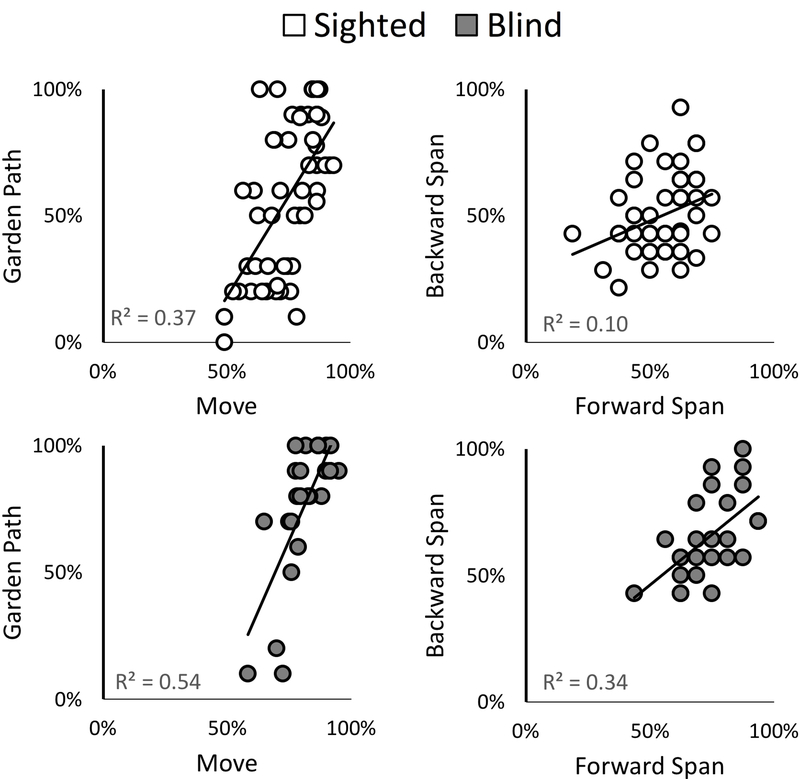
People born blind habitually experience linguistic utterances in the absence of visual cues and activate "visual" cortices during sentence comprehension. Do blind individuals show superior performance on sentence processing tasks? Congenitally blind (n=25) and age and education matched sighted (n=52) participants answered yes/no who-did-what-to-whom questions for auditorily-presented sentences, some of which contained a grammatical complexity manipulation (long-distance movement dependency or garden path). Short-term memory was measured with a forward and backward letter-spans. A battery of control tasks included two speeded math tasks and vocabulary and reading tasks from Woodcock Johnson III. The blind group outperformed the sighted on the sentence comprehension task, particularly for garden-path sentences, and on short-term memory span tasks, but performed similar to the sighted on control tasks. Sentence comprehension performance was not correlated with span performance, suggesting independent enhancements.
Keywords: Sentence processing; blindness; garden path; plasticity; practice.
Figures
References
-
- Baayen RH, Davidson DJ, & Bates DM (2008). Mixed-effects modeling with crossed random effects for subjects and items. Journal of Memory and Language, 59(4), 390–412. 10.1016/j.jml.2007.12.005 - DOI
-
- Bader M. (1998). Prosodic Influences on Reading Syntactically Ambiguous Sentences In Reanalysis in Sentence Processing (Vol. 21, pp. 1–46). Dordrecht: Springer, Dordrecht.
Grants and funding
LinkOut - more resources
Full Text Sources
Other Literature Sources