


COVID-19 lockdown: impact assessment on Aedes larval indices, breeding habitats, effects on vector control programme and prevention of dengue outbreaks
- PMID: 33043162
- PMCID: PMC7534600
- DOI: 10.1016/j.heliyon.2020.e05181
COVID-19 lockdown: impact assessment on Aedes larval indices, breeding habitats, effects on vector control programme and prevention of dengue outbreaks
Abstract
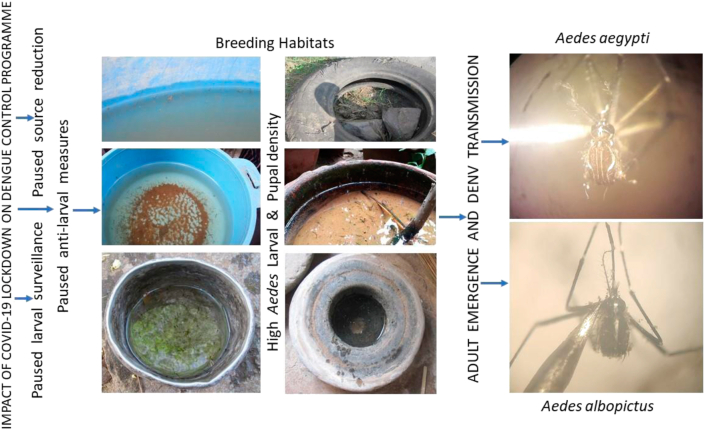
Aedes aegypti (Linn.) and Aedes albopictus (Skuse) are widespread vector mosquitoes responsible for the transmission of various disease-causing viruses to human including dengue virus (DENV). India is endemic for dengue disease and both of these vector mosquitoes are well established throughout India. Since, Aedes mosquitoes breeds in containers, WHO recommends to do a regular immature surveillance and implement appropriate control measures. Owing to the current COVID-19 pandemic, most of the countries have implemented continuous shutdown/lockdown, which affected the routine Aedes surveillance and vector control measures. In India, the first nation-wide lockdown was implemented on 24th, March 2020. As of now, Government of India has extended the lockdown till 30th, June 2020. In the present study, two rounds of Aedes surveillance was carried out in two localities of Bengaluru City (urban) of Karnataka State, India during the COVID-19 lockdown days and results were compared with pre-lockdown surveillance data to assess the impact of lockdown on Aedes larval indices, breeding habitats and dengue vector control programme. The recorded house index (HI) and Breteau index (BI) were 6.6 and 9.3 in K.P. Agrahara and 4.0 and 5.3 in Palace Guttahalli during pre-lockdown survey. The house index (HI) and Breteau index (BI) were found to be increased to 26.6 and 34.6 in K.P. Agrahara and 21.3 and 28.0 in Palace Guttahalli during the COVID-19 lockdown second survey. Aedes immature density has drastically increased in both the localities due to temporarily discontinued Aedes surveillance, larval control activities like source reduction and anti-larval measures during COVID-19 lockdown. The high indices show that the vector is increasing and this may result in higher dengue virus transmission. The results highly recommend to implement the Aedes vector control programme with limited health staffs following the physical distance and other protectives measures to prevent dengue outbreaks.
Keywords: Aedes surveillance; Biological sciences; COVID-19 lockdown; Ecology; Entomology; Health sciences; Insects; Larval indices; Public health; Species dominance index; Vector-borne disease.
© 2020 Published by Elsevier Ltd.
Figures
References
-
- Barraud P.J. Ist ed. Taylor and Francis; London: 1931. Fauna of British India Including Ceylon and Burma. Diptera Vol.V; p. 463.
-
- Barraud P.J. Taylor and Francis; London: 1934. Fauna of British India, Diptera, Vol.V. Family Culicidae, Tribes Megarhini and Culicini.
-
- May R.M. Patterns of species abundance and diversity. In: Cody M.L., Diamond J.M., editors. Ecology and Evolution of Communities. Belknap Press of Harvard University Press; Cambridge, Massachusetts: 1975. pp. 81–120.
LinkOut - more resources
Full Text Sources
