


Determinants of an evidence-based practice environment: an interpretive description
- PMID: 33043300
- PMCID: PMC7542098
- DOI: 10.1186/s43058-020-00070-0
Determinants of an evidence-based practice environment: an interpretive description
Abstract
Background: Despite the available research to inform nursing practice, many patients still fail to receive evidence-based care. Several evidence-based practice (EBP) models have been developed to guide nurses through the steps in the process, yet these models have not been uniformly adopted or consistently used. The original purpose of this research was to gather perspectives and experiences of nurses using the Iowa Model of EBP to help inform its introduction into other practice settings. As a more in-depth understanding was gained, the emphasis of the study shifted towards understanding the determinants of the EBP environment.
Method: The study was conducted in an 800-bed comprehensive academic medical centre in the USA with a 25-year history of using the Iowa Model of EBP. Semi-structured in-depth interviews were conducted with twelve nurses from various roles to ascertain their perspectives and experiences using the model. The interview transcripts were reviewed alongside relevant published literature and internal documents in a process of synthesising, theorising, and conceptualising. Data were collected during the first half of 2019.
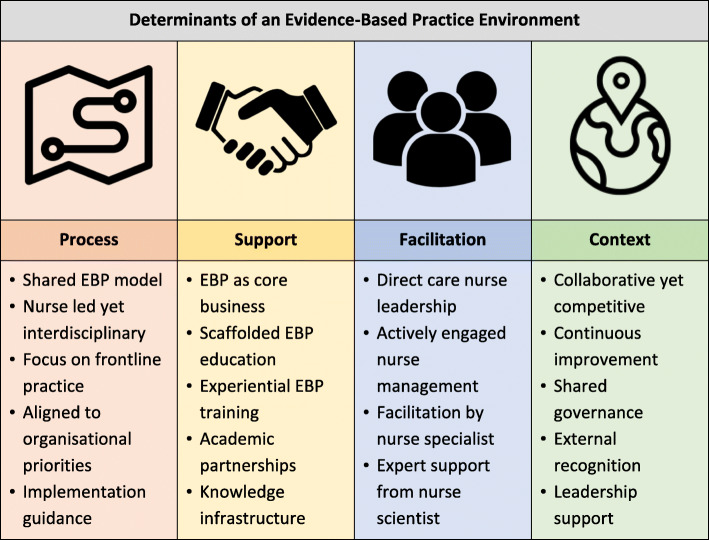
Results: Four determinants of the local EBP environment were identified from the perspectives and experiences of participants: (1) the importance of a shared model to guide staff through the EBP process; (2) support for EBP in the form of education, hands-on training, and knowledge infrastructure; (3) active team facilitation by direct care nurses, nurse managers, nurse specialists, and nurse scientists; and (4) a culture and leadership that encourages EBP.
Conclusion: Introducing an EBP model is an essential first step for an organisation to improve consistent and reliable evidence-based care; to be most effective, this should be done in conjunction with efforts to optimise the EBP environment.
© The Author(s) 2020.
Conflict of interest statement
Competing interestsThe authors declare that they have no competing interests.
References
-
- Titler MG. Translation research in practice: an introduction. Online J Issues Nurs. 2018;23(2):1.
LinkOut - more resources
Full Text Sources
Research Materials
