Review
. 2021 Jan;64(1):5-14.
doi: 10.1007/s00125-020-05293-3. Epub 2020 Oct 12.

Brain control of blood glucose levels: implications for the pathogenesis of type 2 diabetes

Affiliations
Review

Brain control of blood glucose levels: implications for the pathogenesis of type 2 diabetes

Kimberly M Alonge et al. Diabetologia. 2021 Jan.

Erratum in

Abstract

Despite a rapidly growing literature, the role played by the brain in both normal glucose homeostasis and in type 2 diabetes pathogenesis remains poorly understood. In this review, we introduce a framework for understanding the brain's essential role in these processes based on evidence that the brain, like the pancreas, is equipped to sense and respond to changes in the circulating glucose level. Further, we review evidence that glucose sensing by the brain plays a fundamental role in establishing the defended level of blood glucose, and that defects in this control system contribute to type 2 diabetes pathogenesis. We also consider the possibility that the close association between obesity and type 2 diabetes arises from a shared defect in the highly integrated neurocircuitry governing energy homeostasis and glucose homeostasis. Thus, whereas obesity is characterised by an increase in the defended level of the body's fuel stores (e.g. adipose mass), type 2 diabetes is characterised by an increase in the defended level of the body's available fuel (e.g. circulating glucose), with the underlying pathogenesis in each case involving impaired sensing of (or responsiveness to) relevant humoral negative feedback signals. This perspective is strengthened by growing preclinical evidence that in type 2 diabetes the defended level of blood glucose can be restored to normal by therapies that restore the brain's ability to properly sense the circulating glucose level. Graphical abstract.

Keywords: Brain; Diabetes; Glucose; Hypothalamus; Obesity; Review.


Figures
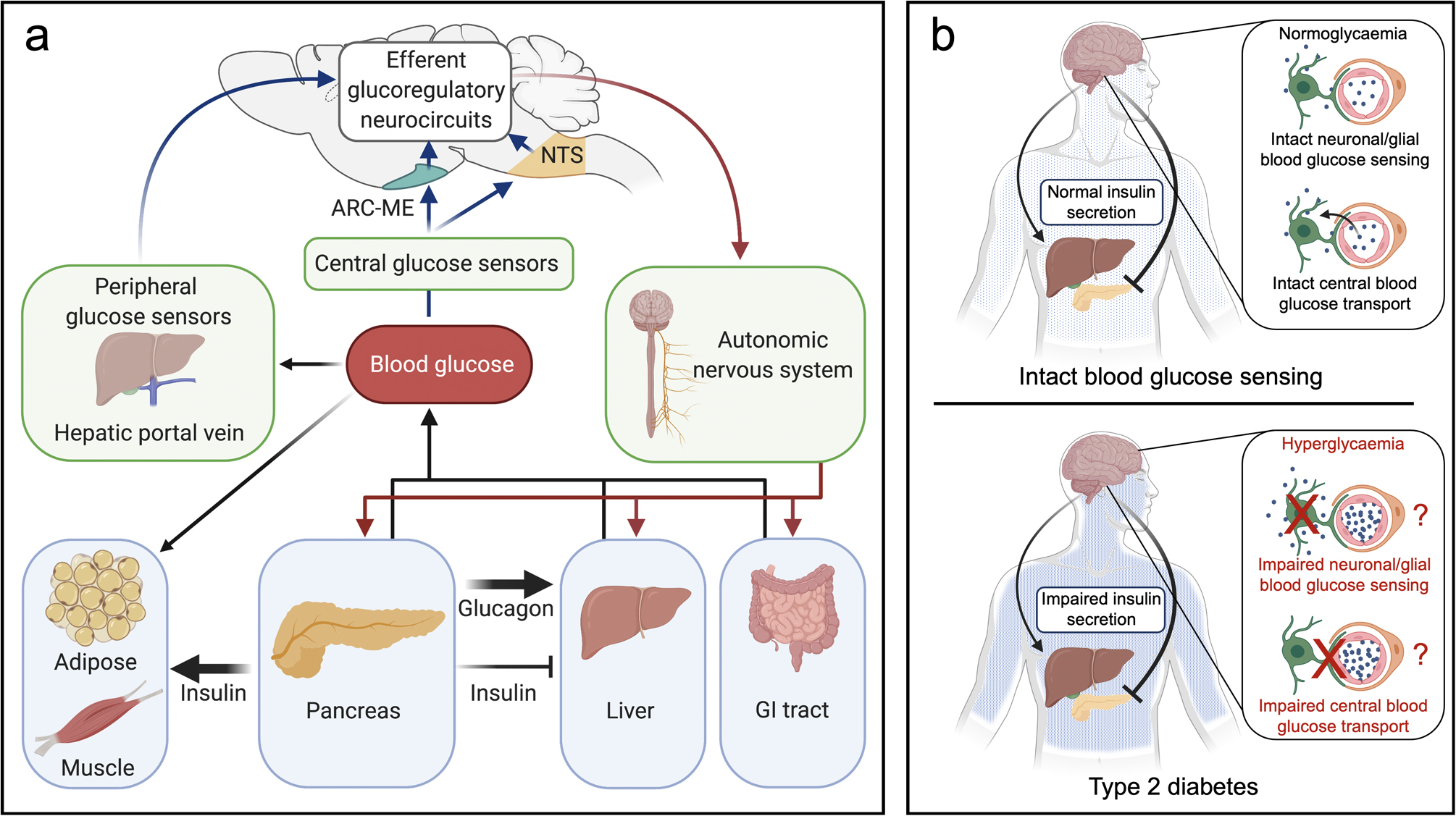
Fig. 1
Fig. 1
Model describing the role of the brain in glucose homeostasis. (a) Maintenance of blood glucose levels within a narrow physiological range requires balancing of glucose disappearance from and entry into the bloodstream. This balance is achieved via both insulin-dependent and insulin-independent mechanisms that are enhanced when blood glucose deviates from its regulated levels. Secreted by the pancreas in response to rising glucose levels, insulin promotes glucose disposal by inducing glucose uptake into insulin-sensitive tissues (e.g. adipose, muscle), while also reducing glucose appearance by inhibiting hepatic glucose production (black arrows). Glucagon opposes the latter effect by stimulating glucose production by the liver. The blood glucose level is also sensed by the brain via afferent input (blue arrows) to both central (e.g. arcuate nucleus–median eminence, NTS) and peripheral sensing mechanisms. When glucose levels deviate from the defended level, the brain powerfully adjusts both insulin-dependent and insulin-independent determinants of glucose entry into and removal from the circulation (red arrows) (in part via effects on insulin secretion) through the autonomic nervous system that ultimately return the glucose level to normal. (b) Impairment of the brain’s ability to sense blood glucose levels (blue dots) can result from either a genetic or acquired defect. This causes the perceived glucose level to be lower than it truly is and, in response, the brain raises the defended blood glucose level in part by inhibiting GSIS. This pathogenic sequence is proposed to play a major role in type 2 diabetes pathogenesis. ARC, arcuate nucleus; ME, median eminence; NTS, nucleus tractus solitarius.
Fig. 2
Fig. 2
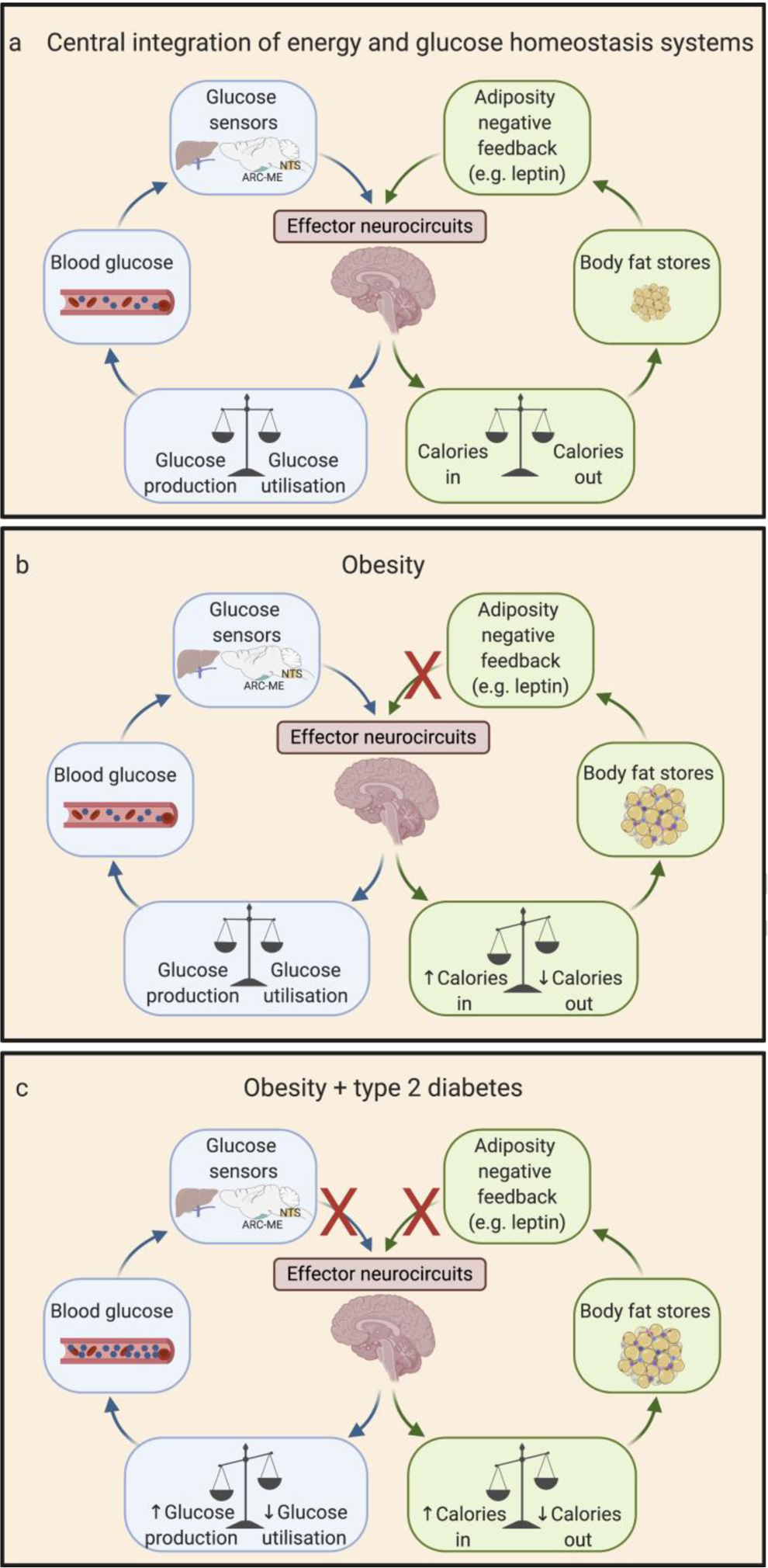
Brain-based model linking obesity to the pathogenesis of type 2 diabetes. Normal energy homeostasis (a) entails brain sensing of circulating adiposity negative feedback signals (such as the hormone leptin). In response to this input, the brain facilitates the matching of energy intake to energy expenditure over time so as to promote stability in the amount of fuel stored as fat. In obese individuals (b), reduced brain sensing of adipose-related negative feedback signals favours the defence of an elevated level of body fat mass. Progression of obesity to type 2 diabetes (c) is proposed to involve an expansion of the underlying brain defect to include impaired sensing of the blood glucose level. This combination of defects causes the defended levels of both blood glucose and adiposity to rise out of the normal range, thus contributing to the close association between obesity and type 2 diabetes. ARC, arcuate nucleus; ME, median eminence; NTS, nucleus tractus solitarius.

References

    1. DʼAlessio DA, Kieffer TJ, Taborsky GJ Jr, Havel PJ (2001) Activation of the parasympathetic nervous system is necessary for normal meal-induced insulin secretion in rhesus macaques. J Clin Endocrinol Metab 86(3): 1253–1259. 10.1210/jcem.86.3.7367 - DOI - PubMed
    1. Carey M, Lontchi-Yimagou E, Mitchell W, et al. (2020) Central KATP channels modulate glucose effectiveness in humans and rodents. Diabetes 69(6): 1140–1148. 10.2337/db19-1256 - DOI - PMC - PubMed
    1. Bernard C (1849) Chiens rendus diabetiques. C R SocBio 1: 60
    1. Oh Y, Lai JS, Mills HJ, et al. (2019) A glucose-sensing neuron pair regulates insulin and glucagon in Drosophila. Nature 574(7779): 559–564. 10.1038/s41586-019-1675-4 - DOI - PMC - PubMed
    1. Schwartz MW, Seeley RJ, Tschöp MH, et al. (2013) Cooperation between brain and islet in glucose homeostasis and diabetes. Nature 503(7474): 59–66. 10.1038/nature12709 - DOI - PMC - PubMed

Publication types

MeSH terms