Review
. 2020 Nov 9;12(1):1824564.
doi: 10.1080/19490976.2020.1824564. Epub 2020 Oct 12.

The early life education of the immune system: Moms, microbes and (missed) opportunities

Affiliations
Review

The early life education of the immune system: Moms, microbes and (missed) opportunities

Nitya Jain. Gut Microbes. .

Abstract

The early life immune system is characterized by unique developmental milestones. Functionally diverse immune cells arise from distinct waves of hematopoietic stem cells, a phenomenon referred to as 'layered' immunity. This stratified development of immune cells extends to lineages of both innate and adaptive cells. The defined time window for the development of these immune cells lends itself to the influence of specific exposures typical of the early life period. The perinatal immune system develops in a relatively sterile fetal environment but emerges into one filled with a multitude of antigenic encounters. A major burden of this comes in the form of the microbiota that is being newly established at mucosal surfaces of the newborn. Accumulating evidence suggests that early life microbial exposures, including those arising in utero, can imprint long-lasting changes in the offspring's immune system and determine disease risk throughout life. In this review, I highlight unique features of early life immunity and explore the role of intestinal bacteria in educating the developing immune system.

Keywords: Perinatal immune system; immune education; layered immunity; microbiota; window of opportunity.


Figures
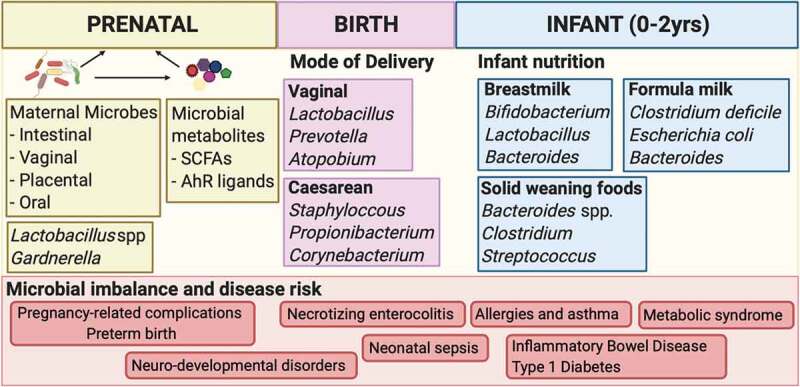
Figure 1.
Figure 1.
Perinatal microbial encounters. Three windows of influential microbial encounters may be distinguished in the pre- and post-natal period. Maternal microbes as well as their metabolites may influence the uterine environment in which the fetus develops. Delivery mode shapes the initial microbial inoculum of the newborn while nutrition drives microbial composition during the postnatal period. Microbial imbalance during these periods alter susceptibility to pathogens and inflammatory disease in early and later life.
Figure 2.
Figure 2.
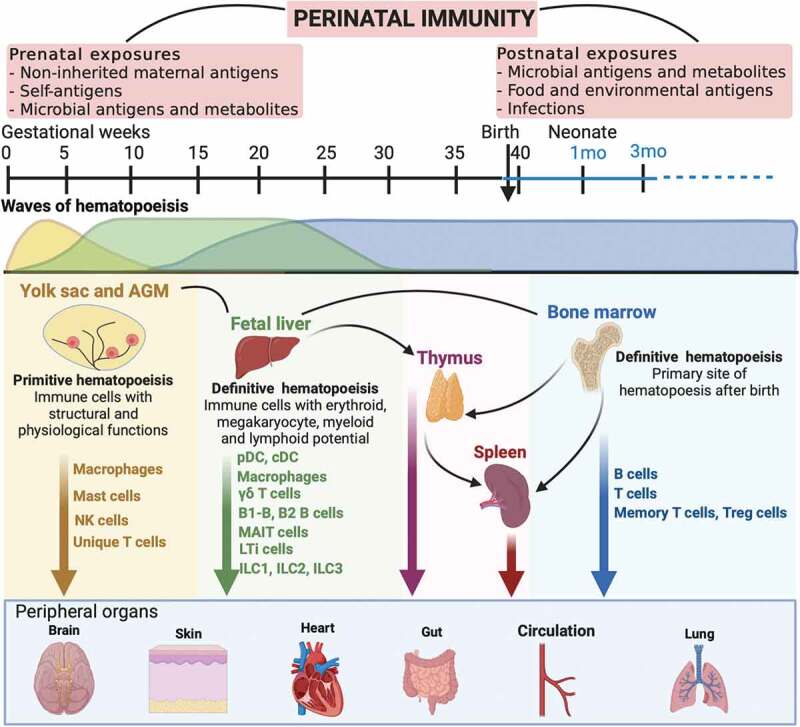
Perinatal immune development. Immune function in early life is shaped by specific prenatal and postnatal exposures. Waves of hematopoietic stem cells arise from the yolk sac, fetal liver and the bone marrow over gestation and generate distinct lineages of immune cells that serve the early life milieu.
Figure 3.
Figure 3.
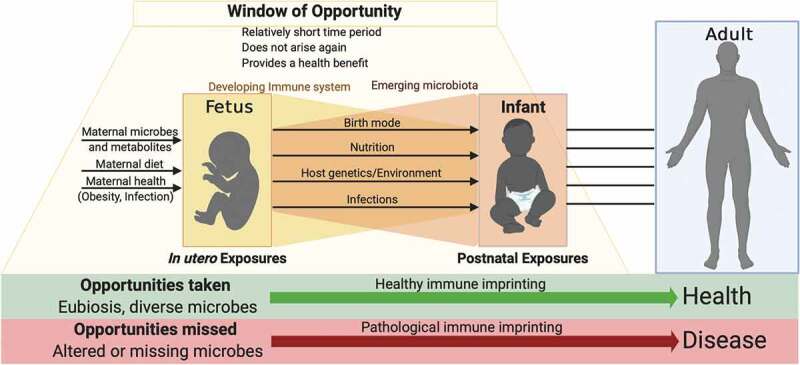
Of opportunities missed and taken. Early life microbial exposures influence developmental imprinting of the immune system that determines health and disease susceptibility in later life. Favorable imprinting of developing immunity by microbes may occur during an early life time window of opportunity. This window of opportunity, by definition, is predicted to be relatively short, to not arise again in later life and must provide a health benefit to the offspring. Numerous factors during pregnancy and in the postnatal period influence the quality of microbial exposures that have the potential to imprint immune functionality. Treatments and behaviors that disrupt these exposures may lead to pathological imprinting, altering risk for disease throughout life.

References

    1. W. H. O. C. o. C. A. o. P. I. Writing Committee , et al. Clinical aspects of pandemic 2009 influenza A (H1N1) virus infection. N Engl J Med. 2010;362:1708–1719. doi: 10.1056/NEJMra1000449. - DOI - PubMed
    1. Brodin P. Why is COVID-19 so mild in children? Acta Paediatr. 2020;109:1082–1083. - PubMed
    1. Rowley AH. Understanding SARS-CoV-2-related multisystem inflammatory syndrome in children. Nat Rev Immunol. 2020. doi: 10.1038/s41577-020-0367-5. - DOI - PMC - PubMed
    1. Yang KD. Perinatal programming of childhood asthma. Clin Dev Immunol. 2012;2012:438572. - PMC - PubMed
    1. Monasta L, Batty GD, Cattaneo A, Lutje V, Ronfani L, Van Lenthe FJ, et al. Early-life determinants of overweight and obesity: a review of systematic reviews. Obes Rev. 2010;11:695–708. - PubMed

Publication types