Review
. 2021;88(1):15-27.
doi: 10.1159/000512007. Epub 2020 Oct 13.

The Impact of COVID-19 Disease on Platelets and Coagulation

Affiliations
Review

The Impact of COVID-19 Disease on Platelets and Coagulation

Geoffrey D Wool et al. Pathobiology. 2021.

Abstract

Coronavirus disease 2019 (COVID-19) causes a spectrum of disease; some patients develop a severe proinflammatory state which can be associated with a unique coagulopathy and procoagulant endothelial phenotype. Initially, COVID-19 infection produces a prominent elevation of fibrinogen and D-dimer/fibrin(ogen) degradation products. This is associated with systemic hypercoagulability and frequent venous thromboembolic events. The degree of D-dimer elevation positively correlates with mortality in COVID-19 patients. COVID-19 also leads to arterial thrombotic events (including strokes and ischemic limbs) as well as microvascular thrombotic disorders (as frequently documented at autopsy in the pulmonary vascular beds). COVID-19 patients often have mild thrombocytopenia and appear to have increased platelet consumption, together with a corresponding increase in platelet production. Disseminated intravascular coagulopathy (DIC) and severe bleeding events are uncommon in COVID-19 patients. Here, we review the current state of knowledge of COVID-19 and hemostasis.

Keywords: COVID-19; Coagulopathy; D-dimer; Thrombocytopenia; Thrombosis.


Conflict of interest statement

G.D.W. is on an advisory committee at Diagnostica Stago and receives honoraria. J.L.M. declares no conflicts of interest.

Figures
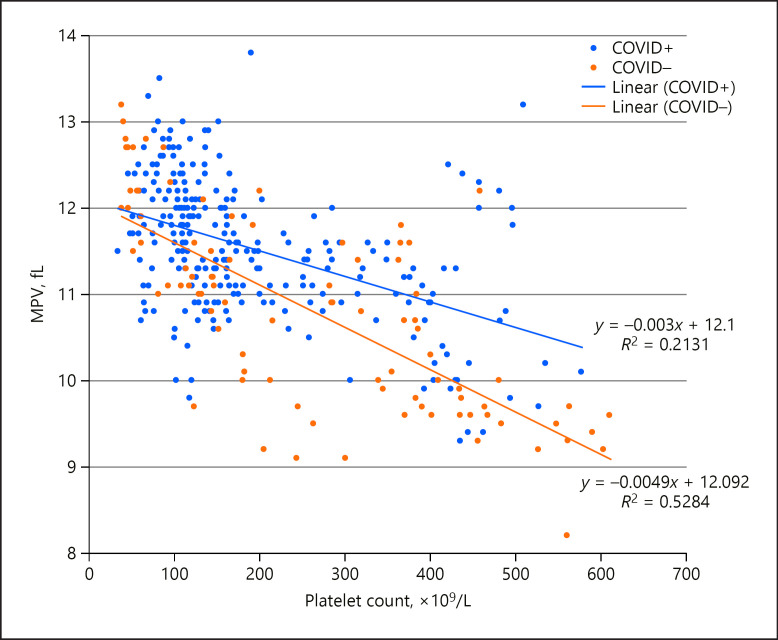
Fig. 1
Fig. 1
Relationship between platelet count and mean platelet volume (MPV) in a sample of ICU patients affected by COVID-19 (COVID+; n = 10, with 266 measurements) or not (COVID–; n = 10, with 91 measurements). These populations were significantly different from each other (Student's t test, p < 5 ×10⁻⁷).
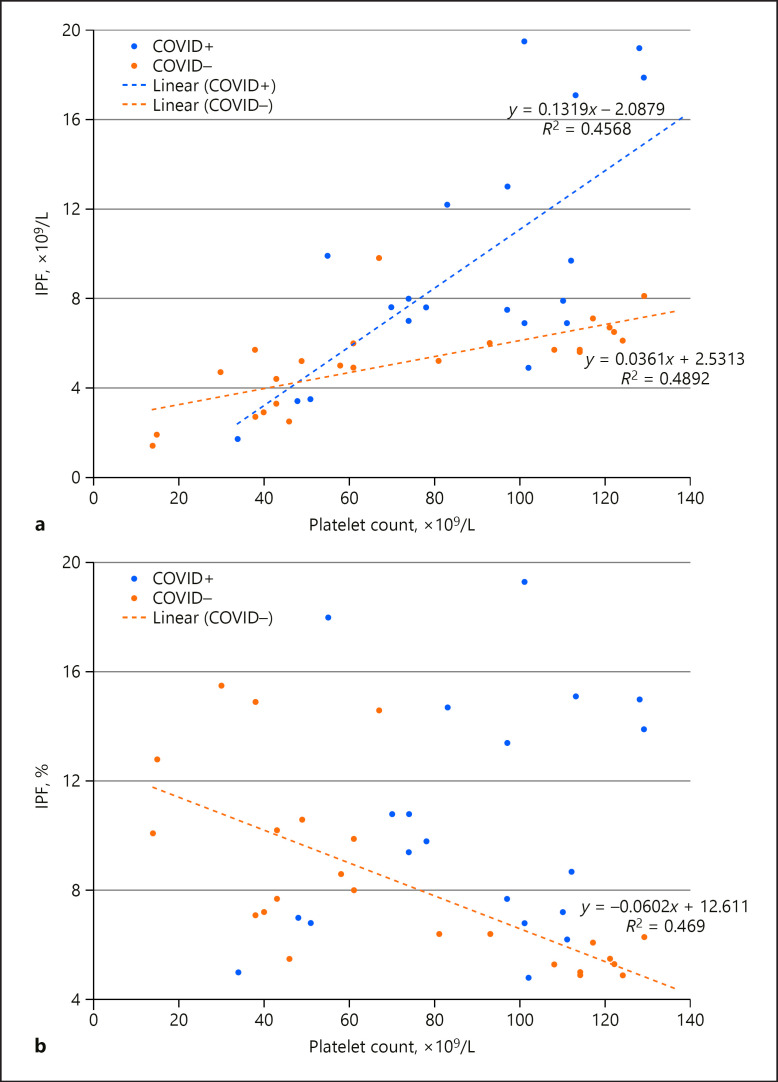
Fig. 2
Fig. 2
Relationship between platelet count and immature platelet fraction (IPF) in a sample of thrombocytopenic ICU patients affected by COVID-19 (COVID+; n = 4, with 23 measurements) or not (COVID–; n = 4, with 23 measurements). a Absolute IPF counts. These populations were significantly different from each other (Student's t test, p < 0.005). b Relative IPF counts. Of note, the relative IPF counts for COVID+ patients did not form a strong enough relationship with platelet count to display a relevant trendline. These populations were significantly different from each other (Student's t test, p < 0.05).

References

    1. Liu Y, Sun W, Guo Y, Chen L, Zhang L, Zhao S, et al. Association between platelet parameters and mortality in coronavirus disease 2019: retrospective cohort study. Platelets. 2020 May;31((4)):490–6. - PMC - PubMed
    1. Tang N, Li D, Wang X, Sun Z. Abnormal coagulation parameters are associated with poor prognosis in patients with novel coronavirus pneumonia. J Thromb Haemost. 2020 Apr;18((4)):844–7. - PMC - PubMed
    1. Klok FA, Kruip MJ, van der Meer NJ, Arbous MS, Gommers DA, Kant KM, et al. Incidence of thrombotic complications in critically ill ICU patients with COVID-19. Thromb Res. 2020 Jul;191:145–7. - PMC - PubMed
    1. Marietta M, Ageno W, Artoni A, De Candia E, Gresele P, Marchetti M, et al. COVID-19 and haemostasis: a position paper from Italian Society on Thrombosis and Haemostasis (SISET) Blood Transfus. 2020 May;18((3)):167–9. - PMC - PubMed
    1. Letko M, Marzi A, Munster V. Functional assessment of cell entry and receptor usage for SARS-CoV-2 and other lineage B betacoronaviruses. Nat Microbiol. 2020 Apr;5((4)):562–9. - PMC - PubMed

MeSH terms

Substances