


Biologically Active Compounds of Plants: Structure-Related Antioxidant, Microbiological and Cytotoxic Activity of Selected Carboxylic Acids
- PMID: 33049979
- PMCID: PMC7579235
- DOI: 10.3390/ma13194454
Biologically Active Compounds of Plants: Structure-Related Antioxidant, Microbiological and Cytotoxic Activity of Selected Carboxylic Acids
Abstract
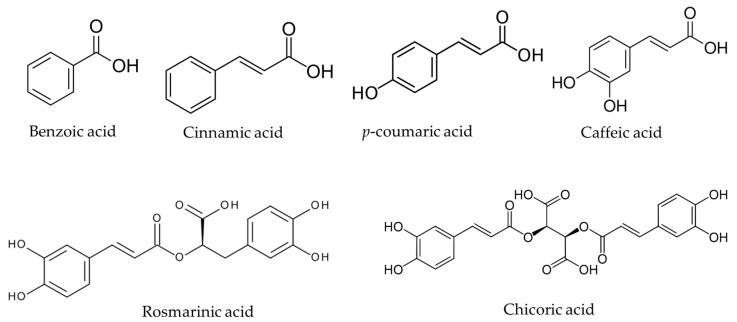
Natural carboxylic acids are plant-derived compounds that are known to possess biological activity. The aim of this review was to compare the effect of structural differences of the selected carboxylic acids (benzoic acid (BA), cinnamic acid (CinA), p-coumaric acid (p-CA), caffeic acid (CFA), rosmarinic acid (RA), and chicoric acid (ChA)) on the antioxidant, antimicrobial, and cytotoxic activity. The studied compounds were arranged in a logic sequence of increasing number of hydroxyl groups and conjugated bonds in order to investigate the correlations between the structure and bioactivity. A review of the literature revealed that RA exhibited the highest antioxidant activity and this property decreased in the following order: RA > CFA ~ ChA > p-CA > CinA > BA. In the case of antimicrobial properties, structure-activity relationships were not easy to observe as they depended on the microbial strain and the experimental conditions. The highest antimicrobial activity was found for CFA and CinA, while the lowest for RA. Taking into account anti-cancer properties of studied NCA, it seems that the presence of hydroxyl groups had an influence on intermolecular interactions and the cytotoxic potential of the molecules, whereas the carboxyl group participated in the chelation of endogenous transition metal ions.
Keywords: antibacterial; antioxidant; cytotoxic activity; hydroxyl groups; natural carboxylic acids; phenolic acids; structure-activity relationship.
Conflict of interest statement
No conflicts of interest have been declared.
Figures
References
-
- Nedorostova L., Kloucek P., Kokoska L., Stolcova M., Pulkrabek J. Antimicrobial properties of selected essential oils in vapour phase against foodborne bacteria. Food Control. 2009;20:157–160. doi: 10.1016/j.foodcont.2008.03.007. - DOI
-
- Mancini E., Camele I., Elshafie H.S., De Martino L., Pellegrino C., Grulova D., De Feo V. Chemical composition and biological activity of the essential oil of Origanum vulgare ssp. hirtum from different areas in the Southern Apennines (Italy) Chem. Biodivers. 2014;11:639–651. doi: 10.1002/cbdv.201300326. - DOI - PubMed
-
- Matejczyk M., Świsłocka R., Golonko A., Lewandowski W., Hawrylik E. Cytotoxic, genotoxic and antimicrobial activity of caffeic and rosmarinic acids and their lithium, sodium and potassium salts as potential anticancer compounds. Adv. Med. Sci. 2018;63:14–21. doi: 10.1016/j.advms.2017.07.003. - DOI - PubMed
Publication types
Grants and funding
LinkOut - more resources
Full Text Sources
