Review
. 2020 Oct 8;21(19):7413.
doi: 10.3390/ijms21197413.

Pericyte-Endothelial Interactions in the Retinal Microvasculature

Affiliations
Review

Pericyte-Endothelial Interactions in the Retinal Microvasculature

Hu Huang. Int J Mol Sci. .

Abstract

Retinal microvasculature is crucial for the visual function of the neural retina. Pericytes and endothelial cells (ECs) are the two main cellular constituents in the retinal microvessels. Formation, maturation, and stabilization of the micro-vasculatures require pericyte-endothelial interactions, which are perturbed in many retinal vascular disorders, such as retinopathy of prematurity, retinal vein occlusion, and diabetic retinopathy. Understanding the cellular and molecular mechanisms of pericyte-endothelial interaction and perturbation can facilitate the design of therapeutic intervention for the prevention and treatment of retinal vascular disorders. Pericyte-endothelial interactions are indispensable for the integrity and functionality of retinal neurovascular unit (NVU), including vascular cells, retinal neurons, and glial cells. The essential autocrine and paracrine signaling pathways, such as Vascular endothelial growth factor (VEGF), Platelet-derived growth factor subunit B (PDGFB), Notch, Angipointein, Norrin, and Transforming growth factor-beta (TGF-β), have been well characterized for the regulation of pericyte-endothelial interactions in the neo-vessel formation processes (vasculogenesis and angiogenesis) during embryonic development. They also play a vital role in stabilizing and remodeling mature vasculature under pathological conditions. Awry signals, aberrant metabolisms, and pathological conditions, such as oxidative stress and inflammation, can disrupt the communication between pericytes and endothelial cells, thereby resulting in the breakdown of the blood-retinal barrier (BRB) and other microangiopathies. The emerging evidence supports extracellular exosomes' roles in the (mis)communications between the two cell types. This review summarizes the essential knowledge and updates about new advancements in pericyte-EC interaction and communication, emphasizing the retinal microvasculature.

Keywords: blood-retinal barrier; diabetic retinopathy; endothelial cells; exosomes; microvasculature; pericytes; placental growth factor; retina; vessel organoids.


Conflict of interest statement

The authors declare that they have no conflicts of interest with this article’s content.

Figures
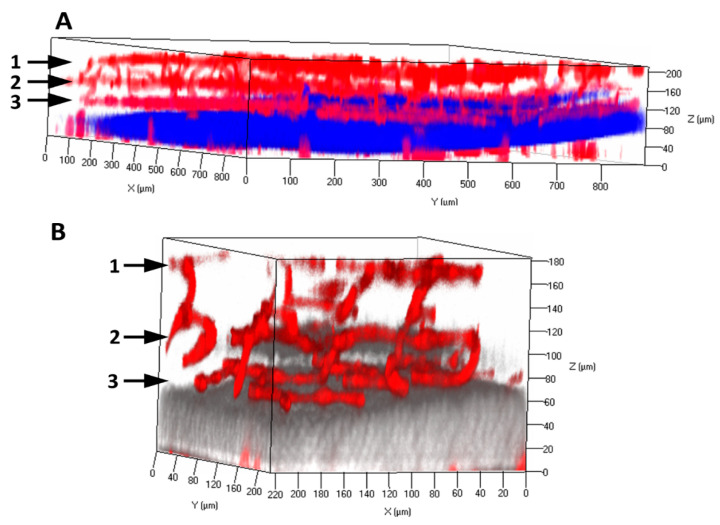
Figure 1
Figure 1
Retinal microvasculature in the adult mouse retina. The retinas were dissected from the adult mice and processed with clarity method. The cleared retinas were performed with the immunofluorescence staining of anti-PECAM1/CD31 primary antibody and Alexa Fluor 594 secondary antibody (red). The three-dimensional (3D) architectures of retinal vasculatures are visualized with low (A) and high magnification (B). One points to superficial vascular plexus at the nerve fiber layer. Two points to intermediate vascular plexus at the inner plexiform form layer. Three points to deep vascular plexus at the outer plexiform layer. The outer inner nuclear layer and the inner nuclear layer were stained with DAPI. The DAPI signals in Panel B were shown with pseudocolor (grey).
Figure 2
Figure 2
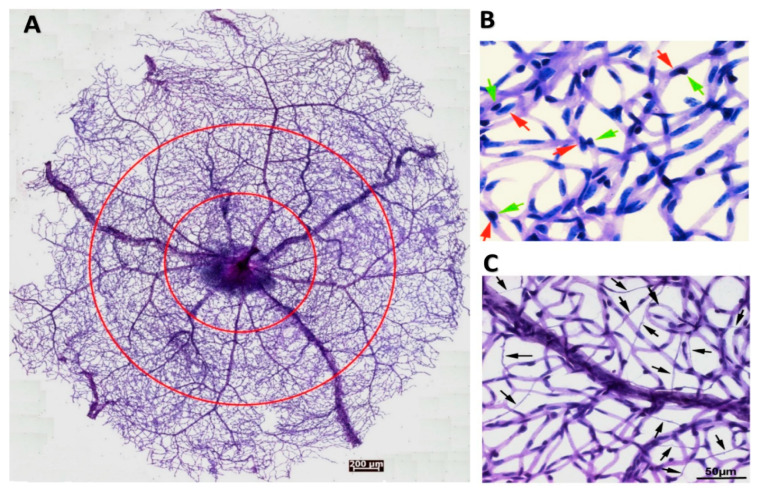
Pericytes-endothelial cell interactions and abnormalities in the retinal microvasculature. (A) Overview of an entire retinal microvasculature made from the adult mouse retina with the trypsin digestion method. The circles divided the vascular network into the periphery, middle, and central zones. (B) The high magnitude of retinal vasculature indicates the close interactions of pericytes and endothelial cells in the normal blood vessel walls. Red arrows point to the nuclei of endothelial cells. Green arrows point to the nuclei of pericytes. (C) The retinal vasculatures are made from the CXCR5 knockout mouse, which was subjected to ischemia-reperfusion injury, leading to a substantial loss of endothelial cells (ECs) and pericytes. Arrows point to the acellular capillary. This image is excerpted from a previous publication with the journal’s permission [22].
Figure 3
Figure 3
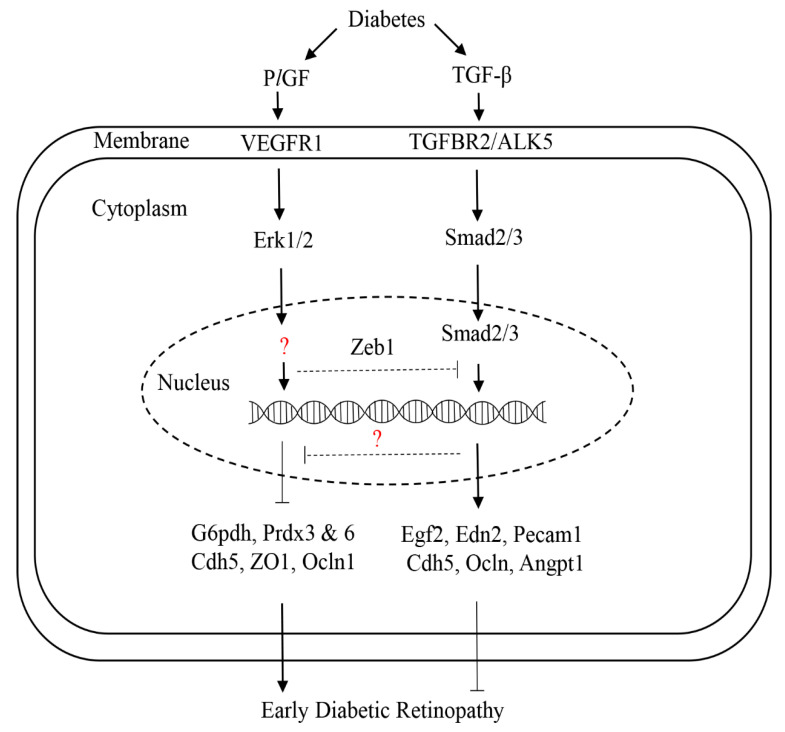
The proposed regulation of PlGF and TGF-β in early diabetic retinopathy. Diabetes upregulates both PlGF and TGF-β in endothelial cells. PlGF can promote early diabetic retinopathy through the activation of VEGFR1 and Erk1/2 signaling, and the expression of downstream target genes, such as G6pdh (pentose phosphate pathway), Prdx3 and 6 (antioxidants), as well as the tight and adhesion junction genes (Cadh5, ZO1, and occludin). The transcription factor(s) that regulate downstream genes’ expressions are to be identified (question maker). Increased TGF-β by diabetes can protect the retina from diabetic injury in the early disease phase through the activation of TGFBR2/ALK5 signaling, which regulates the nuclear translocation of Smad2/3 and then activates the transcription of downstream target genes, such as Egf2, Edn2, and Pcam1. TGF-β can regulate PlGF through the unknown factor (question maker). Arrow lines: stimulation. Blunt line: inhibition.
Figure 4
Figure 4
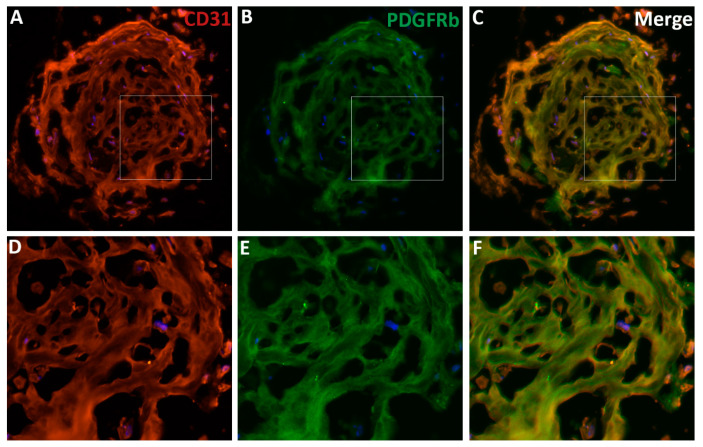
The features of vascular organoids derived from human-induced pluripotent stem cells. (AC) The vascular organoids are differentiated from human induced pluripotent stem cells (iPSCs). The 10-micron cryosections are prepared and stained with the endothelial cell (ECs) marker CD31 (or PECAM1, A, red) and the pericyte marker PDGFRb (B, green). The nuclei were stained with DAPI (blue). (C) The merged image shows the co-localization of the two markers in the blood vessels. (DE) the enlarged images of the boxed areas in panels AC. Note that the integral vascular networks of organoids vasculatures with vessel lumens, ECs, and pericytes in the blood vessels. Human organoids can be an excellent model to study EC-pericyte interaction and other human vascular diseases’ pathophysiology.
Figure 5
Figure 5
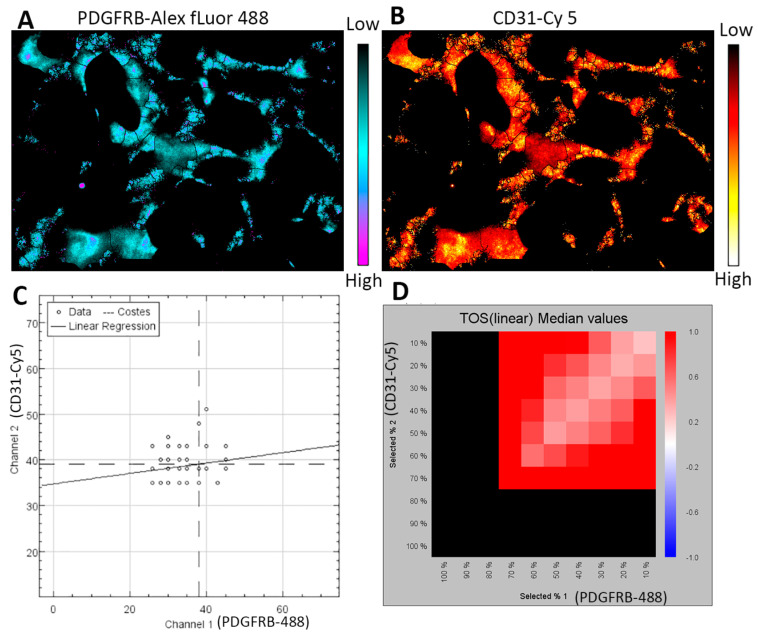
Co-localization analysis of pericytes and endothelial cells in the organoid vasculature. Part of the organoid vasculature (1/6) is used for analysis with the ImageJ software and EzColocalization plugin [96]. (A,B) The heat maps show the localization of PDGFRB and CD31 staining signals in the vessels. The scale bars indicate the signal intensity from low to high. (C) The scatterplot shows the relationship between the signal intensity for PDGFRB-Alex fluor 488 and CD31-Cy 5 channels. Note that (1) the numbers of data represent the vessel segments identified by the software, and (2) data with similar signal intensity for each channel indicate colocalization versus anti-colocalization by the differences in signal intensity. (D) The metric matrix for the threshold overlap score (TOS) linear median values. The X-axis and Y-axis values are the top percentile (FT) of threshold pixels for signal intensity. The black color is not informative. The red color indicates co-localization.

References

    1. Fu Z., Sun Y., Cakir B., Tomita Y., Huang S., Wang Z., Liu C.H., Cho S.S., Britton W., Kern T.S., et al. Targeting Neurovascular Interaction in Retinal Disorders. Int. J. Mol. Sci. 2020;21:1503. doi: 10.3390/ijms21041503. - DOI - PMC - PubMed
    1. Antonetti D.A., Klein R., Gardner T.W. Diabetic retinopathy. N. Engl. J. Med. 2012;366:1227–1239. doi: 10.1056/NEJMra1005073. - DOI - PubMed
    1. Huang H., Gandhi J.K., Zhong X., Wei Y., Gong J., Duh E.J., Vinores S.A. TNFalpha is required for late BRB breakdown in diabetic retinopathy, and its inhibition prevents leukostasis and protects vessels and neurons from apoptosis. Investig. Ophthalmol. Vis. Sci. 2011;52:1336–1344. doi: 10.1167/iovs.10-5768. - DOI - PMC - PubMed
    1. Abcouwer S.F., Lin C.M., Shanmugam S., Muthusamy A., Barber A.J., Antonetti D.A. Minocycline prevents retinal inflammation and vascular permeability following ischemia-reperfusion injury. J. Neuroinflamm. 2013;10:149. doi: 10.1186/1742-2094-10-149. - DOI - PMC - PubMed
    1. Armulik A., Abramsson A., Betsholtz C. Endothelial/pericyte interactions. Circ. Res. 2005;97:512–523. doi: 10.1161/01.RES.0000182903.16652.d7. - DOI - PubMed

LinkOut - more resources