Review
. 2020 Oct 9;9(10):968.
doi: 10.3390/antiox9100968.

Circadian Rhythm in Adipose Tissue: Novel Antioxidant Target for Metabolic and Cardiovascular Diseases

Affiliations
Review

Circadian Rhythm in Adipose Tissue: Novel Antioxidant Target for Metabolic and Cardiovascular Diseases

Andy W C Man et al. Antioxidants (Basel). .

Abstract

Obesity is a major risk factor for most metabolic and cardiovascular disorders. Adipose tissue is an important endocrine organ that modulates metabolic and cardiovascular health by secreting signaling molecules. Oxidative stress is a common mechanism associated with metabolic and cardiovascular complications including obesity, type 2 diabetes, and hypertension. Oxidative stress can cause adipose tissue dysfunction. Accumulating data from both humans and experimental animal models suggest that adipose tissue function and oxidative stress have an innate connection with the intrinsic biological clock. Circadian clock orchestrates biological processes in adjusting to daily environmental changes according to internal or external cues. Recent studies have identified the genes and molecular pathways exhibiting circadian expression patterns in adipose tissue. Disruption of the circadian rhythmicity has been suggested to augment oxidative stress and aberrate adipose tissue function and metabolism. Therefore, circadian machinery in the adipose tissue may be a novel therapeutic target for the prevention and treatment of metabolic and cardiovascular diseases. In this review, we summarize recent findings on circadian rhythm and oxidative stress in adipose tissue, dissect the key components that play a role in regulating the clock rhythm, oxidative stress and adipose tissue function, and discuss the potential use of antioxidant treatment on metabolic and cardiovascular diseases by targeting the adipose clock.

Keywords: Adipokines; branched-chain amino acids; clock genes; endothelial nitric oxide synthase; oxidative stress; sirtuin 1.


Conflict of interest statement

The authors declare no conflict of interest.

Figures
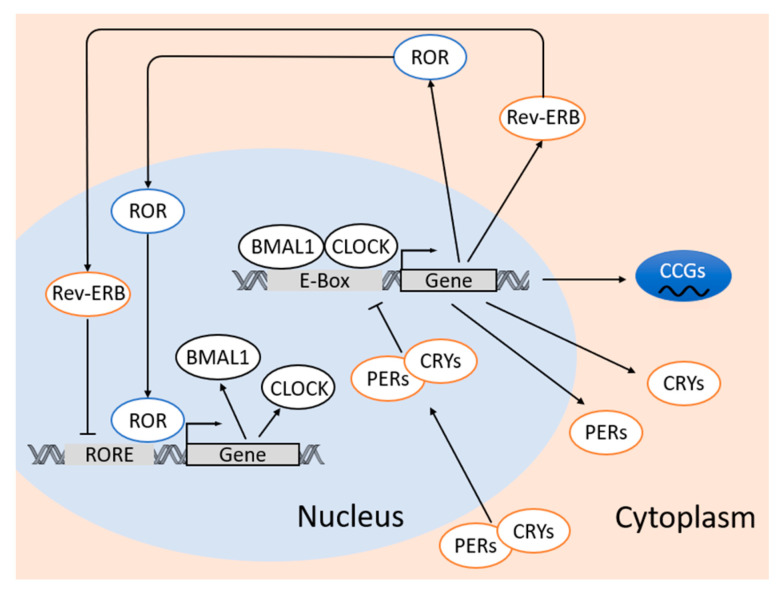
Figure 1
Figure 1
Molecular clock mechanism in adipose tissue. The molecular clockwork in adipose tissue relies on the dimerization of BMAL1 and CLOCK proteins, whereas the heterodimer of CLOCK:BMAL1 binds to E-box sequence (5′-CACGTG-3′) in the promoters and activates the transcription of Per1–3, Cry1/2, ROR and Rev-ERB. When the cytoplasmic levels of PERs and CRYs reach a certain threshold, PERs and CRYs dimerize and translocate into the nucleus and inhibit the CLOCK:BMAL1-mediated transcription. REV-ERB negatively regulates Bmal1 and Clock expression, whereas RORs positively regulate Bmal1 and Clock expression via ROR response elements (RORE) at the promotor regions. The molecular circadian clock also leads to rhythmic expression of clock-controlled genes (CCGs) through CLOCK:BMAL1-mediated activation of circadian promoter elements including E-boxes, D-boxes, and ROR response elements. BMAL1, brain and muscle Aryl hydrocarbon receptor nuclear translocator--like protein 1; CLOCK, circadian locomotor output cycles kaput; CRY, Cryptochrome; PER, Period; REV-ERB, reverse ERB; ROR, retinoic acid receptor-related orphan receptors.
Figure 2
Figure 2
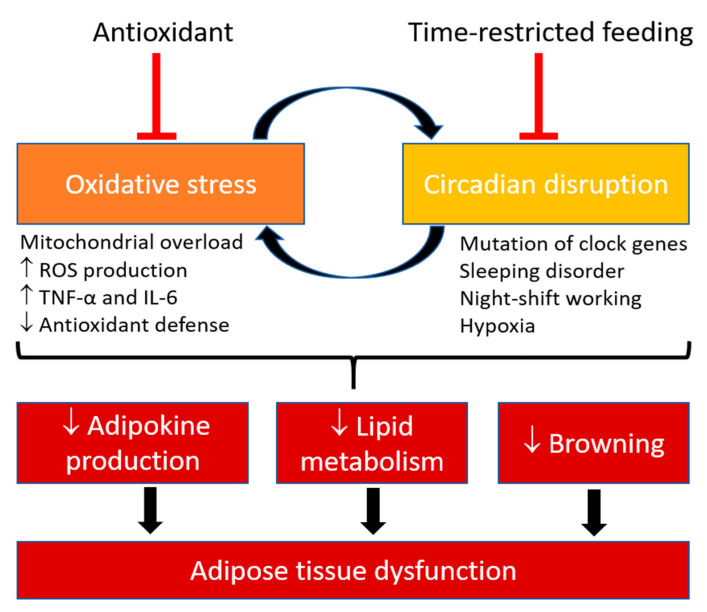
Oxidative stress and circadian rhythm are interrelated in modulating adipose tissue function. Circadian clock regulates the rhythmic oscillation of cellular redox function, while changes in redox state in the cell can influence the clock machinery. Oxidative stress occurs when the production of oxidant molecules exceeds the capacity of antioxidants to defend against these insults. The cellular redox state has been known to oscillate over circadian. Animal models of circadian disruption by hypoxia, clock genes knockout or mutant, night-shift workers and patients with sleeping disorder are reported to have increased oxidative stress and reduced antioxidant defence. Disruption of circadian and increased oxidative stress lead to reduction of adipokine productions, lipid metabolism and browning process in adipose tissue. Metabolic and cardiovascular diseases that are caused by disruption of circadian rhythm and increased oxidative stress can be prevented by antioxidants treatment and time-restricted feeding. ROS, reactive oxygen species; TNF-α, Tumor necrosis factor alpha; IL-6, interleukin 6.
Figure 3
Figure 3
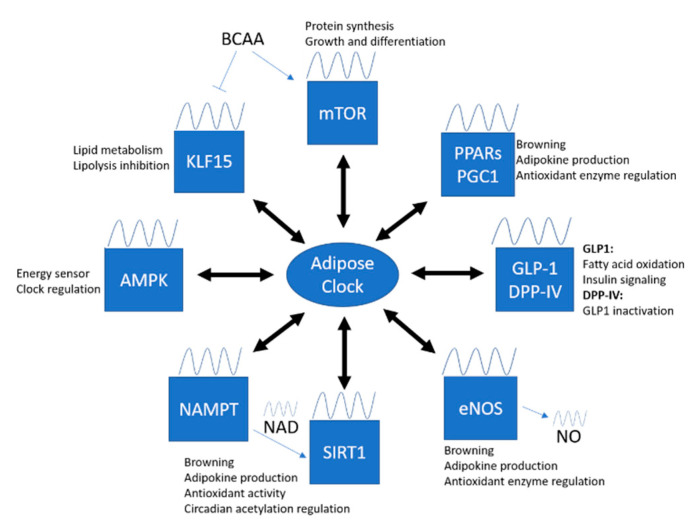
Crosstalk between adipose tissue clock and important signaling targets. Considerable evidence has been shown to support the hypothesis that oxidative stress and circadian rhythm are interrelated. Identification of important CGGs and pathway involved in adipose tissue function is important to improve the understanding of clock involvement in the pathophysiology of metabolic diseases. The intact circadian oscillations of these targets are important in maintaining the balance between oxidative status and energy metabolism in the adipose tissue. mTOR, mammalian target of rapamycin; PPARs, peroxisome proliferator-activated receptors; PGC1, PPARγ coactivator 1; GLP-1, glucagon-like petide-1; DPP-IV, dipeptidyl peptidase-IV; eNOS, endothelial nitric oxide synthase; NO, nitric oxide; SIRT1, sirtuin 1; NAD; nicotinamide adenine dinucleotide; NAMPT; nicotinamide phosphoribosyltransferase; AMPK, 5’ adenosine monophosphate-activated protein kinase; KLF15, Krüppel-like factor 15; BCAA, branched-chain amino acid.

References

    1. Collaborators G.O. Health effects of overweight and obesity in 195 countries over 25 years. N. Engl. J. Med. 2017;377:13–27. doi: 10.1056/NEJMoa1614362. - DOI - PMC - PubMed
    1. Lavie C.J., Milani R.V., Ventura H.O. Obesity and cardiovascular disease: Risk factor, paradox, and impact of weight loss. J. Am. Coll. Cardiol. 2009;53:1925–1932. doi: 10.1016/j.jacc.2008.12.068. - DOI - PubMed
    1. Bass J., Lazar M.A. Circadian time signatures of fitness and disease. Science. 2016;354:994–999. doi: 10.1126/science.aah4965. - DOI - PubMed
    1. Fasshauer M., Bluher M. Adipokines in health and disease. Trends Pharm. Sci. 2015;36:461–470. doi: 10.1016/j.tips.2015.04.014. - DOI - PubMed
    1. Shostak A., Meyer-Kovac J., Oster H. Circadian regulation of lipid mobilization in white adipose tissues. Diabetes. 2013;62:2195–2203. doi: 10.2337/db12-1449. - DOI - PMC - PubMed

LinkOut - more resources