Review
. 2020 Oct 11;21(20):7481.
doi: 10.3390/ijms21207481.

Positron Emission Tomography (PET) and Neuroimaging in the Personalized Approach to Neurodegenerative Causes of Dementia

Affiliations
Review

Positron Emission Tomography (PET) and Neuroimaging in the Personalized Approach to Neurodegenerative Causes of Dementia

Maria Ricci et al. Int J Mol Sci. .

Abstract

Generally, dementia should be considered an acquired syndrome, with multiple possible causes, rather than a specific disease in itself. The leading causes of dementia are neurodegenerative and non-neurodegenerative alterations. Nevertheless, the neurodegenerative group of diseases that lead to cognitive impairment and dementia includes multiple possibilities or mixed pathologies with personalized treatment management for each cause, even if Alzheimer's disease is the most common pathology. Therefore, an accurate differential diagnosis is mandatory in order to select the most appropriate therapy approach. The role of personalized assessment in the treatment of dementia is rapidly growing. Neuroimaging is an essential tool for differential diagnosis of multiple causes of dementia and allows a personalized diagnostic and therapeutic protocol based on risk factors that may improve treatment management, especially in early diagnosis during the prodromal stage. The utility of structural and functional imaging could be increased by standardization of acquisition and analysis methods and by the development of algorithms for automated assessment. The aim of this review is to focus on the most commonly used tracers for differential diagnosis in the dementia field. Particularly, we aim to explore 18F Fluorodeoxyglucose (FDG) and amyloid positron emission tomography (PET) imaging in Alzheimer's disease and in other neurodegenerative causes of dementia.

Keywords: Alzheimer’s disease; FDG; alpha-synucleinopathies; dementia; frontotemporal dementia.


Conflict of interest statement

The authors declare no conflict of interest.

Figures
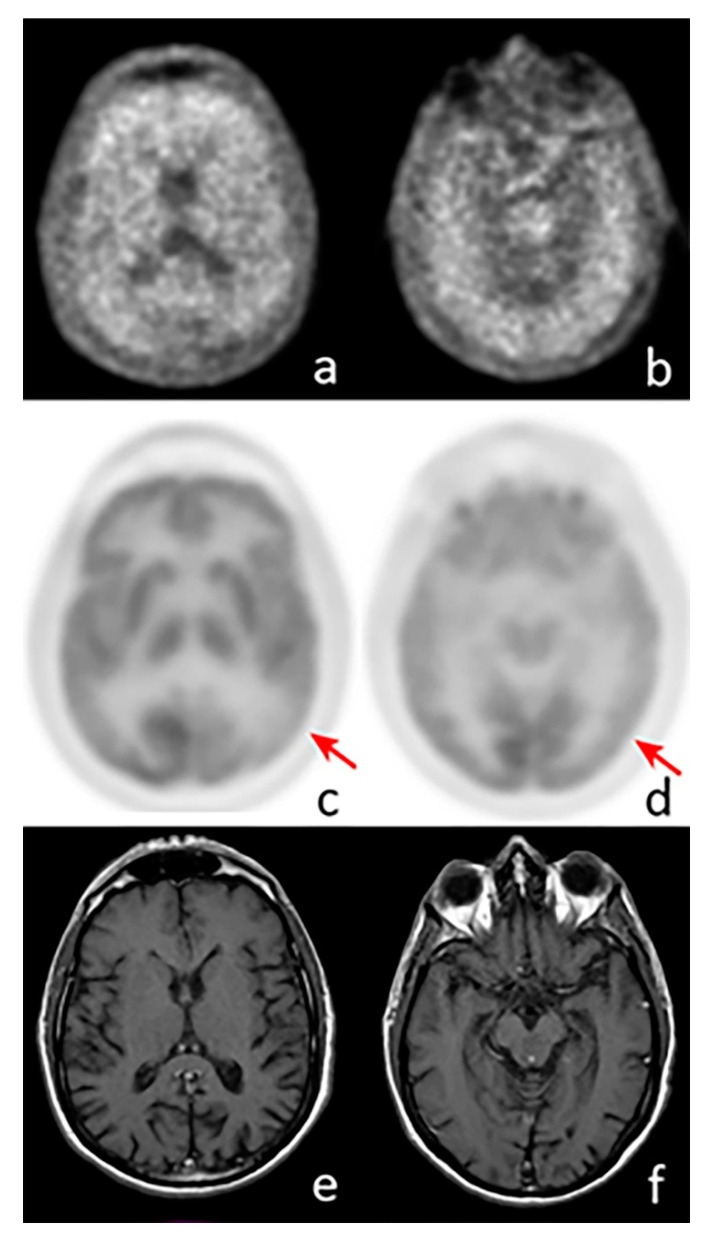
Figure 1
Figure 1
Axial images of a positron emission tomography (PET) scan performed with 18F-Florbetaben (a,b), 18F-Fluorodeoxyglucose (c,d), and MRI (e,f) in a patient with suspected AD. The images show pathological amyloid burden in the cortex, while a significant reduction in cortical glucose consumption is visible in the left parietal (c, arrow) and temporal lobes (d, arrow). MRI does not show any abnormal findings.
Figure 2
Figure 2
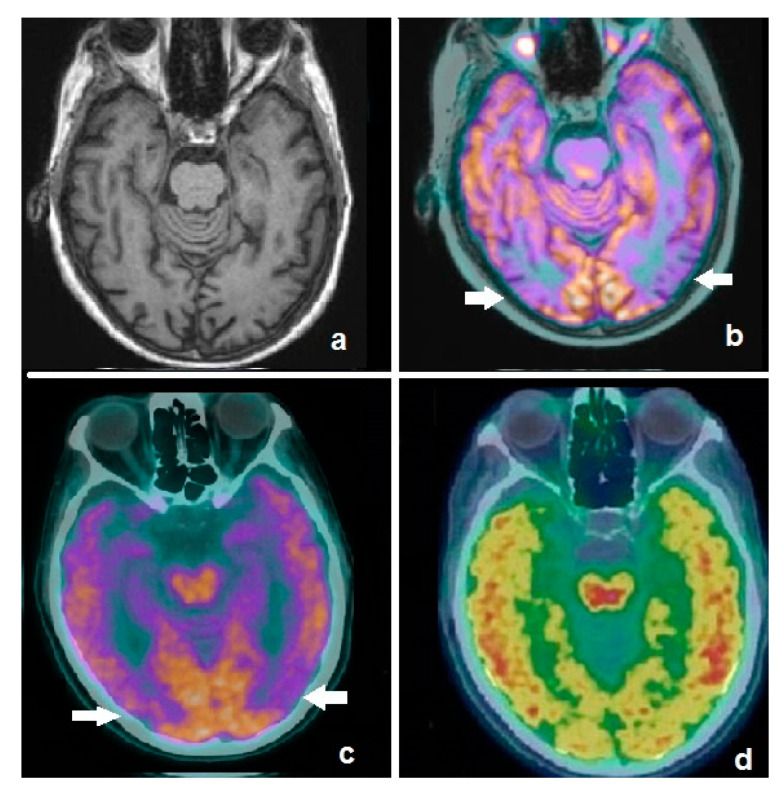
Axial image of an MRI scan in a patient affected by mild cognitive impairment (a), showing no significant abnormalities. Fused corresponding 18F-FDG PET/MRI demonstrates hypometabolism in temporo-occipital lobes (b, white arrows). Patient was submitted to dual-phase amyloid PET with 18F-flutemetamol: the early phase demonstrates an AD-typical pattern (c, white arrows), substantially overlapping with the 18F-FDG findings, while the late phase shows pathological amyloid burden in the cortex (d). Dual-phase amyloid PET resulted to be useful for the simultaneous detection of neuronal dysfunction and amyloid burden.
Figure 3
Figure 3
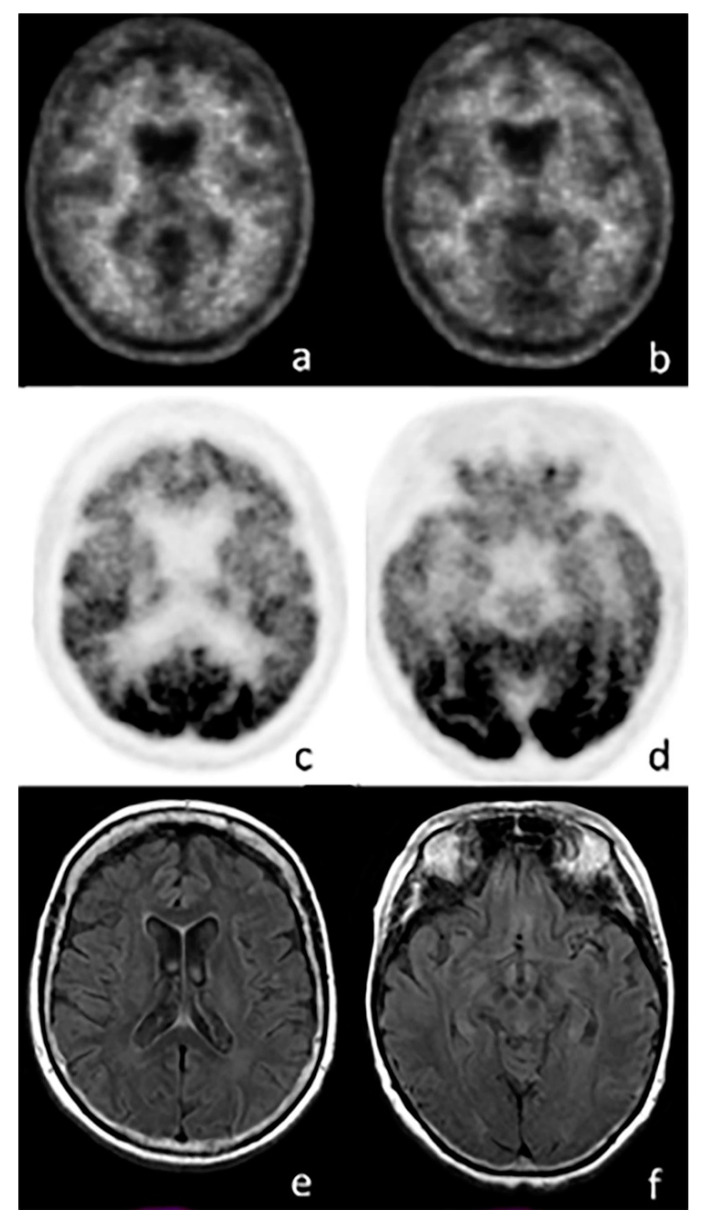
Axial images of a PET scan performed with 18F-FBB (a,b), 18F-FDG (c,d), and MRI (e,f) in a patient with suspected frontotemporal dementia (FTD). The images show no amyloid burden in the cortex, while a significant reduction in cortical glucose consumption is visible in the frontal (c) and temporal lobes (d). MRI does not show any abnormal findings.
Figure 4
Figure 4
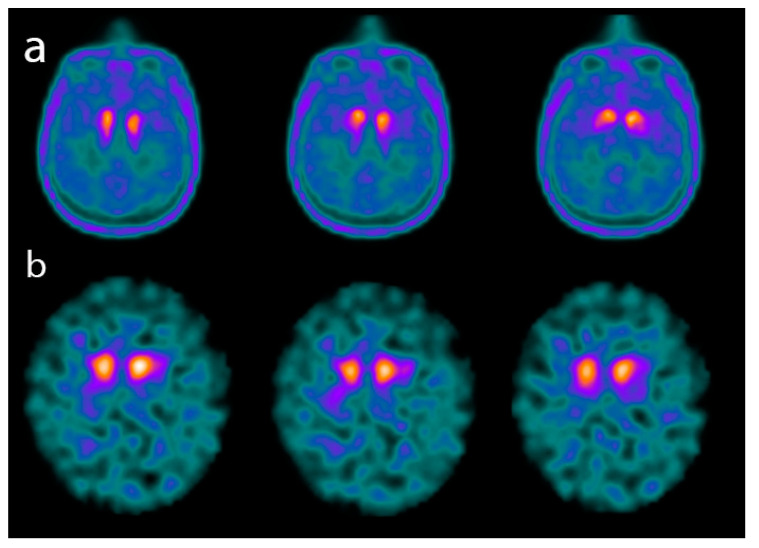
Axial images of a PET scan performed with 18F-Fluoro-L-dopa (FDOPA) (a) and of a single-photon emission CT (SPECT) scan performed with 123I-FPCIT (DATSCAN) (b) in two patients affected by advanced dementia with Lewy bodies (DLB). The images show a significant reduction in both 18F-FDOPA and 123I-FPCIT uptake in the basal ganglia.

References

    1. Prince M., Bryce R., Albanese E., Wimo A., Ribeiro W., Ferri C.P. The global prevalence of dementia: A systematic review and metaanalysis. Alzheimers Dement. 2013;56:963–975.e2. doi: 10.1016/j.jalz.2012.11.007. - DOI - PubMed
    1. Gale S.A., Acar D., Daffner K.R. Dementia. Am. J. Med. 2018;131:1161–1169. doi: 10.1016/j.amjmed.2018.01.022. - DOI - PubMed
    1. Hebert L.E., Weuve J., Scherr P.A., Evans D.A. Alzheimer disease in the United States (2010–2050) estimated using the 2010 census. Neurology. 2013;7:1778–1783. doi: 10.1212/WNL.0b013e31828726f5. - DOI - PMC - PubMed
    1. Dubois B., Hampel H., Feldman H.H., Scheltens P., Aisen P., Andrieu S., Bakardjian H., Benali H., Bertram L., Blennow K., et al. Preclinical Alzheimer’s disease: Definition, natural history, and diagnostic criteria. Alzheimers Dement. 2016;12:292–323. doi: 10.1016/j.jalz.2016.02.002. - DOI - PMC - PubMed
    1. Braak H., Braak E. Neuropathological stageing of Alzheimer-related changes. Acta Neuropathol. 1991;82:239–259. doi: 10.1007/BF00308809. - DOI - PubMed

MeSH terms