


Cost-effectiveness of brentuximab vedotin in advanced stage Hodgkin's lymphoma: a probabilistic analysis
- PMID: 33050897
- PMCID: PMC7557030
- DOI: 10.1186/s12885-020-07374-3
Cost-effectiveness of brentuximab vedotin in advanced stage Hodgkin's lymphoma: a probabilistic analysis
Abstract
Background: Treatment with ABVD (doxorubicin, bleomycin, vinblastine, and dacarbazine) is a well-established therapy for advanced Hodgkin's lymphoma (HL). However, the recently completed ECHELON-1 trial showed potential net clinical benefit for brentuximab vedotin (BREN+AVD) compared to ABVD as frontline therapy in patients with advanced Hodgkin's lymphoma. The objective of this analysis is to determine whether, on current evidence, BREN+AVD is cost-effective relative to ABVD as frontline therapy in patients with advanced HL.
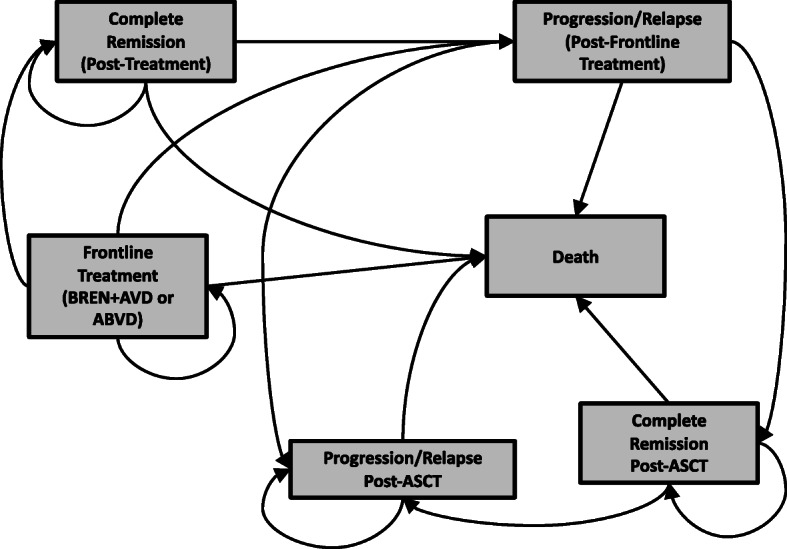
Methods: We constructed a probabilistic Markov model with two arms and six mutually exclusive health states, using six-month cycle lengths, and a 15-year time horizon. Time-dependent transition probabilities were calculated from 'real-world' data collected by the BC Cancer's Centre for Lymphoid Cancer database or from the literature for ABVD. Time-dependent transition probabilities for BREN+AVD were taken from the ECHELON-1 trial. We estimated the incremental cost and effects per patient of each therapy and calculated the incremental cost-effectiveness ratio (ICER). Costs were measured in 2018 Canadian dollars and effects measured in quality-adjusted life years (QALYs). A probabilistic analysis was used to generate a cost-effectiveness acceptability curve (CEAC).
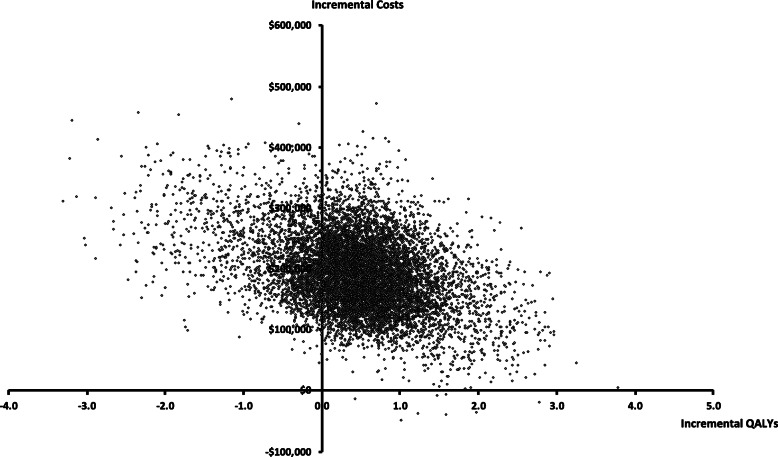
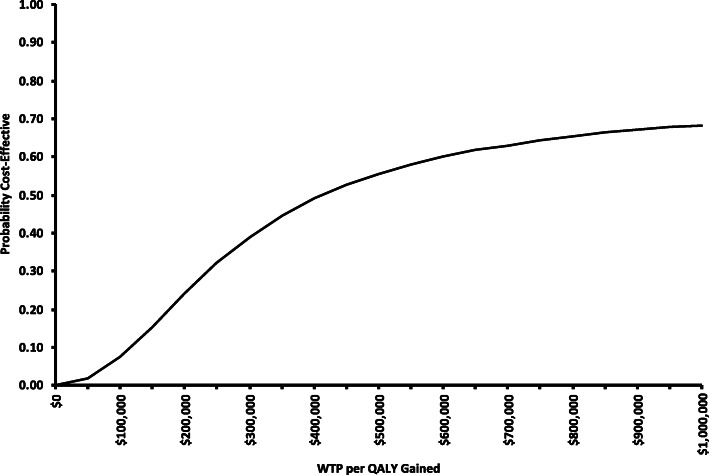
Results: The incremental cost between standard therapy with ABVD and therapy with BREN+AVD was estimated to be $192,336. The regimen of BREN+AVD resulted in a small benefit in terms of QALYs (0.46 QALYs). The estimated ICER was $418,122 per QALY gained. The probabilistic analysis suggests very few (8%) simulations fall below $100,000 per QALY. Even at a threshold of $200,000 per QALY gained, there was only a 24% chance that BREN+AVD would be considered cost-effective. Sensitivity analyses evaluating price reductions for brentuximab showed that these reductions needed to be in excess of 70% for this regimen to be cost-effective at a threshold of $100,000 per QALY.
Conclusions: There may be a clinical benefit associated with BREN+AVD, but on current evidence the benefit is not adequately substantive compared to ABVD therapy given the cost of brentuximab vedotin. Agencies responsible for making decisions about BREN+AVD as frontline therapy for patients with advanced HL should consider whether they are willing to implement this treatment given the current uncertainty and cost-benefit profile, or negotiate substantial price-reductions from the manufacturer should they choose to reimburse.
Keywords: Brentuximab vedotin; Cost-effectiveness; Economic evaluation; Hodgkin’s lymphoma.
Conflict of interest statement
Adam Raymakers reports having received compensation from the Canadian Agency for Drugs and Technologies in Health (specifically from the pan-Canadian Oncology Drug Review for providing economic guidance about oncology drug submissions). Dean Regier has received funding unrelated to this work for conference travel from Illumina and honoraria from Roche.
Figures
References
-
- Canadian Cancer Statistics Advisory Committee . Canadian Cancer Statistics. Toronto: Canadian Cancer Society; 2019.
-
- Shenoy P, Maggioncalda A, Malik N, Flowers CR. Incidence Patterns and Outcomes for Hodgkin Lymphoma Patients in the United States. Adv Hematol. 2011;2011 [cited 2020 Mar 31]. Available from: https://www.ncbi.nlm.nih.gov/pmc/articles/PMC3010617/. - PMC - PubMed
-
- Richardson SE, McNamara C. The Management of Classical Hodgkin’s Lymphoma: Past, Present, and Future [Internet]. 2011, Advances in Hematology. Hindawi; 2011. p. e865870. [cited 2020 Mar 31]. Available from: https://www.hindawi.com/journals/ah/2011/865870/. - PMC - PubMed
MeSH terms
Substances
LinkOut - more resources
Full Text Sources
Medical
