


Genotype-Phenotype Features of Germline Variants of the TMEM127 Pheochromocytoma Susceptibility Gene: A 10-Year Update
- PMID: 33051659
- PMCID: PMC7765648
- DOI: 10.1210/clinem/dgaa741
Genotype-Phenotype Features of Germline Variants of the TMEM127 Pheochromocytoma Susceptibility Gene: A 10-Year Update
Abstract
Purpose: This work aimed to evaluate genotype-phenotype associations in individuals carrying germline variants of transmembrane protein 127 gene (TMEM127), a poorly known gene that confers susceptibility to pheochromocytoma (PHEO) and paraganglioma (PGL).
Design: Data were collected from a registry of probands with TMEM127 variants, published reports, and public databases.
Main outcome analysis: Clinical, genetic, and functional associations were determined.
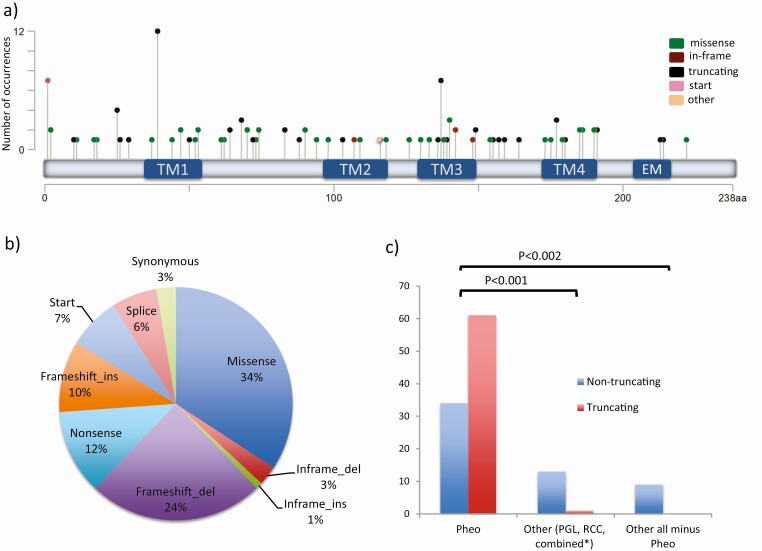
Results: The cohort comprised 110 index patients (111 variants) with a mean age of 45 years (range, 21-84 years). Females were predominant (76 vs 34, P < .001). Most patients had PHEO (n = 94; 85.5%), although PGL (n = 10; 9%) and renal cell carcinoma (RCC, n = 6; 5.4%) were also detected, either alone or in combination with PHEO. One-third of the cases had multiple tumors, and known family history was reported in 15.4%. Metastatic PHEO/PGL was rare (2.8%). Epinephrine alone, or combined with norepinephrine, accounted for 82% of the catecholamine profiles of PHEO/PGLs. Most variants (n = 63) occurred only once and 13 were recurrent (2-12 times). Although nontruncating variants were less frequent than truncating changes overall, they were predominant in non-PHEO clinical presentations (36% PHEO-only vs 69% other, P < .001) and clustered disproportionately within transmembrane regions (P < .01), underscoring the relevance of these domains for TMEM127 function. Integration of clinical and previous experimental data supported classification of variants into 4 groups based on mutation type, localization, and predicted disruption.
Conclusions: Patients with TMEM127 variants often resemble sporadic nonmetastatic PHEOs. PGL and RCC may also co-occur, although their causal link requires further evaluation. We propose a new classification to predict variant pathogenicity and assist with carrier surveillance.
Keywords: TMEM127; genotype-phenotype association; paraganglioma; pheochromocytoma; tumor suppressor gene.
© The Author(s) 2020. Published by Oxford University Press on behalf of the Endocrine Society. All rights reserved. For permissions, please e-mail: journals.permissions@oup.com.
Figures
References
-
- Dahia PL. Evolving concepts in pheochromocytoma and paraganglioma. Curr Opin Oncol. 2006;18(1):1-8. - PubMed
-
- Chen H, Sippel RS, O’Dorisio MS, Vinik AI, Lloyd RV, Pacak K; North American Neuroendocrine Tumor Society (NANETS) . The North American Neuroendocrine Tumor Society consensus guideline for the diagnosis and management of neuroendocrine tumors: pheochromocytoma, paraganglioma, and medullary thyroid cancer. Pancreas. 2010;39(6):775-783. - PMC - PubMed
-
- Dahia PL. Pheochromocytoma and paraganglioma pathogenesis: learning from genetic heterogeneity. Nat Rev Cancer. 2014;14(2):108-119. - PubMed
-
- Toledo RA, Burnichon N, Cascon A, et al. . Consensus statement on next-generation-sequencing-based diagnostic testing of hereditary phaeochromocytomas and paragangliomas. Nat Rev Endocrinol. 2017;13(4):233-247. - PubMed
Publication types
MeSH terms
Substances
Grants and funding
LinkOut - more resources
Full Text Sources
Medical
Molecular Biology Databases
Miscellaneous
