


Dietary Fiber, Genetic Variations of Gut Microbiota-derived Short-chain Fatty Acids, and Bone Health in UK Biobank
- PMID: 33051670
- PMCID: PMC8186524
- DOI: 10.1210/clinem/dgaa740
Dietary Fiber, Genetic Variations of Gut Microbiota-derived Short-chain Fatty Acids, and Bone Health in UK Biobank
Abstract
Context: Dietary fiber intake may relate to bone health.
Objective: To investigate whether dietary fiber intake is associated with bone mineral density (BMD), and the modification effect of genetic variations related to gut microbiota-derived short-chain fatty acids (SCFAs).
Design: The associations of dietary fiber intake with estimated BMD derived from heel ultrasound and fractures were assessed in 224 630 and 384 134 participants from the UK Biobank.
Setting: UK Biobank.
Main outcome measures: Estimated BMD derived from heel ultrasound.
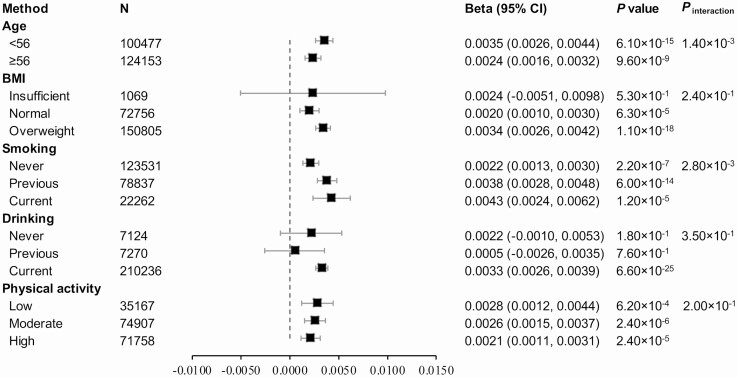
Results: Higher dietary fiber intake (per standard deviation) was significantly associated with higher heel-BMD (β [standard error] = 0.0047 [0.0003], P = 1.10 × 10-54). Similarly significant associations were observed for all the fiber subtypes including cereal, fruit (dried and raw), and vegetable (cooked and raw) (all P < .05). A positive association was found in both women and men but more marked among men except for dietary fiber in cooked vegetables (all Pinteraction < .05). A protective association was found between dietary fiber intake and hip fracture (hazard ratio, 95% confidence interval: 0.94, 0.89-0.99; P = 3.0 × 10⁻²). In addition, the association between dietary fiber and heel BMD was modified by genetically determined SCFA propionate production (Pinteraction = 5.1 × 10⁻³). The protective association between dietary fiber and heel BMD was more pronounced among participants with lower genetically determined propionate production.
Conclusions: Our results indicate that greater intakes of total dietary fiber and subtypes from various food sources are associated with higher heel-BMD. Participants with lower genetically determined propionate production may benefit more from taking more dietary fiber.
Keywords: bone mineral density; dietary fiber; short-chain fatty acids.
© The Author(s) 2020. Published by Oxford University Press on behalf of the Endocrine Society. All rights reserved. For permissions, please e-mail: journals.permissions@oup.com.
Figures

References
-
- WHO. Global Health Observatory (GHO) data. 2019. ProMED-mail website. https://www.who.int/gho/mortality_burden_disease/life_tables/situation_t.... Accessed April 16, 2020.
-
- Ohlsson C, Sjögren K. Effects of the gut microbiota on bone mass. Trends Endocrinol Metab. 2015;26(2):69-74. - PubMed
-
- Rizzoli R. Nutritional influence on bone: role of gut microbiota. Aging Clin Exp Res. 2019;31(6):743-751. - PubMed
Publication types
MeSH terms
Substances
Grants and funding
LinkOut - more resources
Full Text Sources
Medical
