Clinical Features and Outcomes of Pregnancy-Related Acute Aortic Dissection
- PMID: 33052376
- PMCID: PMC7557715
- DOI: 10.1001/jamacardio.2020.4876
Clinical Features and Outcomes of Pregnancy-Related Acute Aortic Dissection
Abstract
Importance: Women with aortopathy conditions are at risk for pregnancy-related aortic dissection, and these conditions may not be recognized until after the aortic dissection occurs.
Objective: To examine the clinical characteristics, imaging features, and outcomes in women with pregnancy-related acute aortic dissection.
Design, setting, and participants: A cohort study, comprising data from the International Registry of Acute Aortic Dissection (IRAD) (February 1, 1998, to February 28, 2018). The multicenter referral center study included 29 women with aortic dissection during pregnancy or less than 12 weeks post partum in IRAD from 1998 to 2018.
Main outcomes and measures: Clinical features of pregnancy-related aortic dissection to be studied included underlying aortopathy, aortic size, type of aortic dissection, timing of dissection, hypertension, and previous aortic surgery.
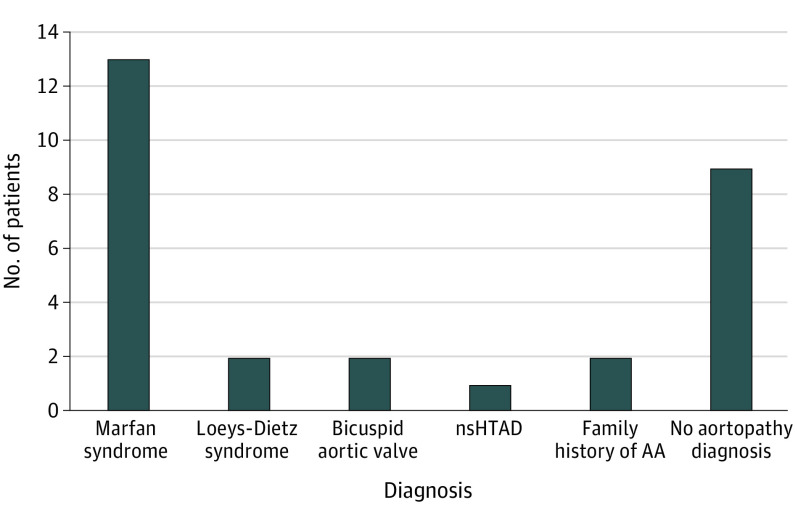
Results: A total of 29 women (mean [SD] age, 32 [6] years) had pregnancy-related aortic dissection, representing 0.3% of all aortic dissections and 1% of aortic dissection in women in the IRAD. Among women younger than 35 years, aortic dissection was related to pregnancy in 20 of 105 women (19%). Thirteen women (45%) had type A aortic dissection, and 16 women (55%) had type B. Aortic dissection onset was known in 27 women (93%): 15 during pregnancy, 4 in the first trimester, and 11 in the third trimester; 12 were post partum, occurring a mean (SD) of 12.5 (14) days post partum. At type A aortic dissection diagnosis, the mean (SD) aortic diameters were sinus of Valsalva, 54.5 (5) mm and ascending aorta, 54.7 (6) mm. At type B aortic dissection diagnosis, the mean (SD) descending aortic diameter was 32.5 (5) mm. Twenty women (69%) had an aortopathy condition or a positive family history: 13 women (65%) with Marfan syndrome, 2 women (10%) with Loeys-Dietz syndrome, 2 women (10%) with bicuspid aortic valves, 2 women (10%) with a family history of aortic disease, and 1 woman (5%) with familial thoracic aortic aneurysm. Aortopathy was not recognized until after aortic dissection in 47% of the women. Twenty-eight women (97%) survived aortic dissection hospitalization.
Conclusions and relevance: Aortic dissection complicating pregnancy is rare. Most pregnancy-related aortic dissection is due to an aortopathy often not diagnosed until after aortic dissection. In this study, type A aortic dissections were associated with a dilated aorta, and type B aortic dissections often were not. Recognition of underlying conditions and risks for aortic dissection may improve management of pregnancy in women with aortopathy.
Conflict of interest statement
Figures
Comment in
-
Aortic Dissection With Pregnancy-Anticipating Prepartum and Postpartum Risk.JAMA Cardiol. 2021 Jan 1;6(1):66-67. doi: 10.1001/jamacardio.2020.4884. JAMA Cardiol. 2021. PMID: 33052378 No abstract available.
References
-
- Hiratzka LF, Bakris GL, Beckman JA, et al. ; American College of Cardiology Foundation/American Heart Association Task Force on Practice Guidelines; American Association for Thoracic Surgery; American College of Radiology; American Stroke Association; Society of Cardiovascular Anesthesiologists; Society for Cardiovascular Angiography and Interventions; Society of Interventional Radiology; Society of Thoracic Surgeons; Society for Vascular Medicine . 2010 ACCF/AHA/AATS/ACR/ASA/SCA/SCAI/SIR/STS/SVM guidelines for the diagnosis and management of patients with Thoracic Aortic Disease: a report of the American College of Cardiology Foundation/American Heart Association Task Force on Practice Guidelines, American Association for Thoracic Surgery, American College of Radiology, American Stroke Association, Society of Cardiovascular Anesthesiologists, Society for Cardiovascular Angiography and Interventions, Society of Interventional Radiology, Society of Thoracic Surgeons, and Society for Vascular Medicine. Circulation. 2010;121(13):e266-e369. - PubMed
-
- Silversides CK, Kiess M, Beauchesne L, et al. . Canadian Cardiovascular Society 2009 Consensus Conference on the management of adults with congenital heart disease: outflow tract obstruction, coarctation of the aorta, tetralogy of Fallot, Ebstein anomaly and Marfan’s syndrome. Can J Cardiol. 2010;26(3):e80-e97. doi:10.1016/S0828-282X(10)70355-X - DOI - PMC - PubMed
MeSH terms
LinkOut - more resources
Full Text Sources
Medical