


Edible Seaweeds and Spirulina Extracts for Food Application: In Vitro and In Situ Evaluation of Antimicrobial Activity towards Foodborne Pathogenic Bacteria
- PMID: 33053649
- PMCID: PMC7601287
- DOI: 10.3390/foods9101442
Edible Seaweeds and Spirulina Extracts for Food Application: In Vitro and In Situ Evaluation of Antimicrobial Activity towards Foodborne Pathogenic Bacteria
Abstract
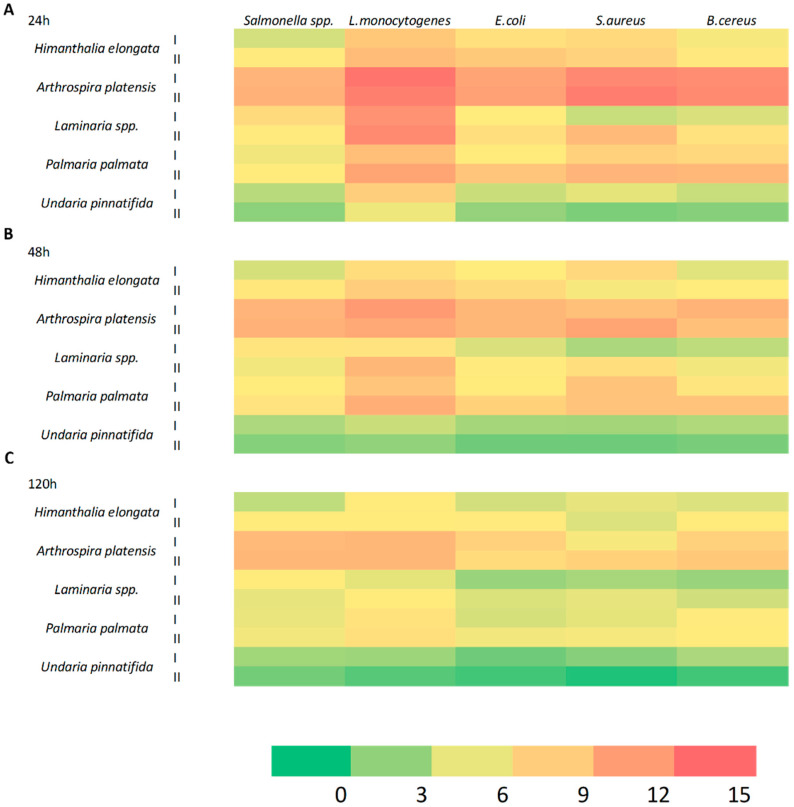
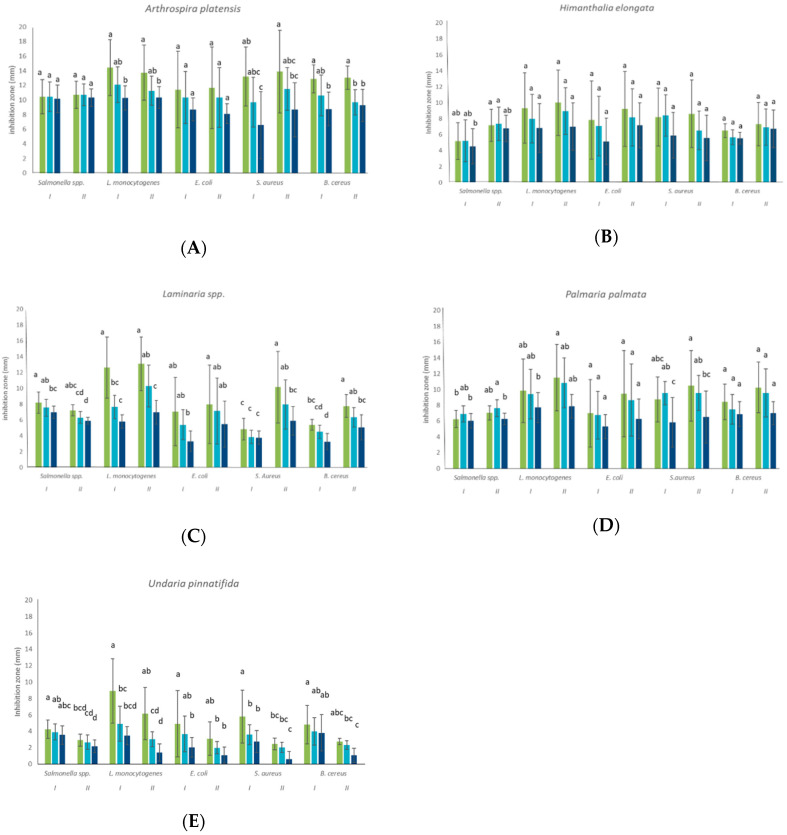
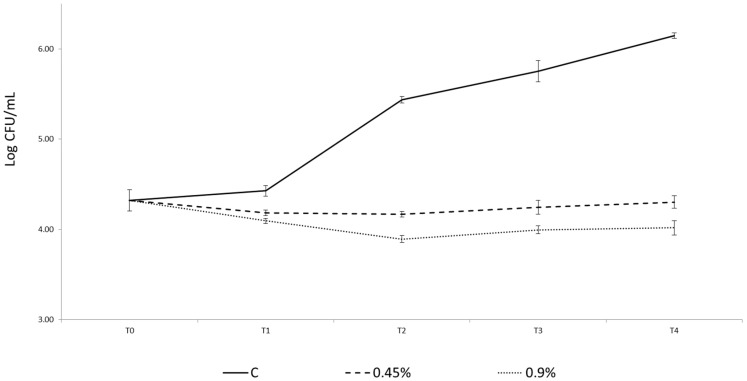
Research is more and more focused on studying and selecting food preservatives of natural origin. In this scenario, algae are an excellent source of bioactive compounds, among which are antimicrobials, whose presence is variable depending on the algal species and environmental conditions. The aim of the present study was to obtain, by a food grade approach, antimicrobial extracts from five species already approved as foods and to test their efficacy in vitro (agar well diffusion assay) and in situ (microbial challenge test) towards foodborne pathogenic bacteria. Moreover, the total phenolic compounds of the extracts were determined in order to evaluate possible correlations with the antimicrobial activity. Strains belonging to Salmonella spp., Listeria monocytogenes, Escherichia coli, Staphylococcus aureus, and Bacillus cereus were considered. Overall, the extracts showed a good antimicrobial activity in vitro towards all the tested microorganisms, especially L. monocytogenes (15 mm of inhibition diameter). The effect of inhibition was monitored during 24, 48 and 120 h showing a good persistence in time. Arthrospira platensis exerted the highest efficacy, further revealed towards L. monocytogenes on salmon tartare as bacteriostatic using 0.45% of the extract and bactericidal using 0.90%. The presence of phenolic compounds could be related to the antimicrobial activity but was not revealed as the main component of this activity. The extract with the highest phenolic content (18.79 ± 1.90 mg GAE/g) was obtained from Himanthalia elongata. The efficacy, confirmed also in a food matrix, might open perspectives for their application as food preservative.
Keywords: Listeria monocytogenes; algae extract; food safety; foodborne pathogenic bacteria; microbiological challenge test; natural antimicrobial; phenolic content.
Conflict of interest statement
The authors declare no conflict of interest.
Figures
References
-
- Holdt S.L., Kraan S. Bioactive compounds in seaweed: Functional food applications and legislation. J. Appl. Phycol. 2011;23:543–597. doi: 10.1007/s10811-010-9632-5. - DOI
-
- Gupta S., Abu-Ghannam N. Recent developments in the application of seaweeds or seaweed extracts as a means for enhancing the safety and quality attributes of foods. Innov. Food Sci. Emerg. Technol. 2011;12:600–609. doi: 10.1016/j.ifset.2011.07.004. - DOI
-
- Samarakoon K., Jeon Y.-J. Bio-functionalities of proteins derived from marine algae—A review. Food Res. Int. 2012;48:948–960. doi: 10.1016/j.foodres.2012.03.013. - DOI
-
- Niccolai A., Shannon E., Abu-Ghannam N., Biondi N., Rodolfi L., Tredici M.R. Lactic acid fermentation of Arthrospira platensis (spirulina) biomass for probiotic-based products. J. Appl. Phycol. 2019;31:1077–1083. doi: 10.1007/s10811-018-1602-3. - DOI
-
- Buschmann A.H., Camus C., Infante J., Neori A., Israel Á., Hernández-González M.C., Pereda S.V., Gomez-Pinchetti J.L., Golberg A., Tadmor-Shalev N., et al. Seaweed production: Overview of the global state of exploitation, farming and emerging research activity. Eur. J. Phycol. 2017;52:391–406. doi: 10.1080/09670262.2017.1365175. - DOI
LinkOut - more resources
Full Text Sources
Molecular Biology Databases
Miscellaneous
