. 2020 Oct 12;10(10):1852.
doi: 10.3390/ani10101852.

Low-Protein Diet Supplemented with Medium-Chain Fatty Acid Glycerides Improves the Growth Performance and Intestinal Function in Post-Weaning Piglets

Affiliations

Low-Protein Diet Supplemented with Medium-Chain Fatty Acid Glycerides Improves the Growth Performance and Intestinal Function in Post-Weaning Piglets

Zhijuan Cui et al. Animals (Basel). .

Abstract

Medium-chain fatty acid glycerides have been shown to provide energy for rapid oxidation in the body. The study was conducted to investigate the effects of dietary supplementation with medium-chain fatty acid glyceride on the growth performance and intestinal health of weaned piglets fed with a low-protein diet. Nighty healthy weaned piglets were randomly divided into five treatments: NP (Normal protein treatment, normal-protein diet no antibiotics included); NC (Negative control, low-protein diet no antibiotics included); PC (Positive control, low-protein diet +75 mg/kg quinocetone, 20 mg/kg virginiamycin and 50 mg/kg aureomycin); MCT (tricaprylin + tricaprin treatment, low-protein diet + tricaprylin + tricaprin); GML (glycerol monolaurate treatment, low-protein diet + glycerol monolaurate). The results showed that the average daily feed intake (ADFI) of the MCT treatment was significantly higher than that of the NP, NC treatments (p < 0.05). In the jejunum, the villus height of the GML treatment was significantly lower than that of the PC treatment (p < 0.05), and the number of goblet cells in the GML treatment was higher than that in the NC treatment (p < 0.05). Compared with the NC treatment, the MCT treatment significantly increased the level of claudin-1, Zonula occludens-1(ZO-1), while the GML treatment significantly increased the level of claudin-1, occludin, ZO-1 (p < 0.05). In the ileum, the level of ZO-1 in the GML treatment was significantly higher than that in the NP, NC, PC treatments (p < 0.05). Compared with the NC treatment, the GML treatment significantly increased the level of Secretory immunoglobulin A (SIgA) in the ileum and serum, while the MCT treatment significantly increased the level of SIgA and decreased the level of interleukin-6 (IL-6) in the ileum (p < 0.05). These results showed that the addition of medium-chain fatty acid glycerides to a low-protein diet could improve the growth performance and intestinal functional barrier of weaned piglets and also improve the immune function of weaned piglets.

Keywords: cytokines; intestinal morphological structure; intestinal permeability; medium-chain fatty acid glycerides; tight junction protein.


Conflict of interest statement

The author(s) confirm that this article content has no conflict of interest.

Figures
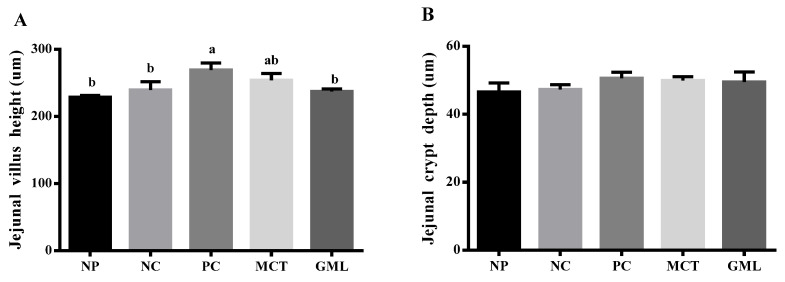
Figure 1
Figure 1
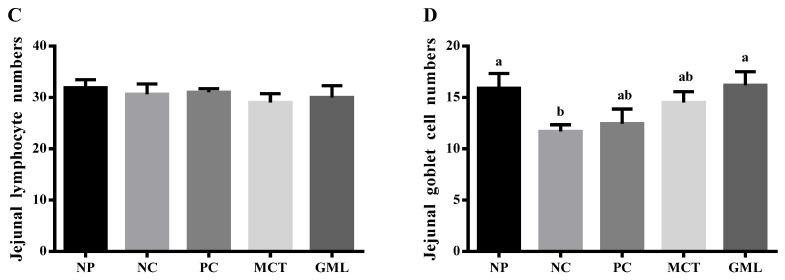
The morphology and structure of the jejunum in the piglets. (A): The jejunal villus height. (B): The jejunal crypt depth. (C): The jejunal lymphocyte numbers. (D): The jejunal goblet cell numbers. Values are the mean ± SEM, n = 6 per treatment (the n = 6 refers to the number of pigs slaughtered and sampled). a,b Mean values sharing different superscripts within a row differ (p < 0.05). NP = normal protein basal diet no antibiotics included; NC = low-protein basal diet no antibiotics included; PC = low-protein basal diet + antibiotics (75 mg/kg quinocetone, 20 mg/kg virginiamycin and 50 mg/kg aureomycin); MCT = low-protein basal diet + 2 kg/T tricaprylin/tricaprin; GML = low-protein basal diet + 2 kg/T glycerol monolaurate.
Figure 1
Figure 1
The morphology and structure of the jejunum in the piglets. (A): The jejunal villus height. (B): The jejunal crypt depth. (C): The jejunal lymphocyte numbers. (D): The jejunal goblet cell numbers. Values are the mean ± SEM, n = 6 per treatment (the n = 6 refers to the number of pigs slaughtered and sampled). a,b Mean values sharing different superscripts within a row differ (p < 0.05). NP = normal protein basal diet no antibiotics included; NC = low-protein basal diet no antibiotics included; PC = low-protein basal diet + antibiotics (75 mg/kg quinocetone, 20 mg/kg virginiamycin and 50 mg/kg aureomycin); MCT = low-protein basal diet + 2 kg/T tricaprylin/tricaprin; GML = low-protein basal diet + 2 kg/T glycerol monolaurate.
Figure 2
Figure 2
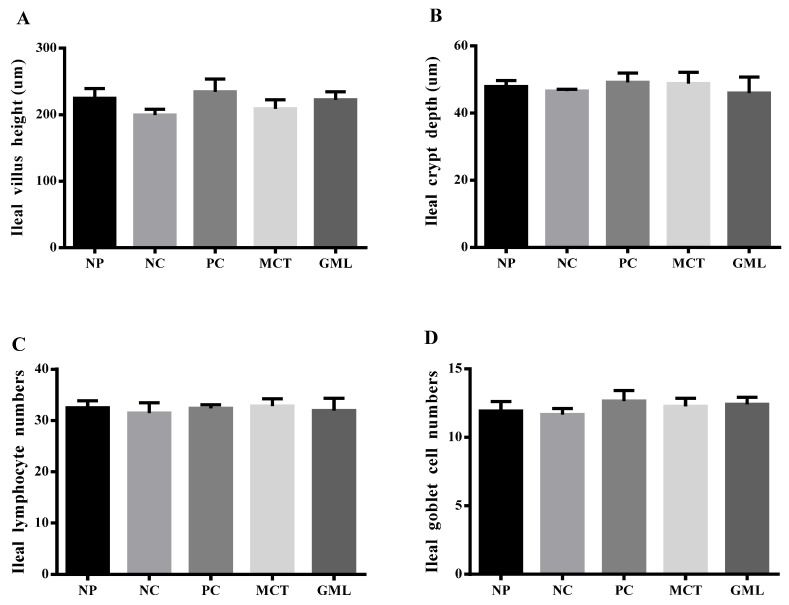
The morphology and structure of the ileum in piglets. (A): The jejunal villus height. (B): The jejunal crypt depth. (C): The jejunal lymphocyte numbers. (D): The jejunal goblet cell numbers. Values are the mean ± SEM, n = 6 per treatment (the n = 6 refers to the number of pigs slaughtered and sampled). NP = normal protein basal diet no antibiotics included; NC = low-protein basal diet no antibiotics included; PC = low-protein basal diet + antibiotics (75 mg/kg quinocetone, 20 mg/kg virginiamycin and 50 mg/kg aureomycin); MCT = low-protein basal diet + 2 kg/T tricaprylin/tricaprin; GML = low-protein basal diet + 2 kg/T glycerol monolaurate.
Figure 3
Figure 3
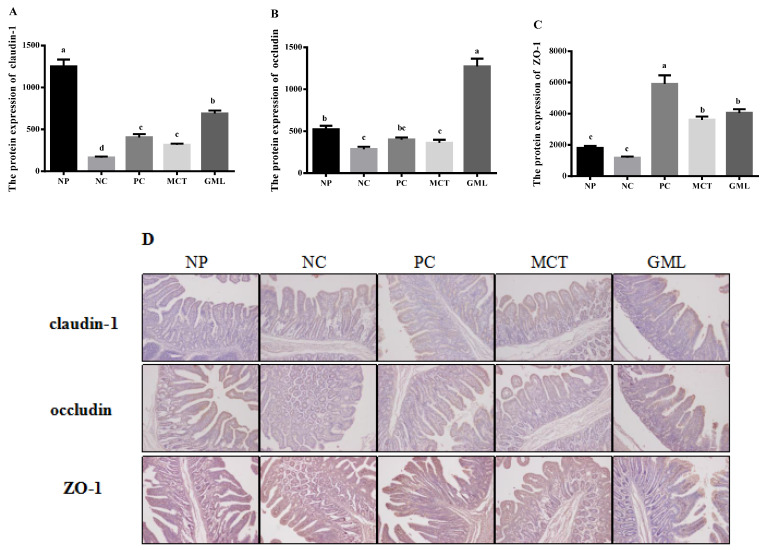
The expressions of tight junction proteins of the jejunum in piglets. (A): The protein expression of claudin-1. (B): The protein expression of occludin. (C): The protein expression of ZO-1. (D): The protein expression of claudin-1, occludin, ZO-1. The (AC) expressions of tight junction protein and (D) representative immunohistochemical staining images in the jejunum of piglets. Values are the mean ± SEM, n = 4 per treatment (the n = 4 refers to the number of pigs slaughtered and sampled). a,b,c,d Mean values sharing different superscripts within a row differ (p < 0.05). NP = normal protein basal diet no antibiotics included; NC = low-protein basal diet no antibiotics included; PC = low-protein basal diet + antibiotics (75 mg/kg quinocetone, 20 mg/kg virginiamycin and 50 mg/kg aureomycin); MCT = low-protein basal diet + 2 kg/T tricaprylin/tricaprin; GML = low-protein basal diet + 2 kg/T glycerol monolaurate.
Figure 4
Figure 4
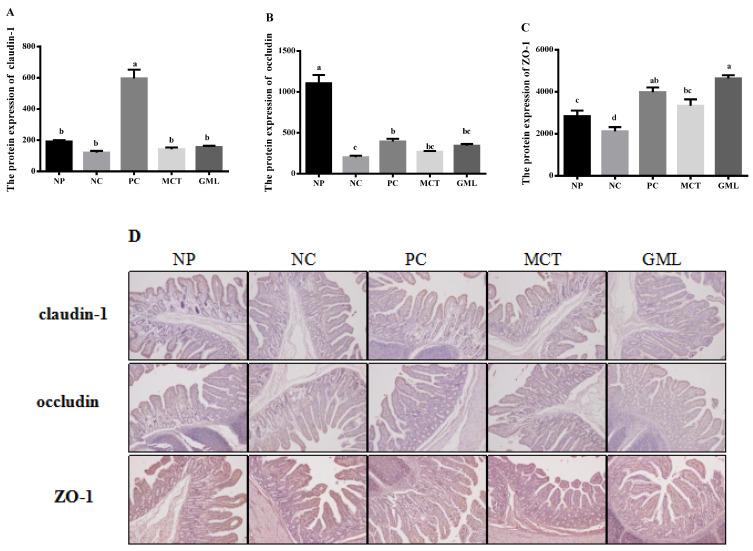
The expressions of tight junction proteins of the ileum in piglets. (A): The protein expression of claudin-1. (B): The protein expression of occludin. (C): The protein expression of ZO-1. (D): The protein expression of claudin-1, occludin, ZO-1. The (AC) expressions of tight junction protein and (D) representative immunohistochemical staining images in the ileum of piglets. Values are the mean ± SEM, n = 4 per treatment (the n = 4 refers to the number of pigs slaughtered and sampled). a,b,c,d Mean values sharing different superscripts within a row differ (p < 0.05). NP = normal protein basal diet no antibiotics included; NC = low-protein basal diet no antibiotics included; PC = low-protein basal diet + antibiotics (75 mg/kg quinocetone, 20 mg/kg virginiamycin and 50 mg/kg aureomycin); MCT = low-protein basal diet + 2 kg/T tricaprylin/tricaprin; GML = low-protein basal diet + 2 kg/T glycerol monolaurate.

References

    1. Van Der Schoor S.R., Reeds P.J., Stoll B., Henry J.F., Rosenberger J.R., Burrin D.G., Van Goudoever J.B. The high metabolic cost of a functional gut. Gastroenterology. 2002;123:1931–1940. doi: 10.1053/gast.2002.37062. - DOI - PubMed
    1. Hanczakowska E. The Use of Medium Chain Fatty Acids in Piglet Feeding—A Review. J. Ann. Anim. Sci. 2017;17 doi: 10.1515/aoas-2016-0099. - DOI
    1. Williams I.H., Pluske J.R., Dividich J.L., Verstegen M.W.A. Growth of the Weaned Pig. Wageningen Academic Publishers; Wageningen, The Netherlands: 2003.
    1. Pluske J.R., Williams I.H., Aherne F.X. Maintenance of villous height and crypt depth in piglets by providing continuous nutrition after weaning. Anim. Sci. 1996;62:131–144. doi: 10.1017/S1357729800014417. - DOI
    1. Van Beers-Schreurs H.M.G., Nabuurs M.J.A., Vellenga L., Van Der Valk H.J.K., Wensing T., Breukink H.J. Weaning and the weanling diet influence the villous height and crypt depth in the small intestine of pigs and alter the concentrations of short-chain fatty acids in the large intestine and blood. J. Nutr. 1998;128:947. doi: 10.1093/jn/128.6.947. - DOI - PubMed

LinkOut - more resources