


Junk Food on Demand: A Cross-Sectional Analysis of the Nutritional Quality of Popular Online Food Delivery Outlets in Australia and New Zealand
- PMID: 33053705
- PMCID: PMC7601596
- DOI: 10.3390/nu12103107
Junk Food on Demand: A Cross-Sectional Analysis of the Nutritional Quality of Popular Online Food Delivery Outlets in Australia and New Zealand
Abstract
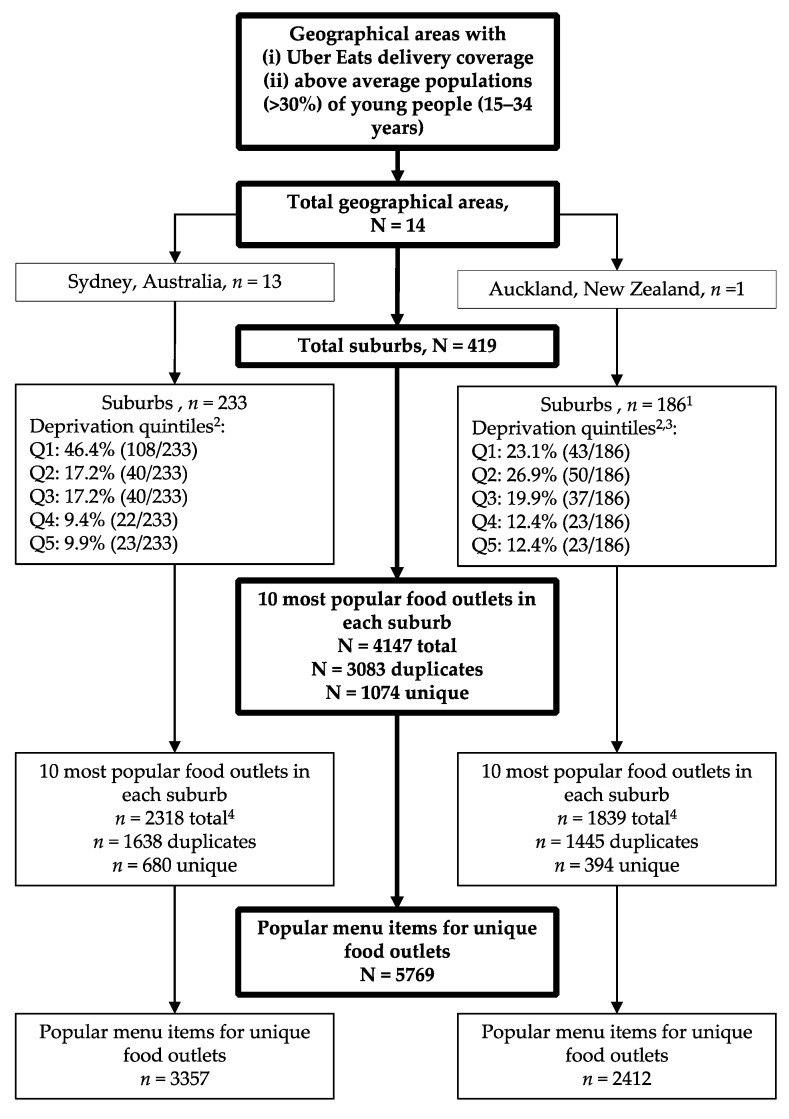
The demand for convenience and the increasing role of digital technology in everyday life has fueled the use of online food delivery services (OFD's), of which young people are the largest users globally. OFD's are disrupting traditional food environments, yet research evaluating the public health implications of such services is lacking. We evaluated the characteristics and nutritional quality of popular food outlets on a market-leading platform (UberEATS®) in a cross-sectional observational study conducted in two international cities: Sydney (Australia) and Auckland (New Zealand). A systematic search using publicly available population-level data was used to identify geographical areas with above-average concentrations (>30%) of young people (15-34-years). A standardized data extraction protocol was used to identify the ten most popular food outlets within each area. The nutritional quality of food outlets was assessed using the Food Environment Score (FES) (range: -10 'unhealthiest' to 10 'healthiest'). Additionally, the most popular menu items from each food outlet were classified as discretionary or core foods/beverages according to the Australian Dietary Guidelines. The majority of popular food outlets were classified as 'unhealthy' (FES range -10 to -5; 73.5%, 789/1074) and were predominately takeaway franchise stores (59.6%, 470/789, e.g., McDonald's®). 85.9% of all popular menu items were discretionary (n = 4958/5769). This study highlights the pervasion and accessibility of discretionary foods on OFD's. This study demonstrated that the most popular food outlets on the market-leading online food delivery service are unhealthy and popular menu items are mostly discretionary foods; facilitating the purchase of foods of poor nutritional quality. Consideration of OFD's in public health nutrition strategies and policies in critical.
Keywords: adolescent; diet; fast food; food environment; nutrition; online food delivery; take out; young adult.
Conflict of interest statement
The authors declare no conflict of interest.
Figures
References
-
- World Health Organisation Obesity and Overweight. [(accessed on 15 June 2020)]; Available online: https://www.who.int/news-room/fact-sheets/detail/obesity-and-overweight.
-
- Abarca-Gómez L., Abdeen Z.A., Hamid Z.A., Abu-Rmeileh N.M., Acosta-Cazares B., Acuin C., Adams R.J., Aekplakorn W., Afsana K., Aguilar-Salinas C.A., et al. Worldwide trends in body-mass index, underweight, overweight, and obesity from 1975 to 2016: A pooled analysis of 2416 population-based measurement studies in 128.9 million children, adolescents, and adults. Lancet. 2017;390:2627–2642. doi: 10.1016/S0140-6736(17)32129-3. - DOI - PMC - PubMed
-
- Afshin A., Sur P.J., Fay K.A., Cornaby L., Ferrara G., Salama J.S., Mullany E.C., Abate K.H., Abbafati C., Abebe Z., et al. Health effects of dietary risks in 195 countries, 1990–2017: A systematic analysis for the global burden of disease study 2017. Lancet. 2019;393:1958–1972. doi: 10.1016/S0140-6736(19)30041-8. - DOI - PMC - PubMed
-
- Gakidou E., Afshin A., Abajobir A.A., Abate K.H., Abbafati C., Abbas K.M., Abd-Allah F., Abdulle A.M., Abera S.F., Aboyans V., et al. Global, regional, and national comparative risk assessment of 84 behavioural, environmental and occupational, and metabolic risks or clusters of risks, 1990-2016: A systematic analysis for the global burden of disease study 2016. Lancet. 2017;390:1345–1422. doi: 10.1016/S0140-6736(17)32366-8. - DOI - PMC - PubMed
Publication types
MeSH terms
Grants and funding
LinkOut - more resources
Full Text Sources
Miscellaneous
