


Mediating factors on the association between fear of falling and health-related quality of life in community-dwelling German older people: a cross-sectional study
- PMID: 33054728
- PMCID: PMC7556961
- DOI: 10.1186/s12877-020-01802-6
Mediating factors on the association between fear of falling and health-related quality of life in community-dwelling German older people: a cross-sectional study
Abstract
Background: Previous research has shown that not only falls, but also fear of falling (FoF) influences health-related quality of life (HrQoL) negatively. The EQ-5D (consisting of an index and a visual analogue scale [EQ-VAS]) is a frequently used instrument to determine HrQoL in clinical studies and economic evaluations, but no previous study compared the association between FoF and the EQ-5D index with the association between FoF and the EQ-VAS. Moreover, factors that influence the association between FoF and HrQoL are rarely examined. Thus, this study aimed to examine the association between FoF and HrQoL and to examine factors that mediate the association.
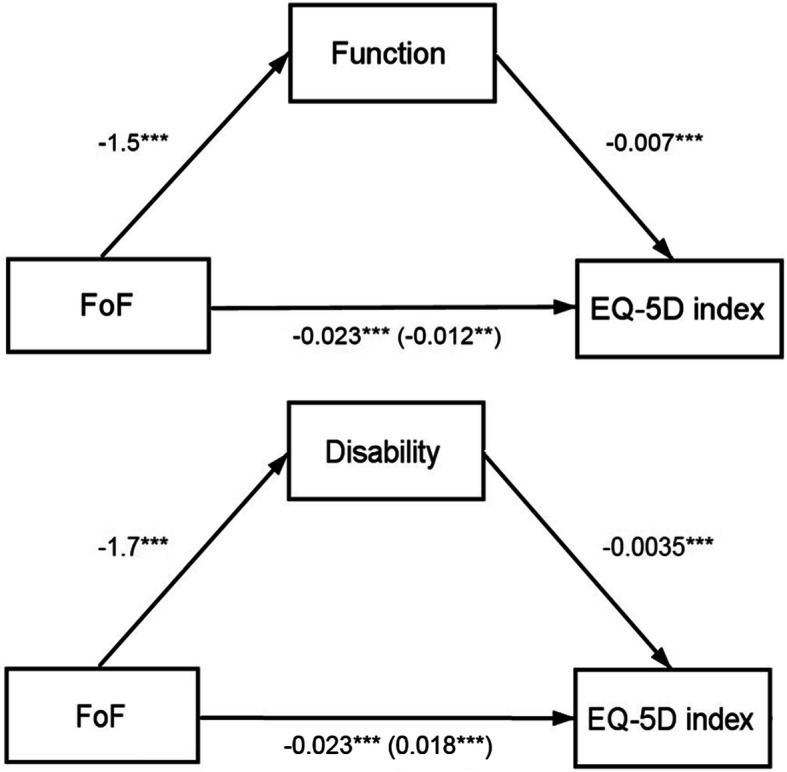
Methods: FoF (Short Falls Efficacy Scale International) and HrQoL (EQ-5D descriptive system, EQ-5D index, and EQ-VAS) were assessed in a sample of community-dwelling older persons (≥70 years) participating in the baseline assessment of a randomized controlled trial (N = 309). Linear and logistic regression analyses were performed, adjusting for sociodemographic variables, frequency of falls, number of chronic conditions, functional mobility (Timed up-and-go test), and subjective functional capacity (LLFDI function and disability scales). Multiple regression models were used to test the mediating effects.
Results: Moderate or high FoF was prevalent in 66% of the sample. After adjusting for covariates, FoF was negatively associated with the EQ-5D index, but not with the descriptive system or the EQ-VAS. Subjective functional capacity partly mediated the association between FoF and the EQ-5D index and completely mediated the association between FoF and the EQ-VAS.
Conclusion: FoF was negatively associated with the EQ-5D index. As subjective functional capacity mediated the association between FoF and HrQoL, future interventions should account for subjective functional capacity in their design.
Keywords: EQ-5D; Falls efficacy; Fear of falling; Health-related quality of life; Older persons.
Conflict of interest statement
The authors declare that they have no competing interests.
Figures

References
-
- United Nations. Department of Economic and Social Affairs. Population Division . World population prospects 2019, volume II. New York: Demographic Profiles; 2019.
Publication types
MeSH terms
Grants and funding
LinkOut - more resources
Full Text Sources
Medical
