Review
. 2020 Oct 14;15(1):18.
doi: 10.1186/s13062-020-00274-3.

Cancer predictive studies

Affiliations
Review

Cancer predictive studies

Ivano Amelio et al. Biol Direct. .

Abstract

The identification of individual or clusters of predictive genetic alterations might help in defining the outcome of cancer treatment, allowing for the stratification of patients into distinct cohorts for selective therapeutic protocols. Neuroblastoma (NB) is the most common extracranial childhood tumour, clinically defined in five distinct stages (1-4 & 4S), where stages 3-4 define chemotherapy-resistant, highly aggressive disease phases. NB is a model for geneticists and molecular biologists to classify genetic abnormalities and identify causative disease genes. Despite highly intensive basic research, improvements on clinical outcome have been predominantly observed for less aggressive cancers, that is stages 1,2 and 4S. Therefore, stages 3-4 NB are still complicated at the therapeutic level and require more intense fundamental research. Using neuroblastoma as a model system, here we herein outline how cancer prediction studies can help at steering preclinical and clinical research toward the identification and exploitation of specific genetic landscape. This might result in maximising the therapeutic success and minimizing harmful effects in cancer patients.

Keywords: Microbiota; Neuroblastoma; Omics; Precision oncology.


Conflict of interest statement

The Authors declare that they have no competing interests.

Figures
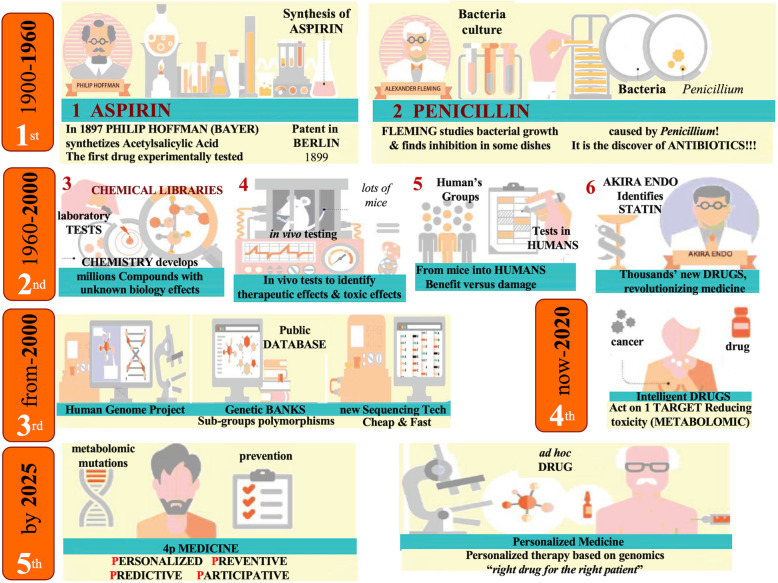
Fig. 1
Fig. 1
Evolution of Drug Development. We may distinguish 5 distinct phases in the evolution of drug discovery. In the first half of the last century, that was mainly occurring by serendipity (phase 1); nonetheless important drugs were identified, including Aspirin by Hoffman and penicillin by Fleming. In the second part of the last century (phase 2), the development of massive chemical libraries that could be tested in vivo in mice, subsequently translated into selective human groups, has allowed the definition of thousands new drugs that have revolutionized medicine, especially cancer therapy. In this century, we are equipped with the sequence of the entire human genome and large numbers of genetic banks, with specific mutations, deletions, polymorphisms and histone modifications (phase 3). This permitted the identification of intelligent drugs, acting only on one single target and therefore wanton toxicity (phase 4), in other wards, selecting the specific drug for the individual patient. With metabolic mutation, identification of predisposing mutations, selection of monitoring or predictive cluster of genes, proteins or phospho-protein, oncology will enter the 4P medicine: Preventive, Personalized, Predictive, Participative
Fig. 2
Fig. 2
Risk groups for neuroblastoma patients. Depending on ploidy, TERT expression, telomerase elongation, ZNF281/ZNF143 expression, Chr17p or Chr1p deletions, neuroblastoma patients can be stratified into distinct sub-groups with distinct prognostic outcome. Therefore, the molecular identification of these markers is pivotal to define the most appropriate therapy for individual patient. For example, patients with Chr17p defect and impaired TRIM37 may be specifically selected for using PLK4 inhibitors, that would be otherwise ineffective in other patients

References

    1. Kim SY, Jeong H-H, Kim J, Moon J-H, Sohn K-A. Robust pathway-based multi-omics data integration using directed random walks for survival prediction in multiple cancer studies. Biol Direct. 2019;14(1):8. doi: 10.1186/s13062-019-0239-8. - DOI - PMC - PubMed
    1. Panchin AY, Aleoshin VV, Panchin YV. From tumors to species: a SCANDAL hypothesis. Biol Direct. 2019;14(1):3. doi: 10.1186/s13062-019-0233-1. - DOI - PMC - PubMed
    1. Qu Q, Li Y, Fang X, Zhang L, Xue C, Ge X, et al. Differentially expressed tRFs in CD5 positive relapsed & refractory diffuse large B cell lymphoma and the bioinformatic analysis for their potential clinical use. Biol Direct. 2019;14(1):23. doi: 10.1186/s13062-019-0255-8. - DOI - PMC - PubMed
    1. Pcawg Transcriptome Core Group C. Calabrese C, Davidson NR, Demircioğlu D, Fonseca NA, He Y, et al. Genomic basis for RNA alterations in cancer. Nature. 2020;578(7793):129–136. doi: 10.1038/s41586-020-1970-0. - DOI - PMC - PubMed
    1. Alexandrov LB, Kim J, Haradhvala NJ, Huang MN, Tian Ng AW, Wu Y, et al. The repertoire of mutational signatures in human cancer. Nature. 2020;578(7793):94–101. doi: 10.1038/s41586-020-1943-3. - DOI - PMC - PubMed

Publication types
